When overseas companies start selling goods to the United Kingdom, one of the questions that almost always comes up eventually is this: Do I need to be the importer of record in the UK, or should my UK customer be the importer instead?
At first, this sounds like a technical customs question. But in reality, it’s much bigger than that. The decision about acting as importer of Record in the UK affects VAT, EORI, pricing, logistics, and the way your entire UK operation is structured. I’ve seen many companies focus only on the sale and the shipping and only later realise that by agreeing to certain delivery terms, they also agreed to become the importer — with all the responsibilities that come with it.
So before we go too far, it’s important to slow down and properly understand what this role actually means in practice, not just in theory.
What Does Acting as Importer of Record in the UK Mean?
Let’s start with the key point: Who is the Importer of record in the UK?
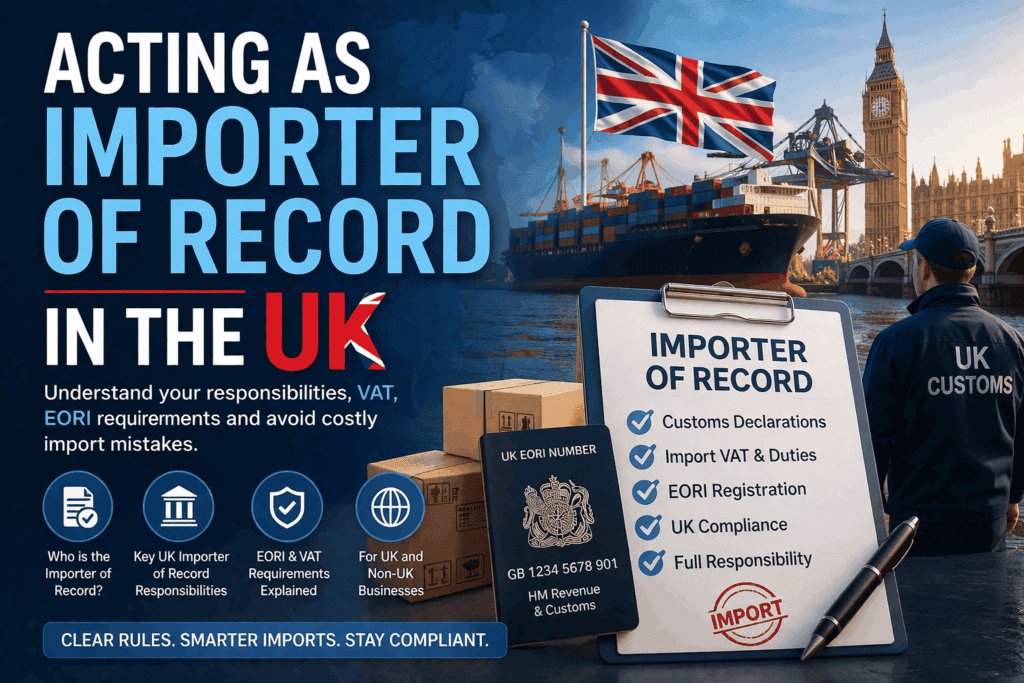
In simple terms, the Importer of Record is the company that is legally responsible for bringing the goods to the UK. This is the company whose name appears on the customs declaration, whose UK EORI number is used for the import, and who is responsible for import VAT and any customs duty.
In other words, acting as the importer of Record in the UK means that, in the eyes of HMRC, your company is the one importing the goods — even if you are not physically based in the UK.
This is where many companies get confused. They assume the importer must be the UK buyer. But that is not always the case. The importer is not simply the company that buys the goods. The importer is the company that takes responsibility for customs clearance and import taxes.
So when someone asks Who is the Importer of Record UK, the correct answer is
It is the company that is legally responsible for the import and whose EORI number is used on the customs declaration.
That distinction is crucial, because responsibility for import also means responsibility for VAT and compliance.
UK Importer of Record Responsibilities
Now let’s talk about the UK Importer of Record responsibilities, because this is the part that is often underestimated.
If your company is acting as Importer of Record in the UK, you are responsible for the import in the legal sense. That includes making sure the customs declaration is correct, that the correct commodity codes are used, and that the correct value of the goods is declared. If import duty applies, the importer is responsible for that. The importer is also responsible for how import VAT is handled.
On top of that, the importer must keep records of the import and must ensure that the goods comply with UK regulations. And if HMRC later reviews the import or asks questions, it is the Importer of Record they will contact.
So this role is not just a name on a shipping document. The Importer of Record is the company that HMRC sees as responsible for the import transaction. That is why the question Do I need to be an importer of Record UK is not just a logistics question — it is a tax and compliance decision as well.
Importer of Record and EORI
You cannot really separate the importer of Record and EORI, because the two go together.
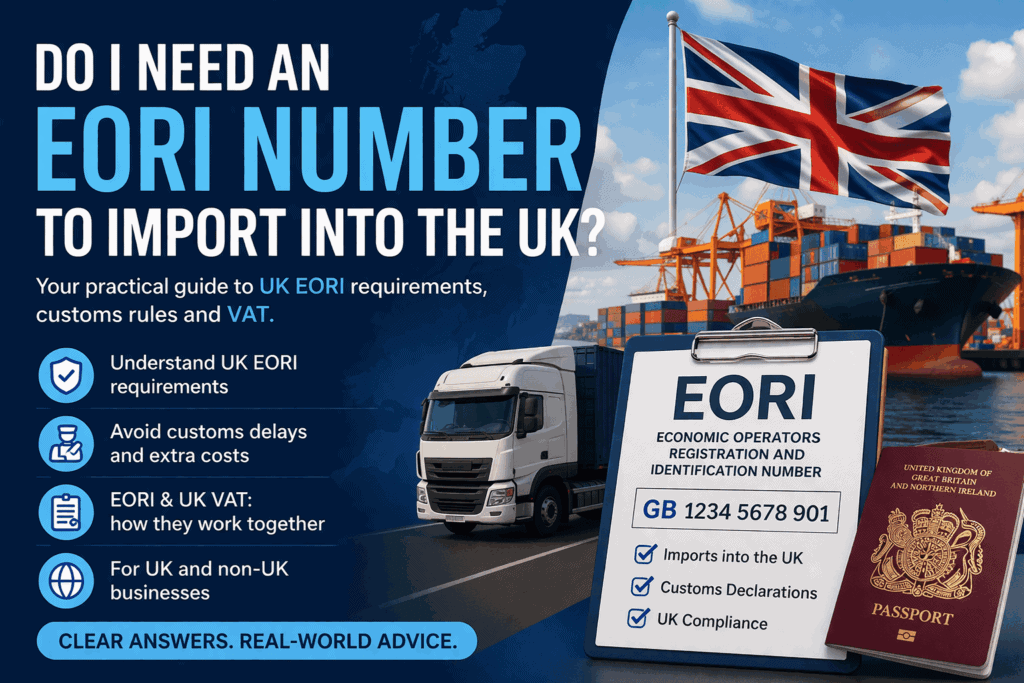
If your company is acting as Importer of Record in the UK, it must have a UK EORI number. The customs declaration is submitted using the EORI number of the importer, so without an EORI number, a company cannot act as the importer of Record.
So the structure is quite straightforward:
- The Importer of Record is legally responsible for the import
- The Importer of Record must have a UK EORI number
- The EORI number is used for customs declarations
This is why many overseas companies first start looking into EORI when they realise they are acting as Importer of Record in the UK, sometimes without planning to do so.
Importer of Record and UK VAT
Now we come to a very important topic: Importer of Record and UK VAT.
If your company is the Importer of Record, then import VAT is linked to your company. If you import goods into the UK and sell them there, you likely need to register for UK VAT.
This is a very common situation for Amazon sellers, Shopify sellers, and companies that import goods into a UK warehouse and then sell those goods to UK customers.
When discussing the Importer of Record and UK VAT, we are really referring to this: if you are the importer bringing goods into the UK market, you often create a UK VAT obligation.
In many cases, a Non-UK company Importer of Record UK structure means the overseas company needs both a UK EORI number and UK VAT registration and often uses Postponed VAT Accounting to handle import VAT efficiently.
This is why you should never consider the Importer of Record decision in isolation. It should always be considered together with VAT.
Non-UK Company Importer of Record UK
A very common question I hear is whether a Non-UK company can be Importer of record in the UK. The answer is yes, a non-UK company can act as an importer of Record in the UK, but it must be properly registered and structured.
In practice, a non-UK company acting as an importer of record will usually need the following:
- A UK EORI number
- Responsibility for import VAT and duty
- Proper customs documentation
- In many cases, UK VAT registration
This structure is very common where overseas companies sell directly to UK customers and agree to deliver goods into the UK, especially under DDP delivery terms.
However, companies should understand that acting as Importer of Record in the UK means taking on UK tax and customs responsibilities, so this decision should be made carefully and planned properly.
Importer of Record vs Consignee vs Buyer
Another area that causes confusion is the difference between importer, consignee, and buyer. These are three different roles, and they are not always the same company.
When companies ask Who is the Importer of record in the UK?” they often assume it must be the buyer. But that is not always correct.
- The Importer of Record is the company legally responsible for the import.
- The Consignee is the company that physically receives the goods.
- The Buyer is the company that purchases the goods.
For example, a non-UK company may sell goods to a UK customer but agree to deliver them to the UK and handle customs clearance. In that case, the non-UK company is acting as Importer of Record in the UK, while the UK company is the consignee and the buyer.
International trade frequently employs this structure, particularly when selling goods under DDP shipping terms.
When Do Companies Accidentally Become Importer of Record?
This is something I see quite often in practice.
Companies agree to sell goods under DDP (Delivered Duty Paid) terms because they want to make things easy for their UK customer. But under DDP terms, the seller is responsible for delivery, customs clearance, duty and import VAT. In other words, the seller becomes the Importer of Record.
So sometimes companies ask later: Do I need to be Importer of Record UK? But by that point, they are already acting as the importer because of the delivery terms they agreed to.
This is why Incoterms are not just logistics terms — they determine who is responsible for import, VAT and customs.
Typical Business Structures
From a practical point of view, there are several common structures used by overseas companies importing into the UK.
In one structure, the overseas company acts as the importer of Record in the UK, imports goods into the UK, stores them in a UK warehouse, and sells them to UK customers. This structure usually requires UK EORI and UK VAT registration.
Sometimes the structure is set up so that a UK distributor imports the goods in their own name and purchases them from an overseas company. In that case, the UK distributor is acting as the Importer of Record, and the overseas company is simply selling goods, not importing them. As a result, the overseas company may not need a UK EORI number or UK VAT registration.
Another common approach is where the overseas business opens a UK company and uses that company to import the goods. The UK company then acts as the Importer of Record, deals with customs, import VAT and compliance, and sells the goods to customers in the UK. This structure is often used when a business wants a more permanent presence in the UK. This is a common approach for companies planning long-term operations in the UK.
So when we ask Who is the Importer of Record UK, the answer depends on how the business and logistics are structured.
Final Thoughts
So, what does acting as Importer of Record in the UK really mean in practical terms?
It means your company is legally responsible for importing the goods into the UK, for customs declarations, for import VAT, and for compliance with UK import rules. The UK Importer of Record responsibilities are significant, and companies should understand them before the first shipment is sent.
In most cases, if a Non-UK company is acting as Importer of Record in the UK, it will need a UK EORI number and, in many cases, UK VAT registration as well. That is why Importer of Record and EORI and Importer of Record and UK VAT are so closely connected.
So when businesses ask Do I need to be an importer of record in the UK?” the real answer is that it depends on your delivery terms, your customers, and your UK business structure. But this decision should always be made deliberately and with a clear understanding of the tax and customs consequences.
From my experience, companies that understand this role and structure things properly from the beginning usually have a much smoother experience importing into the UK. Those that do not often run into VAT issues, customs delays, and unexpected costs — and those problems are always much harder to fix after the goods have already been shipped.