If you are planning to import goods into the United Kingdom, one of the first questions that usually comes up is this: Do I need an EORI number? And, to be honest, this is exactly the right question to ask at the very beginning, not later when the goods are already on the way.
The reason I say this is because, in practice, I’ve seen many situations where companies only discover they need an EORI number when their shipment is already at the UK border. At that point, the problem stops being theoretical — the goods are stuck, storage charges start, the freight agent is waiting, and suddenly a simple registration becomes an urgent and expensive issue.
However, if you understand how the system works in advance, the whole process becomes much more predictable. So let’s go through this step by step, in a practical way, the same way I usually explain it to clients who are entering the UK market for the first time.
What Is an EORI Number?
First of all, let’s start with the basics, because once you understand what an EORI number actually is, the rest becomes much easier to follow.
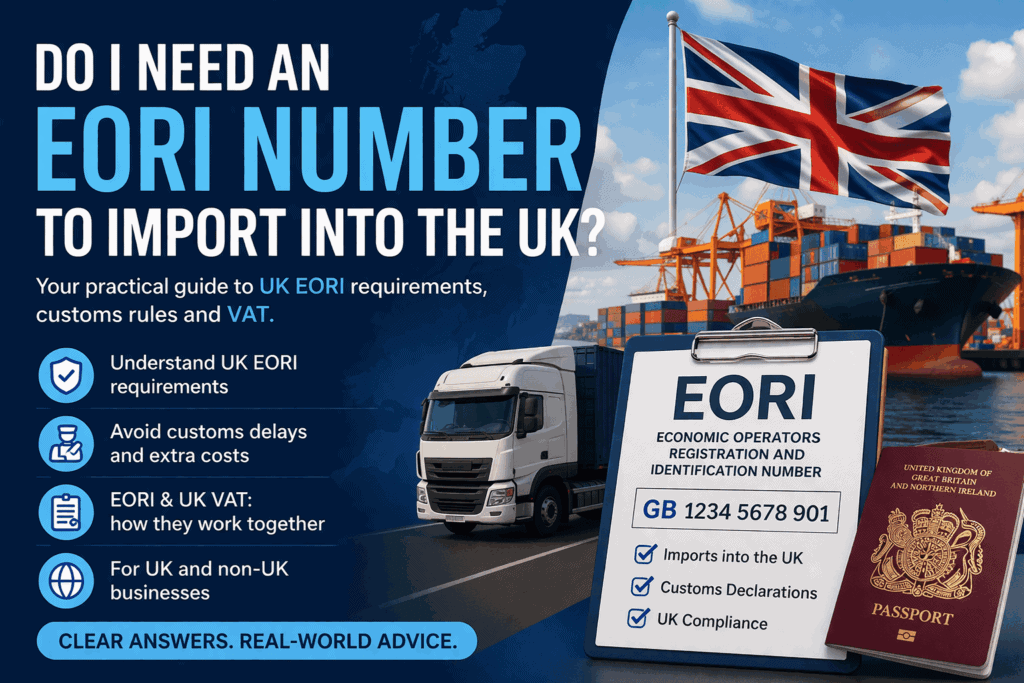
EORI stands for Economic Operators Registration and Identification number. That sounds very official, but in reality the idea behind it is quite simple. It is a number used by customs authorities to identify businesses that import or export goods.
In other words, when goods arrive at the UK border, customs needs to know who the importer is. They need a number in their system that shows which company is responsible for the shipment, who will pay import VAT, who will pay duty if applicable, and who is legally acting as the importer.
So, to put it simply, an EORI number is like your company’s ID in the UK customs system. Without this ID, the system does not know who you are, and without that, the customs declaration cannot be completed properly.
This is why, in most cases, if your company is importing goods into the UK, an EORI number is not optional — it is a basic requirement of the customs process.
Do You Need an EORI Number to Import into the UK?
Now let’s answer the main question directly.
Yes, in most cases you do need an EORI number to import goods into the UK.
But here is where it becomes important to understand one key point. The EORI number is required for the importer of record, not necessarily for the seller of the goods. And this is exactly where many companies get confused, because the seller and the importer are not always the same company.
From my experience, there are usually a few common scenarios.
In the first scenario, a non-UK company sells goods and is responsible for importing them into the UK. In that case, that non-UK company is the importer of record and will need a UK EORI number.
In the second scenario, a non-UK company sells goods to a UK customer, but under the shipping terms the non-UK company is still responsible for import. Again, that non-UK company will need a UK EORI number.
In the third scenario, the UK customer acts as the importer and clears the goods in their own name. In that case, the UK customer uses their EORI number, and the overseas seller may not need one.
So the real question is not just “Do I need an EORI number?”, but rather:
Who is the importer of record for the shipment?
If you are the importer of record, then yes — you will need a UK EORI number.
Do Non-UK Companies Need a UK EORI Number?
This is something many overseas businesses are not sure about, so let me clarify this point.
Yes, non-UK companies can obtain a UK EORI number, and very often they must obtain one if they import goods into the UK.
You do not need to be a UK resident to get a UK EORI number. You also do not always need to have a UK company in order to apply for an EORI number. Overseas companies can register for a UK EORI if they are acting as the importer.
However, in practice, the EORI question is very often connected to another question, and that is UK VAT registration. Because if you are importing goods into the UK and then selling those goods in the UK, in many cases you will also need to register for UK VAT.
So while EORI and VAT are technically different registrations, in real business life they often go together. Companies that import goods into the UK frequently end up needing both a UK EORI number and a UK VAT number.
UK EORI vs EU EORI — Not the Same Thing
This is a very important point, and since Brexit it has become a common source of confusion.
Before Brexit, an EU EORI number could be used for the UK. That is no longer the case. Now the UK has its own EORI system, completely separate from the EU system.
So now:
- An EU EORI is used for imports into EU countries.
- A UK EORI is used for imports into the United Kingdom.
If your goods are entering the UK, you need a UK EORI number, usually starting with GB.
I have seen situations where companies already had an EU EORI number and assumed that was enough. The shipment arrived in the UK, the customs agent tried to submit the declaration, and the system rejected it because the company did not have a UK EORI number. The goods were delayed, storage charges started, and the situation became unnecessarily expensive.
So this is something that should always be checked in advance. If you import into the UK, you need a UK EORI. If you import into the EU, you need an EU EORI. If you import into both, then you may need both numbers.
What Happens If You Try to Import Without an EORI Number?
In practice, this situation is quite straightforward, and not in a good way.
If you try to import goods into the UK without an EORI number, the goods will not be cleared through customs. The customs declaration cannot be completed properly without an EORI number for the importer.
What happens next is usually the following: the goods are held at the port or airport, the freight forwarder contacts you and asks for an EORI number, and while this is being sorted out, storage charges and other fees may start to accumulate.
Sometimes companies think they can arrange the EORI number after the goods arrive, and technically that is possible, but the problem is timing. If the registration takes time and the goods are sitting in a warehouse or port, the storage costs can become quite significant.
So, as a rule, I always tell clients:
Your EORI number should be arranged before the first shipment is sent, not when the shipment is already on the way.
Do You Need a UK Company to Get an EORI Number?
This is another question I hear quite often, especially from overseas businesses that are just starting to sell to the UK.
The technical answer is: No, you do not always need a UK company in order to get a UK EORI number. An overseas company can apply for a UK EORI if it is acting as the importer into the UK.
However, from a practical and business point of view, the situation is often a bit more complex. Many companies that import goods into the UK on a regular basis eventually decide to open a UK company anyway. Not because the EORI number requires it, but because it makes other things easier — VAT registration, working with UK warehouses, dealing with UK customers, opening UK bank accounts, and so on.
So while an EORI number itself does not automatically mean you must open a UK company, the overall business structure sometimes leads companies in that direction, especially if they plan to operate in the UK long term.
How EORI Is Connected to UK VAT
Now we come to a very important practical point.
When goods are imported into the UK, there are usually two possible charges:
- Import duty
- Import VAT
Import VAT is often 20%, depending on the type of goods. The important question is not just how much VAT is due, but how that VAT is paid and who pays it.
If a company is registered for UK VAT, it can usually use something called Postponed VAT Accounting. This means that instead of physically paying import VAT at the border, the company accounts for that VAT on its VAT return. From a cash flow point of view, this is very helpful, because you do not have to pay a large amount of VAT upfront when the goods arrive.
To use this system properly, companies importing goods into the UK usually need:
- A UK EORI number
- A UK VAT number
This is why, in practice, EORI and VAT registrations are often done together when a company plans to import goods into the UK.
Typical Situations When You Need EORI (Real Examples)
It may be easier to understand this with a few typical examples that I see quite often.
For example, a non-UK company sends goods from China to an Amazon warehouse in the UK and sells those goods on Amazon UK. In that case, the non-UK company is the importer of record, and it will need a UK EORI number and usually UK VAT registration.
Another example is a company that imports goods in bulk into a UK warehouse and then sells those goods to UK customers through its own website, for example using Shopify. Again, that company is acting as the importer, so it will need a UK EORI number and normally UK VAT registration as well.
A different situation is when an overseas company sells goods to a UK distributor and agrees to deliver the goods to the UK, meaning the overseas company is responsible for import. In that case, again, the overseas company is the importer and needs an EORI number.
However, if the UK customer buys the goods and acts as the importer themselves, using their own freight agent and their own EORI number, then the overseas seller may not need a UK EORI number. Everything depends on the shipping terms and who is legally acting as the importer.
Common Mistakes Companies Make
Over the years, I have seen a number of the same mistakes repeated again and again.
One common mistake is shipping goods before arranging the EORI number. Another is assuming that an EU EORI number will work in the UK. A third is not clearly understanding who the importer of record is, especially when using different Incoterms like DDP, DAP, FOB and so on.
Another frequent issue is that companies focus only on the EORI number and forget about VAT registration, even though their business model requires UK VAT registration as well.
The problem is that mistakes in this area are not just administrative. They usually lead to delays, extra costs, and sometimes serious VAT problems later if the structure was not set up correctly from the beginning.
How the Process Usually Works (Step-by-Step)
If we look at this from a practical point of view, the process usually follows a fairly logical sequence.
First, the company decides that it wants to import goods into the UK. Then it needs to determine who will be the importer of record. Once that is clear, the importer applies for a UK EORI number.
After that, the company should check whether UK VAT registration is required based on its business model. Then the company usually appoints a freight forwarder or customs agent who will handle the customs declarations.
When the goods are shipped and arrive in the UK, the customs agent submits the import declaration using the importer’s EORI number. Import VAT and any duty are declared, the goods are cleared, and they are released for delivery.
If everything is structured correctly in advance, this process is normally quite smooth. Most problems arise when something was not arranged before the shipment.
When You Should Speak to a VAT or Import Specialist
In my opinion, it is a good idea to speak to a specialist before the first shipment, not after problems appear.
This is especially important if you are a non-UK company, if you plan to import regularly, if you will store goods in the UK, sell through Amazon or other marketplaces, or if you are not completely sure who will be the importer of record.
Very often, one conversation at the beginning can help structure the entire process properly — EORI, VAT, import process, and logistics — so that there are no unpleasant surprises later.
Final Thoughts
So, coming back to the original question: Do you need an EORI number to import into the UK?
In most cases, yes. If your company is acting as the importer of record into the UK, you will need a UK EORI number. And in many business models, especially where goods are imported and then sold in the UK, you will also need UK VAT registration.
The key point here is that the EORI number is not just a formality. It is part of the overall import structure — together with VAT, customs declarations, and your logistics setup.
From my experience, companies that take the time to set this up properly at the beginning usually have a smooth experience importing into the UK. Companies that try to sort it out later often run into delays, unexpected costs, and complicated VAT situations.
So the most important advice I can give is this:
Before you ship your first goods to the UK, make sure you clearly understand who the importer is, whether you need a UK EORI number, and whether you need UK VAT registration.
Once that structure is clear, the rest of the process becomes much easier to manage.