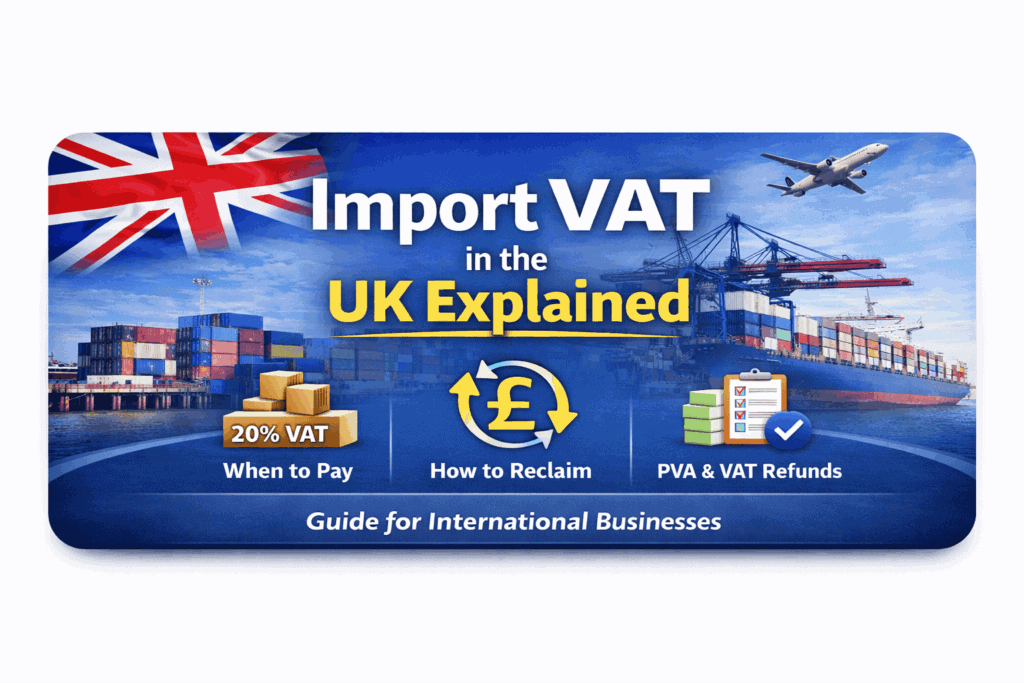
If your business imports goods into the United Kingdom, you will almost certainly come across Import VAT very early on. Many business owners initially think VAT is only something you deal with when you sell goods, but in the UK, VAT is often payable much earlier — at the point when goods enter the country. This is what we call Import VAT.
Import VAT is charged by HMRC when goods arrive in the UK from another country. In most cases, the rate of Import VAT is the same as the normal UK VAT rate for the goods, which is typically 20%. There are some exceptions where reduced VAT rates apply, but for most commercial goods, the standard rate is used.
In practice, Import VAT is not usually a real cost for a VAT-registered business, because it can normally be reclaimed on the VAT return. However, if a company is not VAT registered, then Import VAT becomes a real expense and directly reduces profit. This is why understanding how Import VAT works is so important for international businesses selling goods to the UK.
From my experience working with international clients, many problems start simply because businesses do not realise that VAT appears at the import stage, not only at the sales stage.
When Do You Have to Pay Import VAT
Import VAT is charged when goods enter the UK from outside the country. Since Brexit, this includes goods coming from the EU as well as from the rest of the world.
So Import VAT applies when goods are imported from:
- China
- USA
- Pakistan
- India
- UAE
- European Union countries
- Any other country outside the UK
One important detail that many businesses don’t expect is how Import VAT is calculated. It is not calculated only on the value of the goods. HMRC calculates Import VAT based on the total value of the shipment when it arrives in the UK.
This includes:
- Value of the goods
- Shipping cost
- Insurance
- Customs duty
Let’s look at a simple example.
Imagine:
- Goods value: £10,000
- Shipping: £1,000
- Customs duty: £500
The value for VAT is £11,500, not £10,000.
Import VAT at 20% will be £2,300.
This often surprises business owners because they expect VAT to be calculated only on the product value, but in reality, it is calculated on the total landed cost of the goods.
Who Pays Import VAT When Importing Goods into the UK
Import VAT must be paid by the importer of record. This is the company whose name is shown on the customs declaration.
This point is extremely important, especially for non-UK companies. The importer of record is responsible for:
- Import VAT
- Customs duty
- Customs paperwork
- Keeping import documents
- Reclaiming Import VAT (if VAT registered)
In real business situations, this usually means that the owner of the goods should be the importer.
For example, if a company from China or the USA ships goods to a warehouse in the UK, that company is normally the importer of record, even if they do not have a UK company.
A common mistake I often see is when businesses put the courier company, freight agent, or even the customer as the importer. This creates problems, especially when trying to reclaim Import VAT later. If the wrong company is listed as the importer, HMRC may refuse the VAT reclaim.
So the structure of the import is very important and should be set up correctly before the first shipment arrives.
What is Postponed VAT Accounting (PVA)
Postponed VAT Accounting, usually called PVA, is one of the most useful systems available for importers in the UK.
Before PVA was introduced, businesses had to pay Import VAT immediately when goods arrived in the UK. Only later could they reclaim that VAT on their VAT return. This created cash flow problems, especially for companies importing regularly.
Now, with Postponed VAT Accounting, businesses do not need to physically pay Import VAT at the border. Instead, they declare the Import VAT on their VAT return and reclaim it on the same return.
In practice, this means:
- You import goods
- You do not pay Import VAT immediately
- You declare Import VAT on the VAT return
- You reclaim Import VAT on the same VAT return
- The cash flow impact is zero
From a cash flow perspective, this is extremely helpful, and in my opinion, most VAT-registered importers should be using Postponed VAT Accounting.
To use PVA, you need:
- A UK VAT number
- A customs agent who applies PVA on the import declaration
- To download the monthly PVA statement from HMRC
The PVA statement is the document you use to reclaim Import VAT on your VAT return.
How Import VAT Works for Non-UK Companies
This is an area where there is a lot of confusion.
Many foreign companies believe they only need UK VAT registration if they open a UK company. This is not correct. A non-UK company can still have UK VAT obligations.
In many cases, a foreign company must register for UK VAT if it:
- Imports goods into the UK
- Stores goods in the UK
- Uses a UK fulfilment centre
- Uses Amazon FBA in the UK
- Sells goods to UK customers from UK stock
Once VAT registered, the company can:
- Reclaim Import VAT
- Use Postponed VAT Accounting
- Submit VAT returns
- Charge VAT where required
If the company imports goods but is not VAT registered, Import VAT becomes a cost that cannot be reclaimed. For many businesses, this is the main reason they register for UK VAT in the first place.
Import VAT and Amazon FBA
Import VAT is particularly important for Amazon FBA sellers.
A typical structure looks like this:
- Goods are produced in China
- Goods are shipped to the UK
- Goods are delivered to an Amazon warehouse
- Goods are sold to UK customers
In this situation, the seller is the importer of the goods into the UK. This means:
- Import VAT must be declared
- The seller usually needs a UK VAT number
- Import VAT can be reclaimed
- VAT must be accounted for on sales
I have worked with many Amazon sellers over the years, and one of the most common problems is that sellers start importing first and only think about VAT later. By that time, they have already paid Import VAT and sometimes cannot reclaim it because the documents were completed incorrectly.
It is always better to arrange VAT registration and import structure before the first shipment arrives in the UK.
Can You Reclaim Import VAT in the UK
Yes, Import VAT can normally be reclaimed, but only if certain conditions are met.
To reclaim Import VAT, you need:
- A UK VAT number
- You must be the importer of record
- You must have a C79 certificate or a PVA statement
- The goods must be used for business activities
The Import VAT is reclaimed through the VAT Return.
In practice, the most important document is:
- C79 certificate — if VAT was paid at the border
- PVA statement — if Postponed VAT Accounting was used
If you do not have these documents, you cannot reclaim the Import VAT.
Difference Between Import VAT and Customs Duty
Import VAT and Customs Duty are two different taxes, and it is important not to confuse them.
Import VAT:
- Usually 20%
- Reclaimable if VAT registered
- Based on total import value
Customs Duty:
- Depends on product type and commodity code
- Usually between 0% and 12%
- Cannot be reclaimed
- Is a real business cost
So in simple terms:
- Duty is a cost
- Import VAT is usually recoverable
When calculating profit margins, businesses should always include duty as a cost, but Import VAT is usually neutral if the company is VAT registered.
Common Mistakes Businesses Make with Import VAT
Over the years, I have seen the same mistakes many times, especially with new importers.
Some of the most common mistakes include:
- Not registering for UK VAT before importing
- Using the wrong importer of record
- Not using Postponed VAT Accounting
- Not receiving C79 certificates
- Using a freight agent who does not understand UK VAT
- Incorrect company name on import documents
One situation I see quite often is when a courier company pays Import VAT and then invoices the business. The business pays the invoice, but later discovers that it cannot reclaim the VAT because the import document shows the courier as the importer instead of the business.
Fixing this after the goods have already been imported can be very difficult, so it is much better to set everything up correctly in advance.
Do You Need UK VAT Registration to Reclaim Import VAT
In most cases, yes, you do need UK VAT registration to reclaim Import VAT.
To reclaim Import VAT, a business normally must:
- Be registered for UK VAT
- Submit VAT returns
- Include Import VAT on the VAT return
Without VAT registration, Import VAT is usually not recoverable.
For many international businesses, especially ecommerce sellers, VAT registration is required not only because of sales, but because they import goods into the UK and want to reclaim Import VAT.
Step-by-Step: How Import VAT Is Paid and Reclaimed
To make the process clearer, here is how Import VAT works in a typical situation:
- Goods are shipped to the UK
- Goods arrive at the UK border
- A customs declaration is submitted
- Import VAT is calculated
- Import VAT is either paid immediately or postponed using PVA
- Goods are released and delivered to the warehouse
- The business receives a C79 certificate or PVA statement
- Import VAT is included on the VAT Return
- Import VAT is reclaimed on the VAT Return
Once the process is set up properly, this becomes a routine administrative process for the business.
Conclusion
Import VAT in the UK is a key issue for any international business importing goods into the country, but it is often misunderstood in the early stages.
The most important things to understand are:
- Import VAT is charged when goods enter the UK
- It is usually charged at 20%
- It is calculated on the total import value, including shipping and duty
- VAT-registered businesses can usually reclaim Import VAT
- Postponed VAT Accounting helps avoid paying VAT upfront
- Many non-UK businesses must register for UK VAT if they import goods
In practice, the most important step is to structure the import correctly from the beginning. This means the correct importer of record, correct VAT registration, and correct use of Postponed VAT Accounting.
When the structure is correct, Import VAT is usually not a cost to the business. When the structure is wrong, Import VAT can become an unexpected expense and create serious problems with reclaiming VAT later.
This is why many international businesses prefer to speak with a VAT adviser before they start importing into the UK, rather than trying to fix problems after the goods have already arrived.