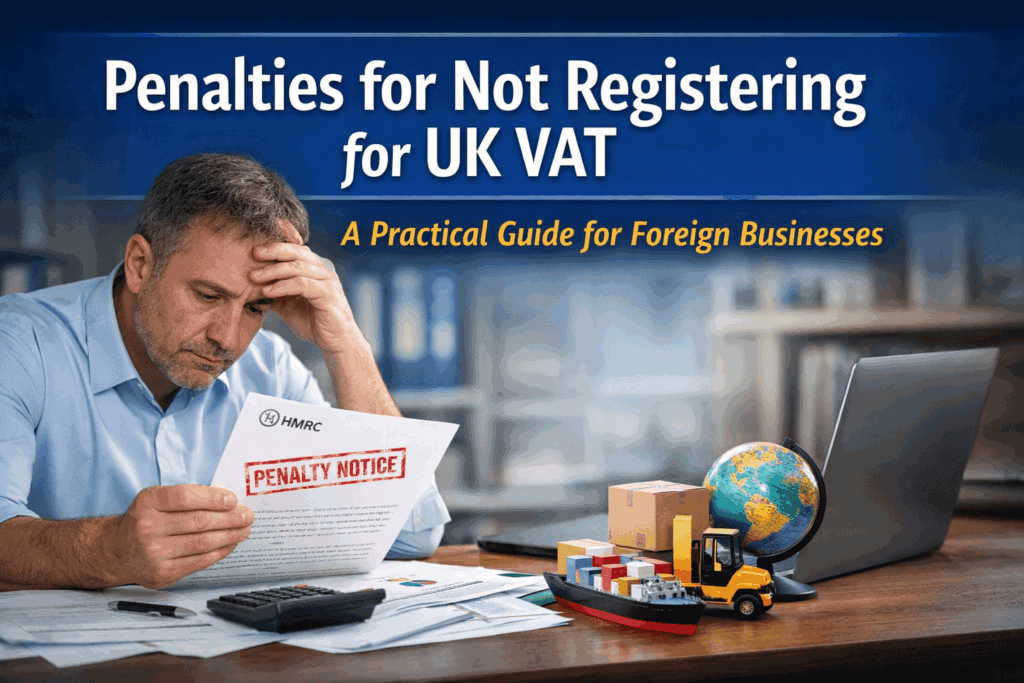
If you run a business that sells goods or services connected to the UK, VAT is something you can’t ignore for long. And, to be honest, many international businesses don’t think about VAT registration until a problem appears. I see this quite often — especially with e-commerce sellers, Amazon businesses, and companies importing goods into the UK. Everything goes well at the beginning, sales grow, goods move, money comes in, and VAT is simply not on the radar. Then one day a letter from HMRC arrives, and that’s when the real conversation starts.
So let’s talk in simple terms about penalties for not registering for UK VAT, what actually happens in real life, how HMRC calculates fines, and what you should do if you realise you are already late.
When You Must Register for UK VAT
First of all, VAT registration is not always about the £90,000 threshold. This is probably the most common misunderstanding I see when speaking to foreign business owners.
As a rule, many non-UK businesses must register for VAT before they reach the threshold. For example, you normally must register if you:
- Import goods into the UK
- Store goods in the UK (for example, Amazon FBA warehouse)
- Sell goods that are already located in the UK
- Take over a UK business
- Make taxable supplies in the UK
- Exceed the VAT threshold (if you are a UK business)
The thing is, the VAT threshold mainly applies to UK-established businesses. However, if your company is based outside the UK but your goods are inside the UK, HMRC usually expects you to register from the first sale.
This is where many problems begin. A business starts selling, everything looks fine, but VAT registration was required from day one. Six months later, a year later, sometimes two years later, the company realises registration should have happened earlier. And that’s when penalties appear.
What Happens If You Register Late
Now let me explain how HMRC looks at late VAT registration, because this part is very important.
If you should have registered but didn’t, HMRC calls this “failure to notify”. In simple terms, you failed to inform HMRC that your business became liable for VAT.
What HMRC will do next is backdate your VAT registration to the date when you should have registered, not when you actually applied.
This means:
- You must calculate VAT on past sales
- You must submit VAT returns for past periods
- You must pay the VAT you should have charged
- You may receive a penalty
- You will be charged interest
And here is the part that surprises many business owners:
Even if you didn’t charge VAT to your customers at the time, you still have to pay that VAT to HMRC. In other words, the VAT often comes out of your own profit.
In practice, this is why late registration becomes expensive very quickly.
UK VAT Late Registration Penalties Explained
Let’s break this down properly, because there isn’t just one penalty. Usually, there are several things added together.
The main penalty is called the Failure to Notify Penalty, and it is based on a percentage of the VAT you owe.
Failure to Notify Penalty
HMRC looks at your behaviour and puts the case into one of the following categories:
| Behaviour | Penalty |
|---|---|
| Non-deliberate | 0% – 30% |
| Deliberate | 20% – 70% |
| Deliberate and concealed | 30% – 100% |
In reality, most international businesses fall into the non-deliberate category. In other words, they didn’t register because they didn’t understand the rules, not because they were trying to avoid tax.
For example, let’s say:
- You should have registered 18 months ago
- You owe £25,000 in VAT
- HMRC applies a 10% penalty
Your penalty would be £2,500, plus interest on top.
However, and this is important, the percentage is not fixed. HMRC can reduce the penalty if you cooperate, provide information, and disclose the problem yourself.
Late VAT Payment Penalties
There is also a penalty for paying VAT late. HMRC introduced a newer penalty system, and it works roughly like this:
- Up to 15 days late → no penalty
- 16–30 days late → 2% penalty
- 31 days late → additional 2%
- After day 31 → daily interest applies
So, the longer the VAT remains unpaid, the more the total cost grows. It doesn’t jump all at once, but it keeps increasing over time.
Interest on Late VAT
On top of penalties, HMRC also charges interest. Interest is calculated from the date the VAT should have been paid up to the date you actually pay it.
So in the end, the total amount you pay is usually:
VAT owed + Failure to Notify penalty + Late payment penalty + Interest
When the delay is long — for example, two years — interest alone can be a significant amount.
Real Examples of UK VAT Penalties
It’s easier to understand this with real scenarios, because this is exactly what happens in practice.
Example 1 — Amazon FBA Seller
A non-UK company was selling through Amazon and storing goods in a UK Amazon warehouse. They didn’t register for VAT because they thought Amazon was handling VAT.
This is a very common assumption, and unfortunately, it’s wrong. Amazon may collect VAT in some situations, but Amazon does not register your company for VAT.
After about 20 months, HMRC contacted the company.
Result:
- VAT owed: £38,000
- Penalty: around £4,000
- Interest: around £3,000
Total cost: about £45,000
The business was profitable, but this unexpected bill caused serious cash flow problems.
Example 2 — Importing Goods Into the UK
Another company imported goods into the UK and sold them to UK customers. Their turnover was below £90,000, so they assumed VAT registration was not required.
However, because they were importing goods and selling in the UK, they should have registered from the first import.
After a compliance check:
- VAT owed: £14,000
- Penalty: £1,400
- Interest: £1,000
Total: £16,400
Again, very typical situation.
How HMRC Finds Businesses That Should Have Registered
Many business owners ask me the same question: “But how will HMRC know?”
The short answer is — HMRC has a lot of data.
They receive information from:
- Amazon
- eBay
- Shopify
- Payment processors
- UK customs import records
- Courier companies
- Online marketplaces
- Banks
So if you import goods, HMRC can see import records.
If you sell through marketplaces, HMRC can request marketplace data.
If you receive UK payments, there is often a financial trail.
In other words, it’s not really about whether HMRC will find out. It’s more about when.
How to Reduce or Avoid VAT Penalties
Now the good news — penalties are often reduced if the situation is handled properly.
For example, penalties can be lower if you:
- Register voluntarily before HMRC contacts you
- Tell HMRC about the problem yourself
- Cooperate fully
- Provide records quickly
- Show that the mistake was not deliberate
- Work with a VAT agent
- Make what is called an unprompted disclosure
An unprompted disclosure means you tell HMRC about the problem before they contact you.
And this makes a big difference:
| Disclosure Type | Penalty |
|---|---|
| Unprompted | 0% – 10% |
| Prompted | 10% – 30% |
So timing really matters here. From my experience, businesses that act early often pay very small penalties compared to those who wait until HMRC contacts them.
What To Do If You Registered Late
If you realise you should have registered earlier, the worst thing you can do is ignore it and hope it goes away. It won’t.
The usual process looks like this:
- Work out the date you should have registered
- Calculate how much VAT you owe
- Register for VAT
- Submit backdated VAT returns
- Write to HMRC explaining why registration was late
- Request a penalty reduction
- If necessary, arrange a payment plan
HMRC is often more cooperative than people expect, especially if you approach them properly and explain the situation clearly.
I’ve seen many cases where penalties were reduced simply because the business was honest, organised, and proactive.
Final Advice from a VAT Consultant
If I can give you some practical advice from experience, it would be this: late VAT registration is very common, especially for international businesses. You are definitely not the first company in this situation.
But the difference between a small problem and a very expensive problem is usually timing.
If the issue is discovered early, the cost might be manageable. If it’s discovered after several years, the numbers can become very large, because VAT, penalties, and interest all add up.
As a rule, VAT problems don’t get better with time — they get more expensive with time.
So if you are not sure whether your business should be VAT registered in the UK, it is much better to check now, even just to be safe. Because in practice, most penalties I see are not because businesses were trying to do something wrong. They simply didn’t understand when UK VAT registration was required.
And the sooner you fix that, the easier — and cheaper — the situation usually is.