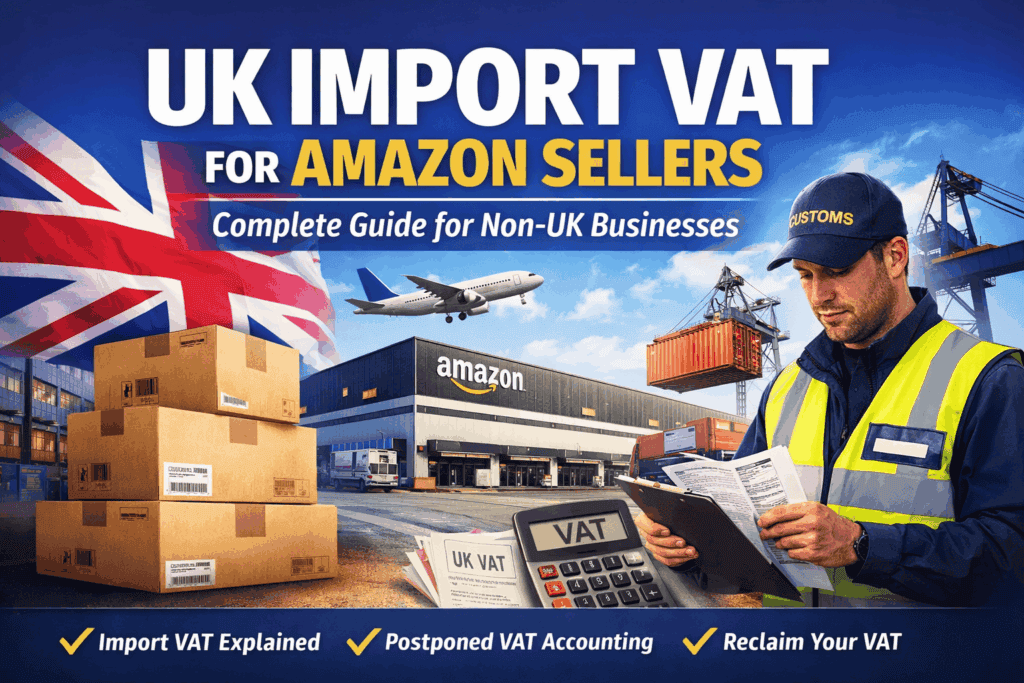
If you sell on Amazon and import goods into the UK, at some point you will run into import VAT. It’s almost unavoidable. And in reality, most sellers don’t learn how it works from a guide or from HMRC — they learn when their goods are sitting at the port and someone emails them saying: “You need to pay this before we release the shipment.”
I see this quite often, especially with non-UK Amazon sellers using FBA. The business is running, sales are growing, the first large shipment arrives in the UK — and suddenly there is import VAT, customs duty, paperwork, and confusion about who is supposed to pay what.
So let’s go through this properly, in plain English, from a practical point of view, not from a textbook.
What Is UK Import VAT
Import VAT is VAT that is charged when goods enter the UK from outside the UK. If your goods are coming from China, the USA, India, Turkey, or anywhere else outside the UK, import VAT will usually apply.
From a VAT point of view, it’s still just VAT. The only difference is where it is charged. Normally VAT is charged when you sell goods. Import VAT is charged earlier — when the goods enter the country.
The standard UK rate is 20%, and it’s calculated on the total landed value of the goods, not just the product price.
That means VAT is calculated on:
- Value of the goods
- Shipping cost
- Insurance (if any)
- Customs duty
This is something many sellers don’t realise at the beginning.
Simple example:
- Goods value: £10,000
- Shipping: £1,000
- Customs duty: £500
- Total value for VAT = £11,500
- Import VAT (20%) = £2,300
So the VAT is not on £10,000 — it’s on £11,500.
That £2,300 is either paid at the border or declared later through something called Postponed VAT Accounting, which we’ll talk about in a moment.
How Import VAT Works for Amazon FBA Sellers
If you use Amazon FBA in the UK, your goods are being imported into the UK and stored in a UK warehouse. From HMRC’s point of view, that usually means you are importing goods into the UK as a business — and that creates VAT obligations.
In real life, the process usually looks like this:
- You order goods from your supplier (very often from China).
- The goods are shipped to the UK.
- The shipment arrives at UK customs.
- Customs calculate duty and import VAT.
- The courier or freight agent (DHL, UPS, FedEx, freight forwarder) pays these charges to customs.
- They then send you an invoice to reimburse them.
- After that, the goods are delivered to the Amazon warehouse.
- You start selling on Amazon UK.
- If you are VAT registered, you reclaim the import VAT on your VAT return.
On paper this looks straightforward. In practice, most problems happen because something in this chain is set up incorrectly — usually the importer of record or the VAT number.
Who Pays Import VAT When Goods Enter the UK
This depends on who is listed as the importer of record on the customs documents.
The importer of record is the company that is officially responsible for the goods when they enter the UK. This company:
- Pays import VAT
- Pays customs duty
- Must have an EORI number
- Usually must have a UK VAT number
- Is responsible to HMRC for the import
If you are a non-UK Amazon seller sending goods to Amazon FBA in the UK, you are usually the importer of record, not Amazon.
This is a very common misunderstanding. Amazon is the warehouse and fulfilment provider. They store the goods and ship them to customers. But they are not the importer of your goods.
If your name (your company) is not listed as the importer of record, you can run into serious problems later when trying to reclaim import VAT.
Postponed VAT Accounting (PVA)
This is one of the most important things for Amazon sellers importing into the UK, and surprisingly many sellers still don’t use it.
Postponed VAT Accounting (PVA) allows you to avoid paying import VAT at the border and instead declare it on your VAT return.
Why does this matter? Cash flow.
Without PVA:
- You pay 20% import VAT when goods arrive
- Then you reclaim it on your VAT return
- That could be 2–3 months later
- Your money is tied up
With PVA:
- You don’t pay import VAT upfront
- You declare import VAT on your VAT return
- You reclaim it on the same VAT return
- The VAT cancels out (in most cases)
For growing Amazon businesses, this makes a huge difference. Otherwise, a large shipment can create a very large VAT bill before you’ve even sold the products.
From experience, once sellers understand PVA, they never want to import without it again.
Do You Need a UK VAT Number to Import Goods
In most Amazon FBA situations — yes, you do.
You typically need a UK VAT number if:
- You store goods in the UK
- You use Amazon FBA in the UK
- You import goods into the UK
- You want to reclaim import VAT
- You want to use Postponed VAT Accounting
- Amazon asks for your VAT number (which they often do)
I’ve seen many sellers try to delay VAT registration because they think they can register later and reclaim everything. Sometimes that works, sometimes it doesn’t — and when it doesn’t, import VAT becomes a real cost, not something you can reclaim.
It’s much safer to set this up before the first shipment arrives.
Can You Reclaim Import VAT
Yes, import VAT is normally recoverable — but only if everything is set up properly.
To reclaim import VAT, you generally need:
- A UK VAT number
- To be the importer of record
- Import documents showing your company as importer
- C79 certificate (if VAT was paid at the border), or
- PVA statements (if using postponed VAT accounting)
One of the most common situations I see is this:
The freight forwarder puts their own company as the importer of record to “make things easier”. The seller pays the import VAT to the freight agent, but legally the freight agent is the importer.
Result: the seller cannot reclaim the import VAT.
This is a very expensive mistake and unfortunately quite common.
Import VAT vs Customs Duty
These two are often confused, but they are completely different.
| Tax | What it is | Can you reclaim it? |
|---|---|---|
| Import VAT | VAT charged on import | Yes |
| Customs Duty | Import tax based on product | No |
Customs duty depends on:
- Product type
- HS code
- Country of origin
Some products have 0% duty, some 5%, some 12%. It varies a lot.
Import VAT is usually 20%, and this is the bigger number in most cases — but the important difference is that VAT is recoverable, duty is not.
So when you calculate your profit margins for Amazon, duty is a real cost, VAT usually isn’t (if registered correctly).
Example: Importing Goods from China to UK for Amazon FBA
Let’s look at a realistic example.
- Product cost: £8,000
- Shipping: £1,200
- Duty (5%): £400
- VAT base = £9,600
- Import VAT (20%) = £1,920
Scenario 1 — Without PVA
At the border you pay:
- £400 duty
- £1,920 VAT
- Total = £2,320
You later reclaim £1,920 on your VAT return, but the money is already paid out.
Scenario 2 — With PVA
At the border you pay:
- £400 duty
- VAT is postponed
- No £1,920 upfront payment
For many Amazon sellers importing regularly, this is the difference between healthy cash flow and constant cash flow pressure.
Common Mistakes Amazon Sellers Make
After working with international Amazon sellers for years, I can say most problems are not caused by VAT rates — they are caused by setup mistakes.
Here are the most common ones:
Mistake 1 — Importing without a UK VAT number
If you are not VAT registered, you usually cannot reclaim import VAT. That 20% becomes a cost.
Mistake 2 — Freight agent listed as importer
If the freight agent is the importer of record, you normally cannot reclaim the VAT.
Mistake 3 — Not using Postponed VAT Accounting
This creates unnecessary cash flow problems.
Mistake 4 — Wrong company details on import documents
HMRC can refuse VAT reclaim if documents don’t match your VAT registration.
Mistake 5 — Thinking Amazon handles VAT
Amazon does not deal with your import VAT. They are a marketplace and fulfilment provider, not your tax agent.
Most VAT problems I see could have been avoided if the structure was set up correctly before the first shipment.
When You Need a VAT Agent
If you are a non-UK company, in many cases you will need a UK VAT agent to handle:
- VAT registration
- VAT returns
- Import VAT and PVA reporting
- Communication with HMRC
- Compliance and deadlines
Technically, you can try to manage this yourself, but in practice, once you are importing regularly, using FBA, and dealing with PVA statements and VAT returns, it becomes quite technical.
Most serious Amazon sellers eventually work with a VAT agent because it reduces mistakes and saves time.
Step-by-Step: How the Import Process Works
If everything is set up properly, the process usually looks like this:
- Register for UK VAT
- Get a UK EORI number
- Enable Postponed VAT Accounting
- Ship goods to the UK
- Your company is listed as importer of record
- Goods arrive at customs
- Customs duty is paid
- Import VAT is postponed (PVA)
- Goods are delivered to Amazon FBA warehouse
- You sell goods on Amazon
- You submit your VAT return
- You declare import VAT from PVA statement
- You reclaim the same import VAT on the same return
When this is set up correctly, import VAT is mostly a paperwork and reporting exercise, not a real cost.
When it’s set up incorrectly, it turns into delays, extra costs, and sometimes VAT that you simply cannot recover.
Final Thoughts
From a practical point of view, import VAT itself is not usually the biggest problem. The real issue is the structure and paperwork around the import.
Most of the difficult situations I see happen when:
- The seller didn’t register for VAT in time
- The wrong importer was listed
- PVA was not activated
- The freight agent “handled everything” but put the wrong details on the documents
- The seller only started asking questions after the goods were already in the UK
It’s always much easier to set this up properly before the first shipment. Once goods are already at the border, you don’t have much room to fix things.
If you are planning to sell on Amazon UK and import goods, you should treat import VAT as part of your business model and pricing structure from the beginning. If everything is done properly, import VAT is recoverable and manageable. If not, it can easily turn into an extra 20% cost, and that can destroy your margins very quickly.
This is why getting the VAT and import structure right from the start is not just an accounting issue — it’s a business decision.