Securing a UK VAT registration is merely the introductory phase. For non-UK businesses, the primary challenge is maintaining ongoing compliance. Many global firms obtain their VAT numbers successfully but later face severe penalties, HMRC investigations, or frozen trading accounts due to inadequate tax management.
What Does UK VAT Compliance Mean?
Ongoing UK VAT compliance refers to your continuous legal obligations once you are registered for VAT in the United Kingdom. These responsibilities apply regardless of where your company is physically located.
Core VAT Compliance Obligations
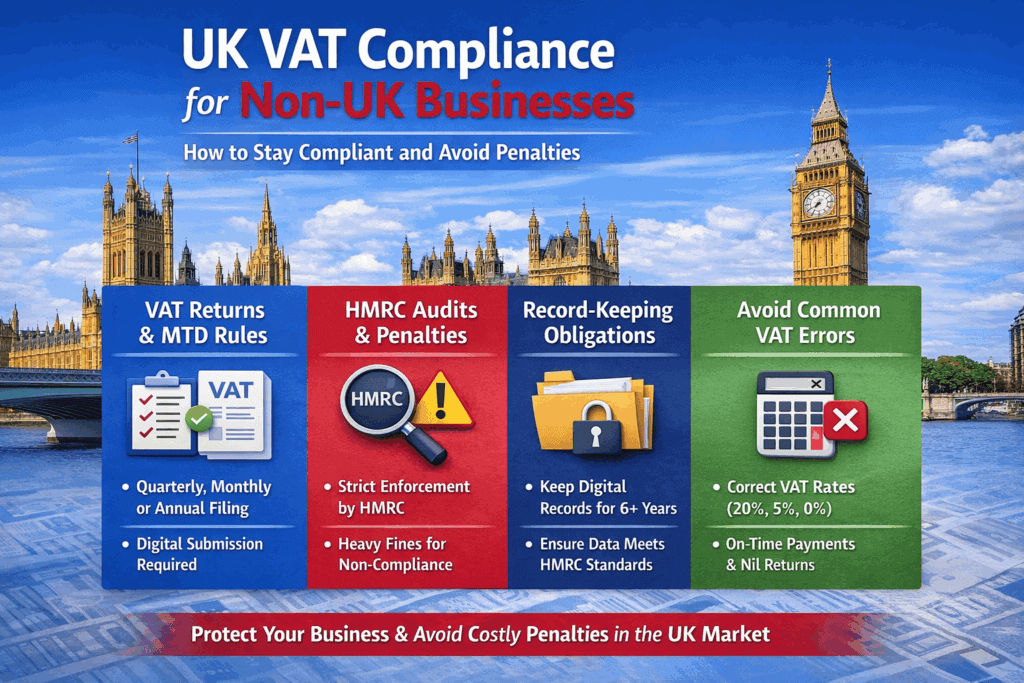
- Filing VAT returns on time via Making Tax Digital (MTD) software
- Applying correct VAT rates (20%, 5%, 0%)
- Maintaining fully digital accounting records
- Paying VAT liabilities within statutory deadlines
- Responding promptly to HMRC correspondence
- Updating processes according to legislative changes
Failure in any of these areas may trigger automated penalties and increased scrutiny.
Who Must Adhere to Ongoing VAT Compliance?
Every business listed on the UK VAT register must comply.
Categories of Businesses Affected
- Non-EU companies (US, China, UAE, etc.)
- EU businesses selling into Great Britain
- Amazon FBA sellers storing stock in the UK
- Dropshipping and e-commerce operators
- SaaS and digital service providers
- Marketplace sellers (Amazon, eBay, TikTok Shop)
Overseas status does not provide exemption.
VAT Returns for Non-UK Businesses
VAT Return Frequency
HMRC assigns reporting cycles:
- Quarterly (default)
- Monthly (for frequent VAT refunds)
- Annual Accounting Scheme (if eligible)
What Must Be Included in a VAT Return?
Under Making Tax Digital rules, VAT returns must include:
- Total sales and purchases
- Output VAT
- Input VAT
- Net VAT payable or reclaimable
Nil VAT Returns
Even if there were no UK transactions, a nil return must be submitted to avoid penalty points.
Common VAT Return Errors Made by Non-UK Businesses
Frequent mistakes include:
- Missing filing deadlines
- Incorrect input VAT claims
- Improper GBP currency conversion
- Manual copy-pasting that breaches MTD digital link rules
- Failure to submit nil returns
These errors often trigger compliance reviews.
VAT Payment Obligations
VAT must be paid electronically in GBP.
Standard Payment Deadlines
Payment is due one month and seven days after the VAT period ends.
Late Payment Penalties
HMRC operates a strict two-stage penalty regime, including fines and accruing interest.
Record-Keeping Requirements
UK VAT law requires digital record retention.
Retention Period
- 6 years (standard VAT records)
- 10 years (specific schemes such as OSS)
Required Digital Records
- Sales and purchase invoices
- Import documentation (C79, PVA statements)
- VAT calculation breakdowns
- General ledger summaries
Poor record integrity is a primary audit trigger.
VAT Rates and Correct Charging
Correct classification of supplies is essential.
UK VAT Rates
- 20% Standard Rate
- 5% Reduced Rate
- 0% Zero Rate
Incorrect rate application may result in:
- Backdated assessments
- 30%–100% penalties
- Accrued interest
Making Tax Digital (MTD) and Non-UK Businesses
MTD is mandatory for all VAT-registered businesses.
MTD Compliance Requirements
- Digital-only submissions
- HMRC-recognised software
- Mandatory digital links between systems
Compliance is required from your first VAT return.
HMRC Audits and Compliance Checks
HMRC actively monitors overseas sellers.
Common Audit Triggers
- Import vs sales discrepancies
- Rapid turnover growth
- Marketplace data mismatches
What HMRC May Request
- Supply chain documentation
- Sample invoices
- Proof of customer location for digital services
Consequences of Poor VAT Compliance
Non-compliance may result in:
- Financial penalties and interest
- Retrospective tax assessments
- Marketplace suspensions
- Payment processor fund blocks
- VAT deregistration
Do Non-UK Businesses Need Ongoing VAT Support?
While internal management is possible, many businesses choose specialist VAT support.
Benefits of Professional VAT Support
- Accurate MTD-compliant filings
- Deadline monitoring
- HMRC correspondence handling
- Audit preparation
- Risk mitigation
VAT Compliance for Growing International Businesses
As turnover increases, compliance complexity rises:
- More tax points
- Larger VAT liabilities
- Higher audit exposure
Early compliance systems protect operational stability.
Best Practices for UK VAT Compliance
- File returns on time
- Maintain digital record integrity
- Monitor legislative updates
- Conduct internal reviews
- Engage VAT specialists when needed
Preventative compliance is always more cost-effective than correcting historical errors.
UK VAT Compliance: A Continuous Operational Pillar
UK VAT compliance is not a one-time administrative step — it is an ongoing operational responsibility that protects cash flow, marketplace access, and long-term growth in the United Kingdom.