When a foreign company registers for VAT in the UK, the real work starts after registration. Many business owners think VAT registration is the difficult part. In reality, ongoing VAT filing is what causes most problems. From our experience, foreign companies rarely get into trouble for registering late. However, they often get penalties because they do not file VAT returns correctly or on time.
The UK VAT system is based on self-reporting. This means HMRC does not calculate VAT for you. Instead, you must report your sales, purchases, and VAT yourself. Then you either pay VAT to HMRC or reclaim VAT back. Therefore, VAT returns are not just a formality. They are the core of the UK VAT system.
Foreign companies must follow the same VAT filing rules as UK companies. However, non-UK businesses usually deal with import VAT, warehouses, or Amazon FBA. Because of this, their VAT returns often require more attention. In practice, most issues appear in the first year. After that, the process becomes routine if everything is set up correctly.
When Foreign Companies Must File VAT Returns
Once your company receives a UK VAT number, you must start submitting VAT returns. It does not matter if your company is based outside the UK. It also does not matter if you have not started selling yet. This is where many foreign companies get confused.
In practice, we often see companies register for VAT because they import goods into the UK. They bring stock into the country first, then start selling later. However, HMRC still expects VAT returns from the date of registration. Even if there are no sales, a VAT return must be submitted.
Foreign companies usually register for UK VAT in the following situations:
- Importing goods into the UK
- Storing goods in a UK warehouse
- Selling through Amazon FBA
- Selling goods to UK customers
- Registering voluntarily to reclaim import VAT
So the rule is very simple. If you have a UK VAT number, you must submit VAT returns. Even if there is no activity, you still submit a return. This is called a nil VAT return.
Many companies only discover this rule after they receive penalties. Therefore, it is better to understand this from the beginning.
How Often VAT Returns Must Be Submitted
Most foreign companies submit VAT returns every three months. This is known as quarterly VAT filing. HMRC assigns your VAT quarters when you register. You usually cannot choose your reporting periods.
A typical VAT year is divided into four periods:
- January to March
- April to June
- July to September
- October to December
After each period ends, you must submit a VAT return and pay any VAT due. The system works on a repeating cycle. Therefore, once you understand one quarter, the rest follow the same process.
Some foreign companies submit VAT returns monthly. This is common for importers who reclaim large amounts of import VAT. Monthly returns allow them to recover VAT faster. As a result, this improves cash flow.
Annual VAT schemes exist, but they are rarely used by foreign companies. In practice, quarterly VAT returns are standard for non-UK businesses.
So in most cases, you should expect to submit four VAT returns per year.
What Information Is Included in a VAT Return
A UK VAT return is a summary of your business activity for the period. You do not send individual invoices to HMRC. Instead, you report totals.
The UK VAT return contains nine boxes. However, most foreign companies mainly use Boxes 1, 4, 6, and 7.
Here is what they represent in simple terms:
- Box 1 — VAT on your sales
- Box 2 — VAT on EU purchases (if applicable)
- Box 3 — Total VAT due
- Box 4 — VAT you reclaim
- Box 5 — VAT to pay or reclaim
- Box 6 — Total sales excluding VAT
- Box 7 — Total purchases excluding VAT
- Box 8 — EU sales (if applicable)
- Box 9 — EU purchases (if applicable)
For importers, Box 4 is very important. This is where you reclaim import VAT. If you import goods into the UK, you usually pay import VAT. Then you reclaim this VAT through your VAT return.
Many foreign companies actually receive VAT refunds instead of paying VAT. This usually happens when import VAT is higher than sales VAT. Therefore, submitting VAT returns correctly is very important for cash flow.
VAT Return Deadlines and Payment Deadlines
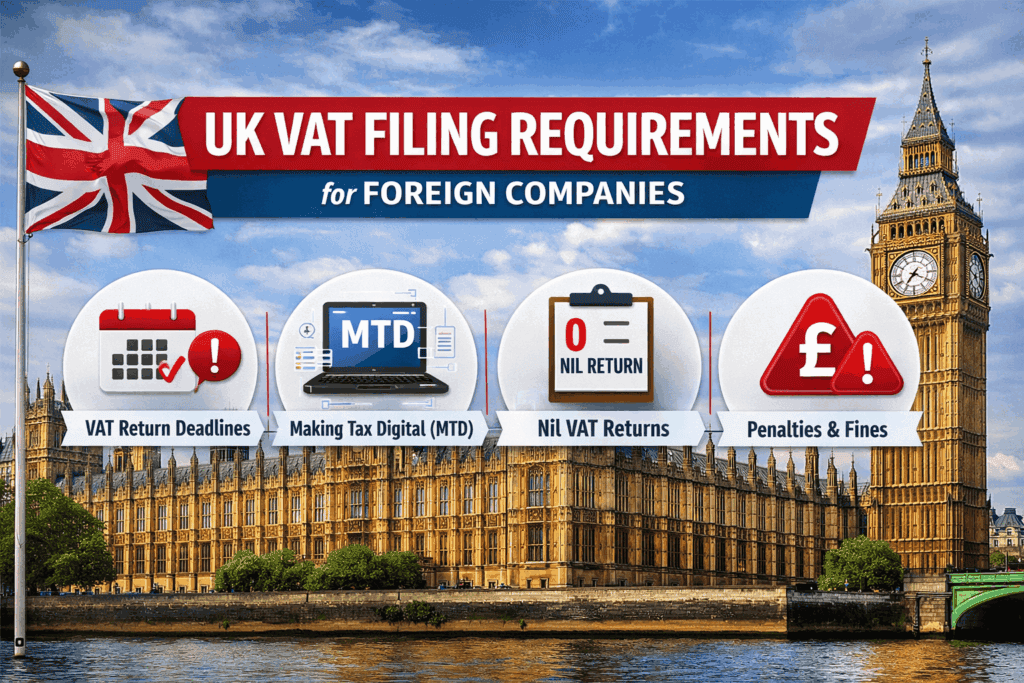
The UK has strict VAT deadlines. You must submit your VAT return one month and seven days after the VAT period ends. The VAT payment deadline is the same date.
For example:
- VAT period ends 31 March
- VAT return deadline is 7 May
- VAT payment deadline is 7 May
This gives you about five weeks to prepare your VAT return. However, do not wait until the last week. Gathering documents and checking figures takes time.
Also, international bank transfers can take several days. Therefore, VAT payments should be sent early. Otherwise, HMRC may receive the payment late and charge penalties.
From our experience, late payments are very common for foreign companies. Usually, the reason is simple. The payment was sent on time, but it arrived late. HMRC still considers this a late payment.
So it is always safer to pay a few days earlier.
Making Tax Digital (MTD) for Foreign Companies
All VAT registered businesses must follow Making Tax Digital rules. This includes foreign companies. You cannot submit VAT returns manually using the HMRC website.
You must use MTD-compatible software. The software connects to HMRC and submits the VAT return electronically.
Common software includes:
- Xero
- QuickBooks
- Sage
- FreeAgent
Your accounting records must also be kept digitally. This includes sales records, purchase records, and VAT calculations. Spreadsheets can be used, but they must be connected to MTD software.
Many foreign companies try to manage VAT using Excel only. Then they discover they cannot submit the VAT return. Therefore, setting up proper software from the beginning saves time and stress later.
In practice, most foreign companies use an accountant or VAT agent who already has MTD software.
Record Keeping Requirements
HMRC requires VAT records to be kept for six years. This rule applies to foreign companies as well.
You must keep:
- Sales invoices
- Purchase invoices
- Import VAT certificates (C79)
- Bank statements
- Credit notes
- VAT reports
Import VAT certificates are especially important. Many companies think courier invoices are enough. However, HMRC requires the official C79 certificate to reclaim import VAT.
The C79 certificate is issued monthly by HMRC. Without this document, import VAT usually cannot be reclaimed.
In practice, we recommend keeping all documents digitally. This makes VAT returns easier and protects you if HMRC asks for records.
Good record keeping prevents most VAT problems before they start.
Nil VAT Returns and Zero Activity
Even if your company has no sales, you must still submit VAT returns. This is called a nil VAT return. Many foreign companies do not know this rule.
For example, a company imports goods and stores them in a UK warehouse. Sales start later. However, VAT returns must still be submitted during this period.
If you do not submit nil returns, HMRC will automatically issue penalties. The system is automated, so there are no warnings at the beginning.
From our experience, this is one of the most common and most expensive mistakes foreign companies make.
So always remember this rule. No activity does not mean no VAT return.
Penalties for Late VAT Returns
The UK uses a penalty points system for late VAT returns. Every late return gives you one penalty point.
When you reach the penalty limit, HMRC issues a £200 penalty.
Penalty thresholds:
- Quarterly returns — 4 points
- Monthly returns — 5 points
Late VAT payment results in additional penalties and interest. So there are two separate problems:
- Late filing
- Late payment
Even if your VAT return shows zero VAT to pay, late filing still creates penalties. Therefore, submitting VAT returns on time is extremely important.
In practice, companies that miss deadlines usually continue missing them. Then penalties start to accumulate. Therefore, it is important to build a routine from the beginning.
Common VAT Filing Mistakes Foreign Companies Make
After working with many international businesses, we see the same mistakes again and again.
The most common mistakes include:
- Registering for VAT but not filing returns
- Missing VAT deadlines
- Not using MTD software
- Reclaiming import VAT without C79 certificates
- Submitting incorrect figures
- Forgetting to submit nil returns
- Paying VAT late due to bank transfer delays
Most of these problems happen because the company does not understand the UK system. However, once the process is set up properly, VAT filing becomes predictable and manageable.
Practical Advice for Foreign Companies
If you are a foreign company registered for UK VAT, the best approach is to create a simple system and follow it every quarter.
First, keep all invoices and import documents organized and stored digitally. This saves a lot of time when preparing VAT returns.
Second, track your VAT deadlines in a calendar. Do not rely on memory.
Third, use proper accounting software that supports Making Tax Digital.
Fourth, consider working with a VAT agent. Many foreign companies choose this option because the UK VAT system is strict and very deadline-driven.
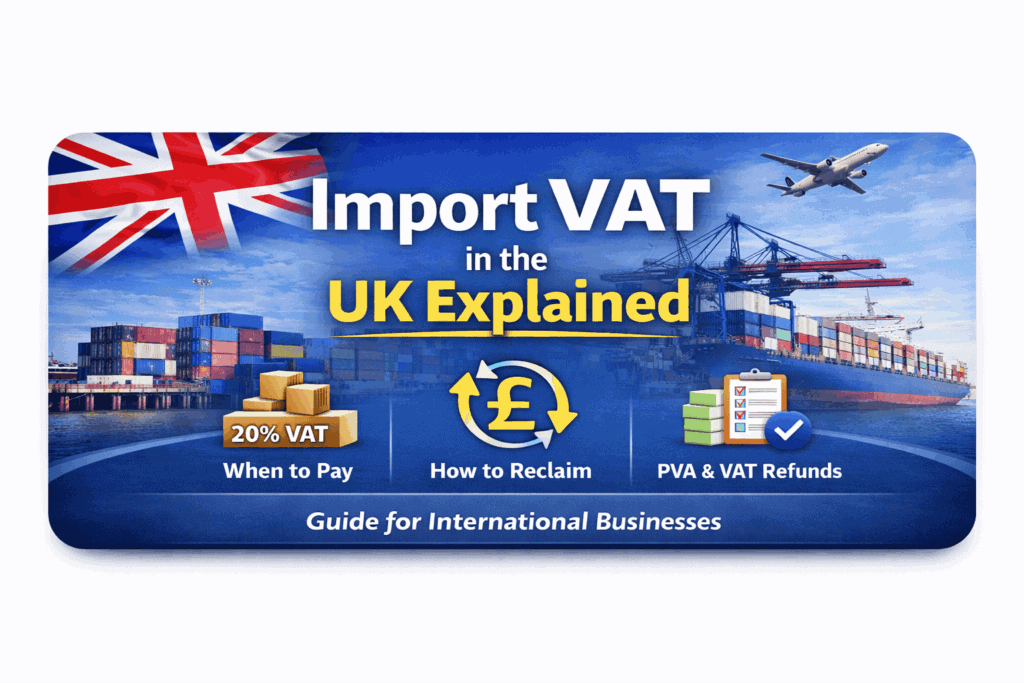
Fifth, if you import goods into the UK, learn how Postponed VAT Accounting works. This allows you to account for import VAT on your VAT return instead of paying it upfront.
In practice, this improves cash flow and simplifies VAT reporting.
Final Thoughts
UK VAT filing requirements for foreign companies are not complicated, but they must be managed properly. The biggest mistake is ignoring VAT returns after registration.
The most important rules are simple:
- Submit VAT returns on time
- Keep proper records
- Use MTD software
- Submit returns even if there is no activity
- Pay VAT on time
From our experience, foreign companies that set up the correct process from the beginning rarely have problems with HMRC. VAT filing becomes a routine task every quarter.
However, companies that ignore deadlines or keep poor records often face penalties and VAT inspections later. Therefore, it is always better to organize the VAT process properly from the start.
If you plan to trade in the UK long term, a good VAT system is not just about compliance. It also helps with cash flow, import VAT recovery, and business stability.