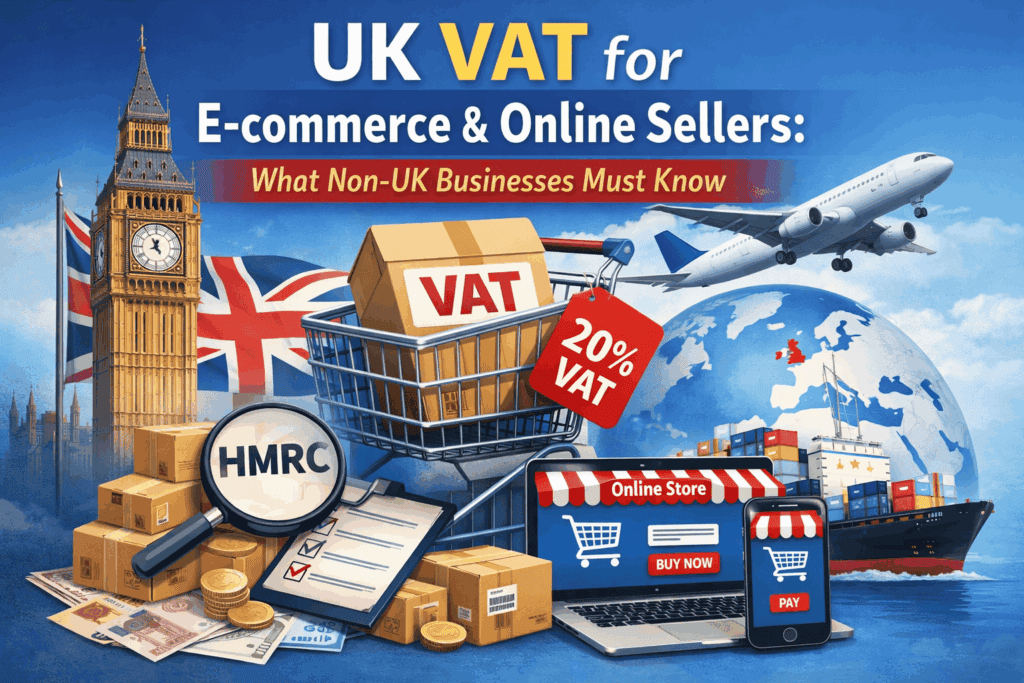
Selling goods to UK consumers online frequently creates immediate VAT liabilities — regardless of where your company is incorporated. Many international retailers mistakenly assume UK VAT applies only to domestic businesses or those exceeding the £90,000 threshold.
In reality, overseas e-commerce sellers are often required to register from their very first taxable sale.
This guide explains:
- When non-UK businesses must register for UK VAT
- How VAT applies to cross-border online sales
- Marketplace vs own website responsibilities
- Ongoing reporting requirements
- Common compliance risks
What Counts as an E-commerce Business for UK VAT?
For VAT purposes, e-commerce includes any business selling physical goods online through:
- Proprietary websites (Shopify, WooCommerce, Magento, etc.)
- Third-party marketplaces (Amazon, eBay, Etsy, TikTok Shop)
- Direct-to-consumer (DTC) brand stores
- Subscription-based delivery models
- Cross-border stock movements into the UK
If you move, store, or sell physical inventory within the UK market, VAT registration is typically required.
When Do E-commerce Sellers Need UK VAT Registration?
Goods Stored in the UK
If your products are held in UK warehouses or fulfilment centres, VAT registration is mandatory immediately — regardless of turnover.
There is no VAT threshold for non-UK businesses.
Importing Goods into the UK
If you act as the Importer of Record, registration is usually required in order to:
- Reclaim import VAT
- Ensure customs compliance
- Avoid shipment delays
Selling From UK Stock to UK Customers
If goods are physically located in the UK at the point of sale, VAT liability arises from the first transaction.
Non-UK Sellers and the First Sale Rule
Unlike UK-established businesses, overseas sellers cannot rely on the £90,000 threshold. VAT registration is generally required from the very first taxable supply.
UK VAT Rules for Non-UK E-commerce Businesses
Key Regulatory Differences
- No VAT threshold
- Immediate registration requirement
- Higher HMRC scrutiny
- Increased audit exposure
HMRC actively monitors overseas online sellers through cooperation with marketplaces and payment providers.
What Is NOT Required for Registration?
- A UK limited company
- A UK resident director
- A physical UK office
You may manage your VAT obligations remotely, provided your registration and digital records meet HMRC requirements.
Selling Through Your Own Online Store
VAT treatment depends on your fulfilment structure.
Shipping From UK-Based Stock
If inventory is stored in the UK, VAT registration is required from the first sale.
Importing Bulk Stock into the UK
If your company imports goods into the UK, registration is typically required to reclaim import VAT and remain compliant.
Shipping Directly From Outside the UK
VAT obligations depend on shipment value and supply chain structure. Incorrect VAT treatment at checkout can result in financial risk.
Risks of Incorrect VAT Setup
- Undercharged VAT and backdated tax liabilities
- HMRC assessments and penalties
- Reduced margins if VAT is absorbed
Incorrect configuration is one of the most common compliance failures among international sellers.
VAT Rates for E-commerce Sales in the UK
Most online retail goods are subject to the 20% standard VAT rate.
20% Standard Rate
Applies to most goods including electronics, adult clothing, cosmetics and homeware.
Reduced and Zero-Rated Categories
5% Reduced Rate
Applies to specific categories such as children’s car seats and certain domestic fuel or energy-saving materials.
0% Zero Rate
Applies to essential goods including most unprocessed food, children’s clothing and footwear, and printed or digital publications.
Using the wrong VAT rate can lead to significant financial consequences.
UK VAT Returns for Online Sellers
Once registered, you must comply with ongoing reporting obligations.
Core Requirements
- Submit quarterly VAT returns (standard cycle)
- Declare total sales and VAT collected
- Account for refunds and credit notes
- Pay VAT by the statutory deadline (1 month and 7 days after period end)
Even if no sales occur, you must submit a nil return.
Common UK VAT Mistakes Made by Online Sellers
- Late VAT registration
- Incorrect VAT rate application
- Failure to submit nil returns
- Overreliance on marketplace VAT handling
- Ignoring HMRC notices
- Incorrect import procedures
These errors frequently lead to penalties, audits, and frozen accounts.
Marketplace vs Own Website: Who Handles VAT?
Marketplace
Under Marketplace Facilitator rules, platforms may collect VAT at checkout. However:
- This does not automatically remove your VAT registration obligation
- If stock is stored in the UK (e.g., fulfilment centres), registration is still required
- Informational VAT returns may still be mandatory
Own Website
When selling via your own website:
- You are fully responsible for VAT calculation and reporting
- VAT must be correctly charged at checkout
- All reporting obligations remain with your business
Assuming VAT is automatically handled by third parties can lead to serious compliance breaches.
Do E-commerce Sellers Need a UK VAT Agent?
For non-UK businesses, appointing a UK VAT agent is strongly recommended.
A VAT specialist assists with:
- Accurate registration
- HMRC correspondence
- Quarterly VAT returns
- Compliance monitoring
- Risk mitigation
This is particularly important for:
- Businesses without UK presence
- High-volume sellers
- Multi-channel retailers
- Companies scaling into the UK market
What Happens If You Ignore UK VAT Rules?
HMRC collaborates with marketplaces, payment providers and customs authorities.
Non-compliance may result in:
- Backdated VAT assessments
- Financial penalties and interest
- Frozen marketplace funds
- Supply chain disruption
- Legal enforcement
Correcting violations is typically far more expensive than proactive compliance.
Scaling Your E-commerce Business with Proper VAT Compliance
As your business grows, VAT complexity increases.
Growth often means:
- Higher transaction volumes
- Increased reporting requirements
- Greater HMRC scrutiny
Integrating structured VAT processes early allows safe and uninterrupted scaling within the UK market.
Get Expert Support for UK VAT as an Online Seller
In 2026, UK VAT compliance is a critical risk management factor for international e-commerce businesses.
Professional support helps you:
- Register correctly
- Stay compliant
- Reduce financial exposure
- Scale confidently in the UK