Belgian companies have long had strong trade links with the United Kingdom. Even after Brexit, the UK remains one of the most attractive markets for European exporters. British consumers are comfortable buying from overseas sellers, and many Belgian businesses — from ecommerce brands to industrial manufacturers — see the UK as a natural extension of their market.
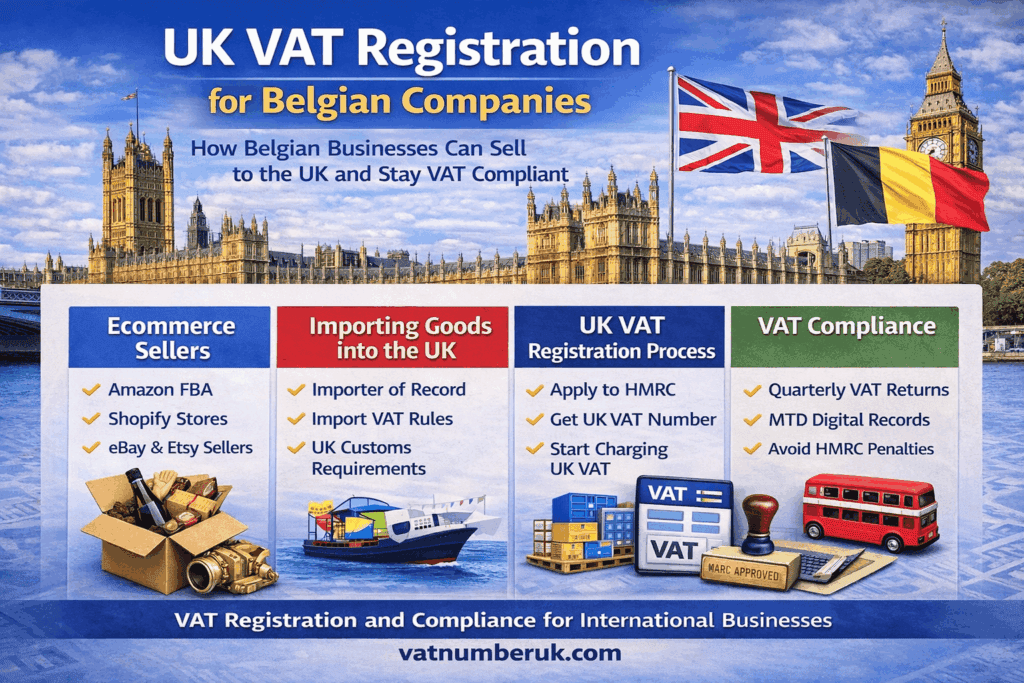
In practice, we see Belgian companies entering the UK market in several ways. Some sell directly to UK consumers through their own online stores. Others rely on marketplaces such as Amazon or eBay. Many ship goods to UK fulfilment centres so customers receive orders faster. In the manufacturing sector, Belgian exporters often establish UK distribution partners or import goods directly into the country.
As soon as a Belgian business begins trading with the UK, VAT rules quickly become relevant. Since the UK is no longer part of the EU VAT system, cross-border transactions are treated differently than before. This means that Belgian companies selling goods to the UK may need to register for UK VAT, sometimes even before the first sale takes place.
Understanding when UK VAT registration for Belgian companies is required — and how the process works — can prevent delays, compliance issues, and unexpected costs. This guide explains the most common situations we see when helping Belgian businesses enter the UK market.
Do Companies from Belgium Need UK VAT Registration?
In many cases, yes. Belgian companies selling goods to the UK often need a UK VAT number.
A key point that many business owners do not realise is that the UK VAT registration threshold generally does not apply to foreign businesses. While UK companies can trade up to a certain turnover before registering for VAT, non-UK businesses may need to register immediately once they begin making taxable supplies in the UK.
This situation typically arises when:
- goods are stored in the UK
- goods are imported into the UK under the company’s name
- inventory is held in UK fulfilment centres
- sales are made from stock already located in the UK
For example, imagine a Belgian ecommerce company selling premium kitchen accessories. The business decides to ship a pallet of products to a UK fulfilment warehouse to speed up deliveries. Once those goods are physically in the UK, any sale made to a UK customer becomes a domestic UK transaction, which means VAT must be charged and reported to HMRC.
Another common example involves Belgian distributors importing goods into the UK under their own company name. In this case, import VAT is usually paid at the border. Without a UK VAT registration, recovering that VAT can be difficult.
Because of these rules, many Belgian businesses apply for VAT registration before launching their UK sales operations.
Common Scenarios When Businesses from Belgium Must Register for UK VAT
Over the years, certain situations appear again and again when Belgian companies approach us for help with UK VAT registration. Below are some of the most common scenarios.
Storing Goods in UK Warehouses
If a Belgian company keeps inventory inside the United Kingdom, VAT registration is normally required.
From HMRC’s perspective, the goods are already in the UK when they are sold. This means the sale takes place within the UK VAT system.
Typical storage arrangements include:
- third-party logistics providers (3PL)
- UK distribution centres
- fulfilment services for ecommerce stores
- marketplace warehouses
Once goods are held in the UK, the Belgian company is considered to be making taxable supplies within the UK, which triggers the obligation to register for VAT.
Selling Through Amazon FBA
Amazon FBA is one of the most frequent reasons Belgian sellers need a UK VAT number.
Under the Fulfilment by Amazon (FBA) model, sellers send their inventory to Amazon warehouses in the UK. Amazon then handles storage, packing, and delivery to customers.
For instance, a Belgian business selling artisanal chocolate gift boxes may ship its stock to an Amazon fulfilment centre in the UK. When a UK customer places an order, the product is dispatched from within the country. From a VAT perspective, this becomes a domestic UK sale.
Because of this structure, Amazon sellers typically need to register VAT in the UK from Belgium before storing inventory in FBA warehouses.
Selling Through Ecommerce Platforms
Belgian online retailers often sell to UK customers through platforms such as:
- Shopify
- WooCommerce
- eBay
- Etsy
If products are shipped directly from Belgium to UK consumers, the VAT treatment can vary depending on the value of the goods and how the sale is structured.
In some cases, marketplaces may collect VAT at checkout. However, once sales volumes increase or goods are imported in bulk, sellers frequently need their own UK VAT registration.
Importing Goods into the UK
Another situation where VAT registration becomes necessary is when the Belgian company imports goods into the UK under its own name.
When a company acts as the importer of record, it becomes responsible for:
- paying import VAT
- ensuring VAT compliance for onward sales
To recover import VAT paid at the border, the business usually needs a valid UK VAT number.
For this reason, many Belgian exporters arrange VAT registration before their first shipment enters the UK.
UK VAT Rules for Ecommerce Sellers from Belgium
Ecommerce has become one of the main channels through which Belgian companies reach UK consumers. The VAT treatment can vary depending on the sales platform and fulfilment model.
Amazon
Many Belgian businesses sell on Amazon through:
- Amazon FBA (Fulfilment by Amazon)
- Amazon FBM (Fulfilled by Merchant)
When inventory is stored in UK warehouses under FBA, UK VAT registration for foreign companies is normally required. Amazon may also request a VAT number to ensure sellers comply with tax regulations.
Shopify
Shopify has become extremely popular among Belgian ecommerce brands, especially those selling directly to international customers.
At the beginning, some companies ship orders directly from Belgium to UK consumers. As demand grows, however, many businesses switch to UK fulfilment warehouses to improve delivery times and reduce shipping costs.
At that stage, UK VAT registration for Belgian companies usually becomes necessary.
eBay
Belgian sellers on eBay frequently sell products such as:
- refurbished electronics
- industrial spare parts
- collectibles
- specialist equipment
While eBay may handle VAT collection in certain low-value transactions, businesses with regular UK sales often require their own VAT registration.
Etsy
Belgium has a strong community of designers, craftspeople, and independent brands selling on Etsy.
Typical Belgian products sold through the platform include:
- handmade jewellery
- ceramics and pottery
- textiles and fashion accessories
- vintage design items
When Etsy sellers begin importing goods into the UK or shipping inventory to fulfilment centres, VAT registration requirements usually arise.
Unique VAT Considerations for Businesses from Belgium
Belgium has a highly developed export economy, and several industries are particularly active in selling products to the United Kingdom. These sectors often encounter UK VAT obligations when expanding into the British market.
Belgian Food and Beverage Exports
Belgium is globally recognised for its premium food products. Items such as Belgian chocolate, craft beer, gourmet biscuits, and speciality confectionery are widely exported to the UK.
Many producers initially sell through distributors, but increasingly they are launching direct-to-consumer ecommerce stores targeting British customers.
When these goods are imported into the UK in commercial quantities, the Belgian company typically needs UK VAT registration.
Design and Lifestyle Products
Belgian design brands have built a strong reputation internationally, particularly in sectors such as:
- furniture
- lighting
- interior design products
- fashion accessories
These products are often sold online and shipped to UK customers through fulfilment warehouses. As a result, VAT registration frequently becomes part of the expansion process.
Industrial and Manufacturing Goods
Belgium is also home to a large number of industrial exporters. Companies selling machinery components, chemicals, engineering parts, or construction materials often supply UK clients.
When these businesses import goods into the UK under their own company name or establish local distribution warehouses, UK VAT registration becomes necessary.
How Belgian Companies Typically Enter the UK Market
From our experience working with international clients, Belgian businesses usually enter the UK market through one of three routes:
- Direct ecommerce sales from Belgium to UK consumers
- UK fulfilment centres used to speed up delivery times
- Distribution partnerships with UK companies
Each approach has different VAT implications, which is why many businesses seek professional guidance before launching their UK operations.
How Businesses from Belgium Can Register for UK VAT
The UK VAT registration process for Belgian companies is relatively straightforward, but it requires careful preparation.
Step 1 – Determine VAT Obligation
First, the business must confirm whether UK VAT registration is required. This depends on factors such as:
- where goods are located
- who acts as the importer of record
- how sales are structured
- which ecommerce platforms are used
Step 2 – Prepare the VAT Application
The company then submits an application to HM Revenue & Customs (HMRC).
Foreign businesses usually register as non-UK established taxable persons (NETP).
Step 3 – Provide Supporting Information
HMRC requires documentation confirming the company’s identity and business activities.
Applications that are incomplete or inconsistent may lead to delays.
Step 4 – Receive the UK VAT Number
Once the application is approved, HMRC issues a UK VAT number. This allows the company to:
- charge VAT on UK sales
- submit VAT returns
- reclaim import VAT
- operate fully within the UK tax system
Documents Required for UK VAT Registration
Belgian businesses usually need to provide several documents during the VAT registration process.
Typical requirements include:
- company incorporation documents
- official company registry extract from Belgium
- passport or identification of company directors
- description of the business activities
- website or ecommerce platform details
- expected trading activity in the UK
HMRC may occasionally request additional documentation depending on the nature of the business.
Preparing these documents carefully can help avoid unnecessary delays.
How Long UK VAT Registration Takes
Processing times for UK VAT registration for Belgian companies can vary depending on the complexity of the application and HMRC’s current workload.
In most cases:
- straightforward applications take around 3–6 weeks
- more complex situations may take 6–8 weeks or longer
If HMRC asks for additional clarification or documentation, the timeline may extend.
For companies planning to store goods in UK warehouses or launch ecommerce operations, it is advisable to begin the VAT registration process before inventory is shipped to the UK.
UK VAT Compliance Requirements
Once a Belgian company obtains a UK VAT number, it must comply with ongoing tax obligations.
VAT Returns
Most businesses must submit quarterly VAT returns to HMRC.
These returns include details of:
- total sales
- VAT charged on sales
- VAT paid on purchases
- VAT owed or reclaimable
VAT Payments
If VAT is due to HMRC, payment must be made by the required deadline.
Late payments may result in interest charges or penalties.
Record Keeping
Businesses must maintain accurate financial records, including:
- invoices
- sales transactions
- import documentation
- VAT calculations
Under the Making Tax Digital (MTD) rules, many businesses must maintain digital VAT records and submit returns using compatible software.
Professional Help with UK VAT Registration
Navigating VAT rules in a foreign country can be challenging, particularly when ecommerce platforms, imports, and fulfilment logistics are involved.
VATNumberUK specialises in helping international businesses manage UK VAT registration for Belgian companies and ongoing VAT compliance.
Our team assists with:
- UK VAT registration for foreign companies
- VAT compliance for ecommerce sellers
- Amazon and Shopify VAT requirements
- import VAT and customs considerations
- ongoing VAT returns and reporting
We regularly work with Belgian companies entering the UK market and understand the practical issues they face — from warehouse logistics to HMRC documentation requirements.
If your company in Belgium plans to sell goods or services to customers in the United Kingdom, obtaining the correct VAT registration is an essential first step.
Contact VATNumberUK today to register VAT in the UK from Belgium and ensure your business remains fully compliant with UK VAT regulations.