Over the past few years, we have seen a noticeable increase in the number of companies from the Czech Republic selling to customers in the United Kingdom. For many Czech businesses, the UK is a natural next step after Germany, Austria, or other EU markets. The market is large, customers are used to buying online, and in many sectors UK prices are still attractive compared to Central Europe.
The Czech Republic has a very strong manufacturing and export base, and this is clearly reflected in the type of Czech businesses entering the UK market. We often work with Czech companies involved in automotive components, industrial equipment, glass and crystal products, cosmetics, engineering goods, hobby equipment, and speciality food products. Czech crystal, technical engineering products, and automotive parts in particular are well known internationally and regularly sold to UK customers either through distributors or directly online.
From a logistics point of view, the Czech Republic is well positioned for UK trade. Many companies ship pallets by road through Germany and the Netherlands or Belgium, and then into the UK via ferry or the Channel Tunnel. Once UK sales start to grow, many Czech companies decide to store stock in a UK fulfilment centre to reduce delivery times. This is usually the moment when UK VAT becomes relevant.
The important thing to understand is that UK VAT rules are completely separate from EU VAT rules. A Czech company can be fully VAT registered in the Czech Republic and still be required to register for UK VAT. This is something many businesses only discover after they start selling, which can create problems if not handled properly from the beginning.
This guide explains when UK VAT registration for Czech Republic companies is required, how the process works, and what ongoing obligations look like in practice.
Do Companies from Czech Republic Need UK VAT Registration?
This is one of the most common questions we receive from Czech clients. Many business owners assume that if they do not have a UK company or UK office, then they do not need to worry about UK VAT. Unfortunately, that is not how UK VAT works.
A foreign company can be required to register for UK VAT if it is making taxable supplies in the UK. In simple terms, this usually means selling goods that are located in the UK, importing goods into the UK, or storing goods in the UK and selling them to UK customers.
One important difference between UK companies and foreign companies is the VAT threshold. UK resident businesses have a VAT threshold, but non-resident businesses often have to register from the first sale if their activity creates a UK VAT obligation.
So, if you are running a Czech company and you are physically moving goods into the UK, storing goods in the UK, or selling goods that are delivered from within the UK, there is a very strong chance that you will need a UK VAT number.
This is why UK VAT for foreign companies is a very common requirement, especially for ecommerce and product-based businesses.
Common Scenarios When Businesses from Czech Republic Must Register for UK VAT
In practice, we see the same scenarios coming up again and again with Czech businesses entering the UK market.
Storing goods in UK warehouses
Many Czech companies start by shipping goods from the Czech Republic directly to UK customers. This works in the beginning, but once order volumes increase, delivery times become an issue. UK customers expect fast delivery, and returns are easier to handle locally, so businesses often move stock into a UK fulfilment warehouse.
For example, we worked with a Czech company producing designer lighting and glass interior products. They initially shipped each order from Brno directly to UK customers. After about a year, they moved stock to a fulfilment centre near Birmingham. At that point, UK VAT registration became mandatory because the goods were now located in the UK at the point of sale.
Amazon FBA in the UK
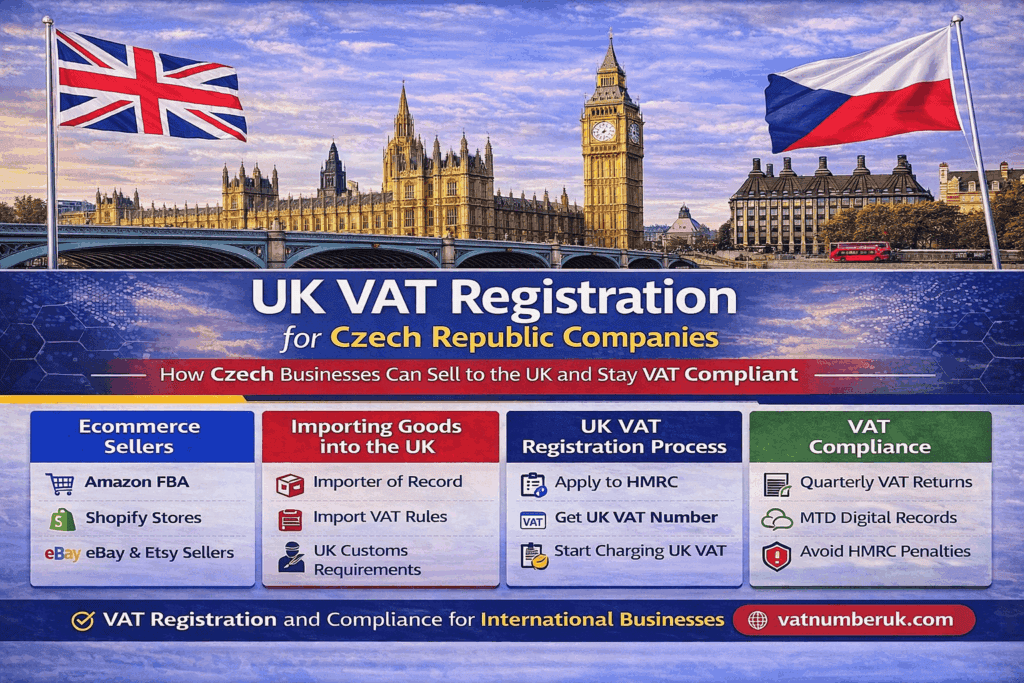
Amazon is very popular with Czech sellers, particularly those selling smaller items such as electronics accessories, car accessories, sports equipment, hobby products, and beauty products. If you use Amazon FBA and your goods are stored in an Amazon UK warehouse, then you will need a UK VAT number. This applies even if your company has no office or staff in the UK.
Importing goods into the UK
Another common situation is where a Czech company imports goods into the UK in its own name. This is very common for manufacturers of machinery, tools, spare parts, and technical equipment. The Czech company acts as the importer of record, pays import VAT, and then sells the goods to UK customers. In this case, UK VAT registration is normally required so that the company can recover import VAT and charge UK VAT on sales.
Ecommerce sales to UK customers
Many Czech Shopify, eBay, and Etsy sellers supply directly to UK consumers. The VAT position depends on where the goods are located and who is acting as importer. If goods are delivered from within the UK, VAT registration is required. If goods are shipped from the Czech Republic and the seller is responsible for importing the goods into the UK, VAT registration is also usually required.
UK VAT Rules for Ecommerce Sellers from Czech Republic
Ecommerce is probably the biggest driver of UK VAT registration for Czech Republic companies.
The platforms we most often see Czech sellers using are Amazon, Shopify, eBay, and Etsy. Each platform creates slightly different VAT implications depending on how goods are stored and delivered.
On Etsy, for example, we work with several Czech sellers of handmade products such as glass jewellery, wooden toys, puppets, ceramics, and art prints. These businesses often start by shipping individual parcels from the Czech Republic. Later, when UK orders become more frequent, they send bulk stock to a UK fulfilment partner. That is usually the point where UK VAT registration becomes necessary.
Shopify is often used by Czech brands selling natural cosmetics, skincare products, cycling equipment, pet accessories, and home design products. Many of these companies use UK third-party logistics providers so that delivery within the UK takes 1–2 days rather than a week. Again, once stock is stored in the UK, a UK VAT number is required.
Amazon FBA is the most straightforward case. If Amazon stores your goods in a UK warehouse, you need UK VAT registration. This is one of the most common situations where Czech companies need a VAT number UK.
So when we talk about UK VAT for ecommerce sellers, we are usually talking about stock being physically present in the UK, or the seller acting as the importer into the UK.
Unique VAT Considerations for Businesses from Czech Republic
Every country has slightly different trade patterns, and the Czech Republic is a good example of this. The structure of Czech exports has a direct impact on when UK VAT registration becomes necessary.
The Czech Republic is one of the most industrialised economies in Central Europe, with a very strong focus on manufacturing and engineering. The automotive industry is particularly important, with Czech companies producing a large volume of components, spare parts, and technical systems that are exported across Europe. We regularly see Czech automotive suppliers selling parts directly to UK garages, distributors, and specialist retailers. In many cases, these companies store spare parts in the UK so that UK customers can receive them quickly, which creates a UK VAT obligation.
Another sector where we frequently see UK VAT issues is Czech glass and crystal. Czech glass manufacturers often sell chandeliers, decorative glass, and tableware to UK interior designers, hotels, and private customers. These products are often shipped in bulk to the UK and stored locally before being delivered to customers, again creating a VAT registration requirement.
There is also a growing number of Czech ecommerce brands in cosmetics, health products, and specialist food products. The Czech Republic has a strong cosmetics manufacturing sector, and many smaller Czech brands sell natural skincare and beauty products abroad. These companies often start with cross-border shipping and then move to UK warehousing once sales increase.
In terms of logistics, Czech companies rarely ship directly by sea. Most goods move by truck through Germany and then to ports in the Netherlands or Belgium before arriving in the UK. Because of these consolidated shipments, many businesses import goods into the UK in bulk rather than shipping individual parcels. Importing in bulk is usually more efficient, but it almost always means the Czech company needs to register for UK VAT.
So, from a practical point of view, many Czech business models — bulk shipping, UK warehousing, Amazon FBA, and acting as importer — all lead to the same result: UK VAT registration becomes necessary.
How Businesses from Czech Republic Can Register for UK VAT
The UK VAT registration process for a Czech company is not complicated, but the application must be prepared properly. The biggest issue we see is that HMRC does not clearly understand what the business is doing, which leads to delays and additional questions.
The general process is as follows:
- Confirm that UK VAT registration is required.
- Review the supply chain and import structure.
- Prepare the VAT registration application.
- Submit the application to HMRC.
- Respond to any HMRC questions.
- Receive the VAT number UK.
- Set up accounting software for Making Tax Digital.
- Start filing VAT returns.
A Czech company can register as a non-resident business. There is no requirement to open a UK limited company in order to obtain a UK VAT number, although in some cases having a UK company can simplify operations.
Documents Required for UK VAT Registration
HMRC will usually request supporting documents to understand the business activity and confirm that the company genuinely needs UK VAT registration.
Typical documents include:
- Czech company registration extract
- Czech VAT certificate
- Passports of directors
- Proof of trading activity (website, Amazon store, Shopify store, contracts, invoices)
- Details of UK warehouse or fulfilment centre
- Import documentation if goods are imported into the UK
- Description of goods sold
- Estimated UK turnover
One of the most important parts of the application is a clear explanation of the business model. HMRC wants to understand where the goods are located, who imports them, and who sells them to the final customer.
How Long UK VAT Registration Takes
For Czech companies registering as non-resident businesses, the typical timeframe is between 4 and 8 weeks. However, in practice it depends on how clear the application is and whether HMRC asks additional questions.
If HMRC does not understand the supply chain, they will send questions, and this can extend the process. We have seen applications approved in around a month, and others that took two to three months because additional information was required.
Planning the VAT registration before you move stock into the UK is always the safest approach.
UK VAT Compliance Requirements
Once you receive your UK VAT number, there are ongoing compliance obligations.
These include:
VAT returns
Most businesses submit VAT returns every quarter. The return shows sales, purchases, import VAT, and the VAT payable to HMRC.
Paying VAT to HMRC
If you collect VAT from UK customers, you must pay this to HMRC, usually quarterly.
Making Tax Digital (MTD)
All VAT-registered businesses must keep digital records and submit VAT returns using compatible software.
Record keeping
You must keep proper records, including:
- Sales invoices
- Purchase invoices
- Import VAT certificates
- Shipping documents
- Bank statements
Good record keeping is very important, especially for ecommerce and import businesses.
Professional Help with UK VAT Registration
We regularly assist with UK VAT registration for Czech Republic companies, including ecommerce sellers, manufacturers, and exporters.
At VATNumberUK, we help Czech businesses:
- Register VAT UK from Czech Republic
- Obtain a VAT number UK
- Communicate with HMRC
- Structure import and VAT arrangements
- Set up VAT reporting
- Remain compliant with UK VAT rules
- Manage UK VAT for ecommerce sellers
- Handle UK VAT for foreign companies
If your company in the Czech Republic is planning to sell goods in the UK, store goods in a UK warehouse, use Amazon FBA, or import goods into the UK, it is very likely that you will need UK VAT registration.
If you are not sure whether you need UK VAT registration for Czech Republic companies, contact VATNumberUK and we will review your business model and guide you through the process step by step.