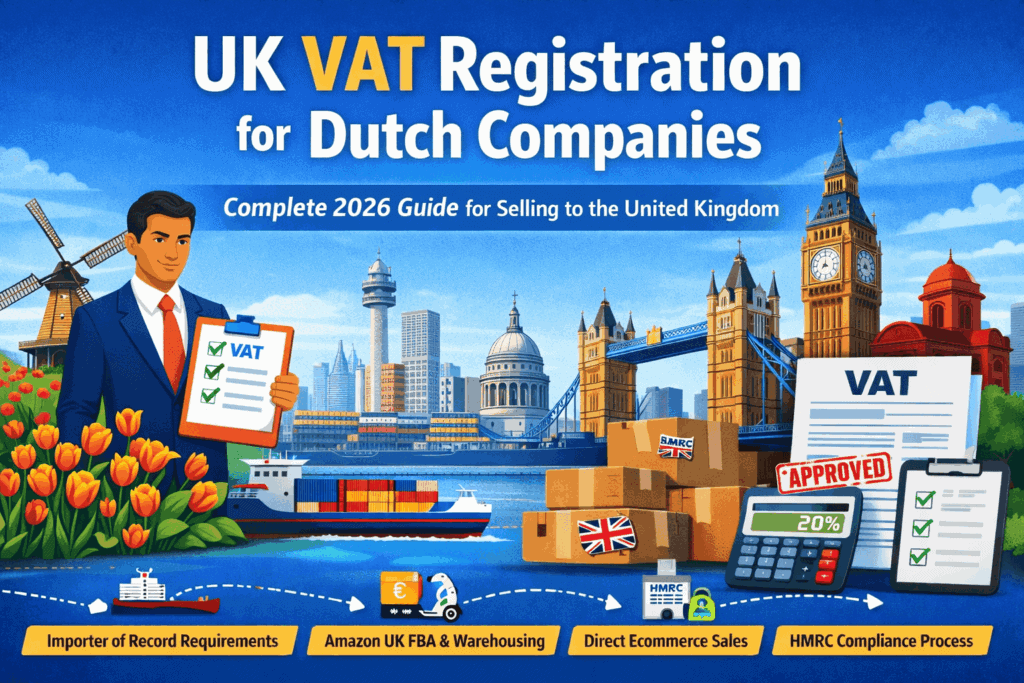
The Netherlands possesses one of the most internationally oriented economies in Europe, with Dutch companies serving as the backbone of EU-wide e-commerce, manufacturing, and distribution. For many firms in the Netherlands, the United Kingdom remains a vital trade partner and a high-priority export destination.
However, since the end of the Brexit transition period, the UK has operated as a third country for VAT purposes. This means that European Union intra-community supply rules no longer apply.
If your Dutch company engages in any of the following activities, you may be legally required to obtain a UK VAT registration:
• Exporting goods to the UK
• Importing goods into the UK
• Utilising Amazon UK FBA warehouses
• Maintaining inventory in UK fulfilment centres
• Acting as importer of record for customs purposes
• Direct-to-consumer sales to UK customers
This guide explains the 2026 triggers for mandatory VAT registration for Dutch companies, how the application process works, and how to structure compliance when expanding into the UK market.
Why Dutch Companies Often Require UK VAT Registration
Post-Brexit Trade Environment
The Netherlands functions as one of Europe’s most important logistics and distribution hubs. Many Dutch companies currently:
• Operate international ecommerce businesses
• Use Rotterdam as a global export gateway
• Supply goods to UK consumers through Amazon marketplaces
• Manage international distribution networks from Dutch warehouses
Since Brexit, trade between the Netherlands and the UK is no longer treated as intra-EU movement of goods. Instead, shipments now involve formal import and export procedures.
Importantly, your Dutch BTW number does not allow domestic trading inside the United Kingdom.
When Is UK VAT Registration Required?
UK VAT registration is usually required for Dutch companies when:
• Acting as importer of record for goods entering the UK
• Storing inventory inside UK warehouses
• Making domestic taxable supplies within the UK
• Structuring B2C ecommerce sales that require UK VAT collection
Unlike UK-based businesses, overseas companies generally do not benefit from the £90,000 VAT threshold.
In many cases, VAT obligations begin from the very first taxable transaction.
Scenario 1: Importing Goods into the UK
If your Dutch company imports goods into the UK and appears as the importer of record on customs declarations, VAT registration is usually mandatory.
This requirement applies even if:
• Your UK sales volume is still relatively small
• Your company does not have a physical UK office
• You sell exclusively through marketplaces like Amazon or eBay
Importing goods creates immediate UK VAT obligations.
Risks of Late Registration
Failing to register at the correct time may lead to:
• Retrospective VAT liabilities
• Financial penalties imposed by HMRC
• Interest charges on outstanding tax
These costs can significantly reduce profitability for exporters.
Scenario 2: Holding Stock in the UK
Many Dutch ecommerce businesses use UK logistics infrastructure to provide faster delivery to customers.
Typical fulfilment models include:
• Amazon UK FBA warehouses
• UK third-party logistics providers
• Local distribution hubs for ecommerce shipments
Inventory Stored in the UK
If goods are physically located in the UK at the moment they are sold, your company is making domestic taxable supplies.
Under 2026 rules, this normally requires VAT registration before inventory is even moved into the UK warehouse.
Marketplace VAT collection does not always remove your independent obligation to register if stock is stored locally.
Scenario 3: Direct Ecommerce Sales to UK Customers
Dutch online retailers shipping goods directly from the Netherlands must carefully structure their delivery model.
Important Operational Factors
• Delivery terms such as DDP or DAP
• Responsibility for import VAT at the UK border
• Customs declarations and documentation
• The £135 low-value consignment rule
If these elements are incorrectly structured, companies may face unexpected VAT liabilities and customs delays.
No UK VAT Threshold for Many Dutch Businesses
UK-based companies benefit from a VAT registration threshold of £90,000.
However, overseas businesses — including those based in the Netherlands — typically do not qualify for this threshold when they:
• Import goods into the UK
• Store stock in UK warehouses
• Make domestic taxable supplies
As a result, VAT registration may be required from the first transaction.
The UK VAT Registration Process for Dutch Companies
Obtaining a UK VAT number requires careful preparation and accurate documentation.
Step 1: Determine VAT Liability Date
Before submitting an application, your Dutch company must determine:
• The date when VAT registration became mandatory
• Whether retrospective registration is required
• Whether voluntary registration may be beneficial
Incorrect liability dates can lead to penalties for late notification.
Step 2: Prepare Your Documentation Pack
HMRC requires a full documentation package to verify overseas businesses.
Typical documents include:
• KvK extract from the Dutch Chamber of Commerce
• Articles of association (Statuten)
• Passport copies of company directors
• Proof of residential addresses
• Dutch BTW registration details
• Import documentation
• Logistics contracts with warehouses or Amazon
• Business bank statements
Providing complete documentation helps reduce processing delays.
Step 3: Submit the VAT Registration Application
Dutch companies apply as Non-Established Taxable Persons (NETPs).
This classification means that although the company trades in the UK, its headquarters remain overseas.
Processing Timelines
• Standard applications: 4–8 weeks
• Complex supply chains: up to 12 weeks
HMRC may request additional clarification about:
• Import structures
• Supply chain logistics
• Commercial trading activity
Step 4: Receive VAT Number and Begin Compliance
Once the application is approved, your Dutch company will receive a UK VAT number.
After registration, you must:
• Charge UK VAT on applicable sales
• Issue VAT-compliant invoices
• Submit quarterly VAT returns
• Maintain records using Making Tax Digital software
VAT Returns and Ongoing Compliance
After registration, Dutch companies must maintain full compliance with UK tax rules.
Core Compliance Duties
• Filing quarterly VAT returns
• Maintaining digital accounting records under MTD
• Retaining VAT documentation for six years
• Issuing compliant VAT invoices
Failure to comply may result in penalties or operational restrictions.
Reclaiming UK Import VAT
Once registered for VAT, Dutch companies can reclaim certain UK tax costs.
These include:
• Import VAT paid when goods enter the UK
• VAT on UK professional services
• VAT on fulfilment and logistics services
Recovering these expenses helps maintain strong profit margins.
Common Mistakes Dutch Companies Make
Assuming EU VAT Registration Is Enough
Many exporters mistakenly assume that a Dutch BTW number allows them to trade domestically in the UK.
However, UK VAT registration is separate from EU VAT rules.
Delaying VAT Registration
Waiting to register can lead to:
• Backdated VAT liabilities
• Financial penalties
• Interest charges
Incorrect Incoterms
Using DDP shipping terms without VAT registration can prevent companies from reclaiming import VAT.
Overreliance on Marketplaces
Even when marketplaces collect VAT, businesses storing inventory in the UK may still require their own VAT registration.
Strategic VAT Planning for Dutch Exporters
Before expanding operations in the UK, Dutch companies should:
• Analyse their logistics structure
• Confirm who acts as importer of record
• Review warehouse arrangements
• Identify the correct VAT liability date
• Register before scaling operations
• Implement compliant digital accounting systems
Proper planning significantly reduces compliance risks.
Should Dutch Companies Use a UK VAT Agent?
Many Dutch companies appoint a UK VAT specialist to manage compliance.
A VAT agent can:
• Handle VAT registration with HMRC
• Manage correspondence with tax authorities
• Prepare VAT returns
• Monitor compliance risks
Professional support helps ensure smooth expansion into the UK market.
UK VAT Registration Timeline
Typical timelines include:
• Standard registrations: 4–8 weeks
• Complex structures: up to 12 weeks
Applying early helps avoid delays with UK marketplaces and logistics providers.
The Strategic Value of Voluntary VAT Registration
Voluntary VAT registration may benefit Dutch exporters who want to:
• Reclaim import VAT earlier
• Improve credibility with UK partners
• Ensure ecommerce platforms operate smoothly
This strategy is commonly used by growing international brands.
UK VAT Compliance Checklist for Dutch Companies
Before trading with the UK, ensure your business has addressed:
• Import structure
• Warehouse arrangements
• VAT liability date
• Required documentation
• MTD-compatible accounting software
• Quarterly VAT reporting procedures
Conclusion
For Dutch companies trading with the United Kingdom, obtaining a UK VAT registration is often a mandatory requirement.
Since Brexit, EU VAT numbers no longer allow domestic trading in the UK. Businesses importing goods, storing inventory in UK warehouses, or acting as importer of record must generally register for VAT before conducting taxable transactions.
Understanding these obligations early allows Dutch companies to avoid penalties, reclaim import VAT, and build a compliant and efficient cross-border trading structure.