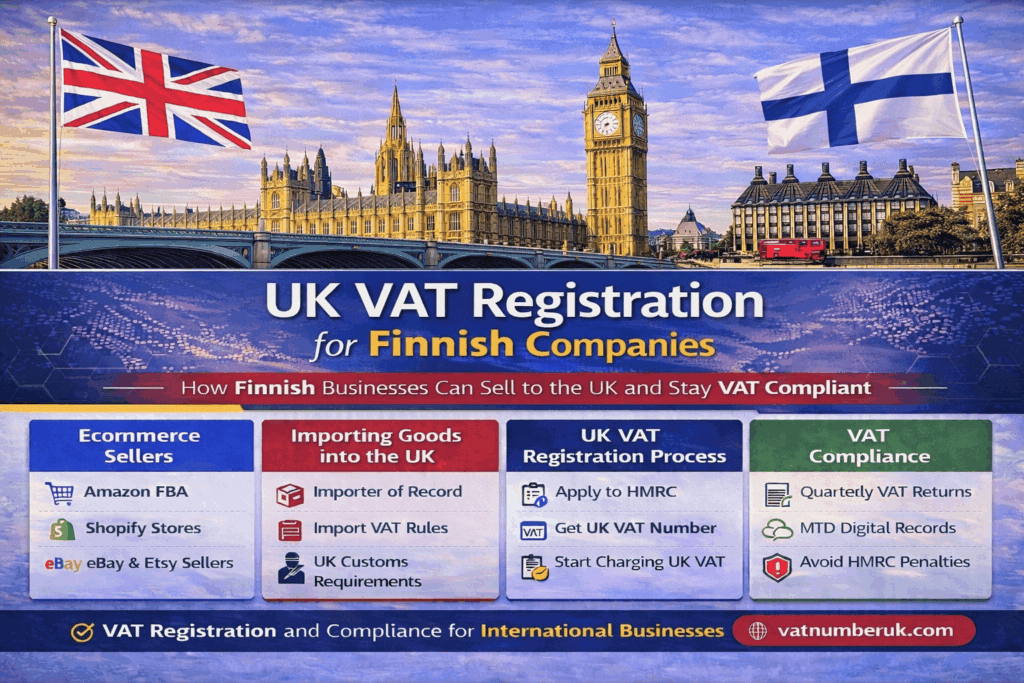
Over the past few years, I’ve seen a steady increase in Finnish companies entering the UK market. For many of them, the UK is a natural expansion step: the market is large, customers are used to buying online, and there is strong demand for high-quality imported products. Finnish businesses, in particular, tend to do well in the UK because Finnish products are associated with good design, durability, and sustainability.
A lot of the Finnish companies we work with are not just typical online sellers. Many are manufacturers or established brands in Finland that start selling to the UK either through Amazon, through a UK distributor, or through their own Shopify store. Common sectors include furniture and interior products, sauna and wellness equipment, outdoor and winter sports gear, sustainable clothing, natural cosmetics, and food products such as oat-based nutrition and speciality health foods. Finland has a strong food innovation sector, and products like oat drinks and health foods are increasingly visible in the UK market.
Logistics also plays a role. Finnish companies often ship goods directly from Finland to UK customers at first, but once sales grow, many move stock into UK fulfilment centres to reduce delivery times and shipping costs. Others import goods in bulk into the UK and then sell locally. These decisions are commercial decisions, but they have VAT consequences, and this is usually the point where companies realise they need UK VAT registration.
This guide explains when UK VAT registration for Finnish companies is required, how the process works, and what Finnish businesses should expect once they are VAT registered in the UK.
Do Companies from Finland Need UK VAT Registration?
One of the most common misunderstandings is that a company needs a UK office or a UK company before registering for UK VAT. That is not the case. A Finnish company can be required to register for UK VAT even if it has no physical presence in the UK at all.
The key question is not where the company is located, but where the goods are located and where the sale takes place for VAT purposes.
In practice, a Finnish business will usually need to register VAT UK from Finland if it is making taxable supplies in the UK. This includes situations where goods are imported into the UK, stored in the UK, or delivered to UK customers from within the UK.
It is also important to understand that the UK VAT threshold that applies to UK companies does not always apply in the same way to foreign companies. In many cases, once a Finnish company starts making taxable supplies in the UK, VAT registration is required from the start.
So even without a UK company, UK office, or UK staff, a Finnish business can still have a UK VAT obligation.
Common Scenarios When Businesses from Finland Must Register for UK VAT
In practice, there are several situations where Finnish companies typically need UK VAT registration. These are not theoretical scenarios — these are the exact situations we regularly see with Finnish clients.
Storing Goods in UK Warehouses
Many Finnish companies sell products that are large, heavy, or expensive to ship individually from Finland — for example furniture, sauna equipment, gym equipment, or interior design products. To make delivery faster and cheaper, they send goods in bulk to a UK warehouse and then ship to customers from within the UK.
Once goods are stored in the UK and sold to UK customers, the Finnish company is making a UK domestic supply and must register for UK VAT.
For example, a Finnish company selling sauna heaters and accessories might ship pallets of goods to a fulfilment centre in the Midlands and then deliver across the UK. From a VAT perspective, those sales are UK sales, and UK VAT registration is required.
Amazon FBA Fulfilment
Amazon FBA is probably the most common trigger for UK VAT registration for Finnish ecommerce sellers.
A typical scenario is a Finnish brand selling kitchen products, children’s products, wooden homeware, or fitness accessories. They send inventory to Amazon’s UK fulfilment centres so Amazon can deliver quickly to UK customers. The moment stock is stored in an Amazon warehouse in the UK, UK VAT registration is required.
Many companies only discover this after Amazon asks for a VAT number, by which point they are already late registering.
Importing Goods into the UK
Another common scenario is where a Finnish company imports goods into the UK in its own name and then sells those goods to UK customers or UK businesses.
This is very common for Finnish manufacturers of machinery parts, electronics, and specialist equipment. The company imports goods, pays import VAT, and then sells the goods in the UK. In order to recover the import VAT and sell goods correctly, the company must have a UK VAT number.
Ecommerce Sales Where the Seller Is the Importer
Some Finnish Shopify stores sell directly to UK consumers and arrange shipping so that they are the importer of record into the UK. In that case, the Finnish company is responsible for UK VAT and will usually need to register for UK VAT.
UK VAT Rules for Ecommerce Sellers from Finland
Finnish ecommerce companies use several main platforms to sell to UK customers, and the VAT treatment depends on how the goods are shipped and who is responsible for import.
The most common platforms are:
- Amazon
- Shopify
- eBay
- Etsy
Etsy is particularly popular with Finnish sellers offering handmade goods, Nordic design products, textiles, wooden items, and craft products, which are very popular with UK customers looking for Scandinavian design.
There are a few common structures we see:
Goods shipped from Finland directly to UK customers
If goods are shipped from Finland and the marketplace handles VAT collection at checkout under marketplace rules, the marketplace may account for VAT. However, the situation must be reviewed carefully because the VAT responsibility depends on who is acting as importer.
Goods imported in bulk and stored in the UK
This is very common for Finnish companies selling furniture, sports equipment, wellness products, and homeware. Once goods are in the UK, the Finnish company must register for UK VAT.
Amazon FBA in the UK
If Amazon stores goods in the UK, VAT registration is required immediately.
Etsy sellers storing stock in the UK
Some Finnish Etsy sellers with higher sales volumes store stock in UK fulfilment centres to speed up delivery. This also creates a VAT registration requirement.
For UK VAT for ecommerce sellers, the supply chain structure is everything. Two businesses selling the same product can have completely different VAT obligations depending on how their goods move.
Unique VAT Considerations for Businesses from Finland
Finnish companies are quite distinctive in the way they expand into the UK market, and this affects VAT.
Finland’s export economy is heavily focused on manufacturing, engineering, sustainable materials, and design products. Major Finnish export sectors include machinery, electrical equipment, paper and packaging materials, furniture, environmental technology, and speciality food products. Compared to many other countries, Finland exports a high proportion of engineered or designed products rather than mass-produced low-cost goods.
In practice, this leads to a few common UK expansion models.
First, many Finnish brands test the UK market using Amazon. This is especially common for consumer products such as kitchenware, fitness products, children’s products, and home items. They send a limited quantity of stock to Amazon FBA UK and see how the market responds. From a VAT perspective, this immediately creates a UK VAT registration requirement, even if the company has no UK presence otherwise.
Second, Finnish companies selling bulky or high-value products — for example furniture, sauna equipment, or gym equipment — often import goods in bulk into the UK and store them in a UK warehouse. Shipping these products individually from Finland would be too expensive, so a UK warehouse is the only commercially viable option. Again, this creates a UK VAT obligation.
Third, Finland has a strong sustainability and natural products sector. Finnish companies selling eco clothing, reusable household products, natural cosmetics, and health foods often sell through Shopify stores to UK customers and then move to UK fulfilment once sales increase.
Fourth, many Finnish engineering companies sell spare parts and components to UK businesses. They import parts into the UK and sell locally, which also requires UK VAT registration.
So while the VAT rules are the same, the way Finnish companies operate often means VAT registration becomes necessary quite early in the UK expansion process.
How Businesses from Finland Can Register for UK VAT
The UK VAT registration process for Finnish companies is relatively straightforward, but the application must match the actual business model. If the supply chain is described incorrectly, HMRC will ask questions and delays are very common.
The usual process looks like this:
- Review the business model and confirm that UK VAT registration is required
- Decide whether to register as a non-resident company or set up a UK Limited company
- Gather the required documents
- Submit the VAT registration application to HMRC
- Respond to any HMRC questions
- Receive the UK VAT number
- Register for Making Tax Digital
- Start submitting VAT returns
Most Finnish companies begin by registering as a non-resident VAT registered business, especially if they are testing the UK market first.
Documents Required for UK VAT Registration
HMRC will normally request documentation to prove that the Finnish company is a genuine business and that it is making or planning to make taxable supplies in the UK.
Typical documents include:
- Finnish company registration documents
- Extract from the Finnish Trade Register
- Articles of association
- Director ID documents
- Proof of trading activity
- Contracts with UK customers or UK distributors
- Amazon account or Shopify store evidence
- UK warehouse or fulfilment agreement
- Import documentation if goods are being imported
The clearer the documentation, the faster the registration process tends to be.
How Long UK VAT Registration Takes
In most cases, UK VAT registration for Finnish companies takes between 4 and 8 weeks. However, if HMRC asks additional questions — which often happens with foreign companies — the process can take 8 to 12 weeks or sometimes longer.
Timing is important. Ideally, Finnish companies should apply for UK VAT before shipping goods to the UK, especially if they will be importing goods in their own name.
UK VAT Compliance Requirements
Once a Finnish company has a UK VAT number, there are ongoing obligations that must be taken seriously.
VAT Returns
VAT returns are usually submitted every quarter. The return includes:
- Sales made in the UK
- VAT collected from customers
- Import VAT paid
- VAT on business expenses
- The final VAT payable or refundable amount
Record Keeping
HMRC requires companies to keep proper records, including:
- Sales invoices
- Purchase invoices
- Import and customs documents
- Shipping records
- Warehouse records
These records must normally be kept for at least six years.
Making Tax Digital (MTD)
All VAT-registered businesses must submit VAT returns using Making Tax Digital compatible software. This applies to UK VAT for foreign companies as well as UK companies.
Professional Help with UK VAT Registration
From experience, most problems do not happen because companies refuse to register for VAT. Problems happen because companies register too late, register incorrectly, or do not fully understand how their supply chain affects VAT.
We help Finnish companies at every stage:
- Assess whether UK VAT registration for Finnish companies is required
- Help companies register VAT UK from Finland
- Obtain a VAT number UK
- Set up Making Tax Digital
- Handle VAT returns and ongoing compliance
- Advise on the most efficient VAT structure for UK trade
If your Finnish company is selling to the UK, planning to use Amazon FBA, importing goods, or storing products in the UK, it is very likely that UK VAT registration will be required.
You can contact VATNumberUK and we will guide you through the process and make sure everything is set up correctly from the start.