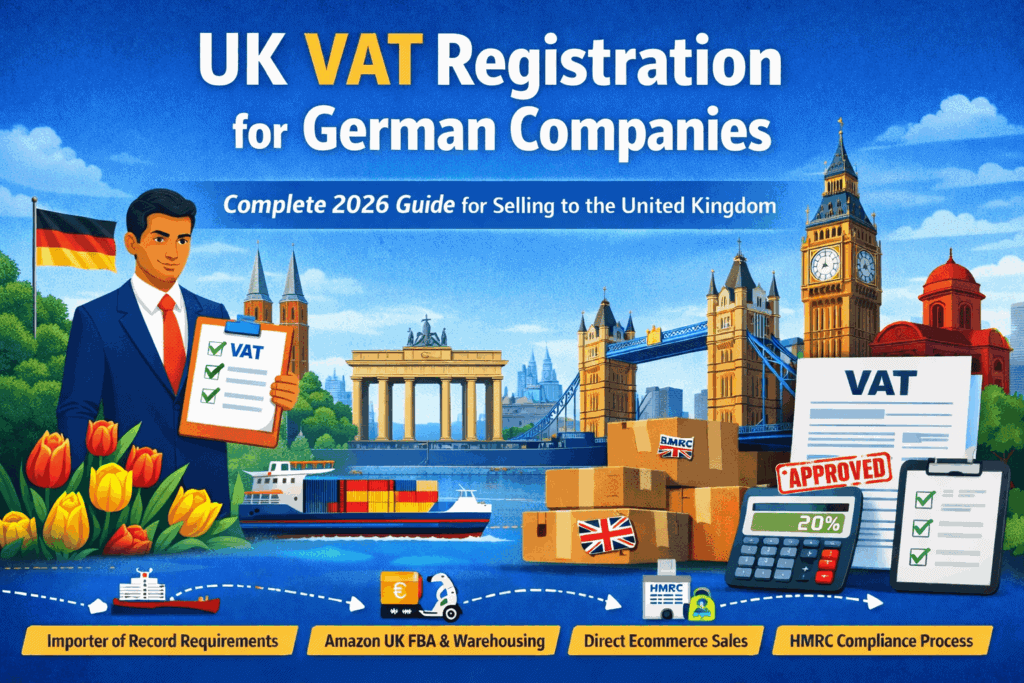
For many German enterprises, the United Kingdom remains a premier export destination. Even in the post-Brexit era, UK e-commerce, B2C retail, and international trade sectors continue to generate strong demand for products from German manufacturers, wholesalers, and digital retailers.
However, since the formal separation from the European Union, shipping from Germany to the UK is no longer treated as an intra-Community supply. The UK is now regarded as a third country for VAT purposes, which fundamentally changes the tax obligations of German exporters.
If your German company engages in any of the following activities, you may be legally required to obtain a UK VAT registration:
• Shipping goods to UK customers
• Using Amazon UK FBA
• Storing inventory in UK warehouses
• Importing goods into the UK
• Acting as importer of record
This guide explains when UK VAT registration becomes mandatory for German businesses, how the 2026 application process works, and how to avoid common compliance errors.
Why German Companies Often Need UK VAT Registration
Before Brexit, many German sellers relied on EU distance selling rules, which applied turnover thresholds before local VAT registration became necessary.
Post-Brexit VAT Position
That framework no longer applies to UK trade. Today, UK VAT rules operate independently from EU VAT law, and German businesses must treat the UK as a separate non-EU jurisdiction.
As a non-established taxable person, a German company is usually subject to a nil registration threshold in many common trading scenarios.
Common Registration Triggers
UK VAT registration is typically required if:
• You import goods into the UK
• You hold stock in UK warehouses
• You sell directly to UK consumers
• You use UK fulfilment services
• You act as importer of record for customs purposes
For many German ecommerce businesses, VAT registration becomes necessary from the first taxable supply in the United Kingdom.
Scenario 1: Importing Goods into the UK from Germany
If your German company exports products and acts as the importer of record in the UK, VAT registration is generally mandatory.
This applies even if:
• Your sales volume is still relatively low
• You sell through Amazon, Shopify, or other platforms
• You do not have a physical office in the UK
Importing goods creates an immediate taxable presence for VAT purposes.
Risks of Delayed Registration
If registration is delayed, HMRC may assess VAT retrospectively from the date goods first entered the UK market.
This can lead to:
• Backdated VAT liabilities
• Financial penalties
• Interest charges on unpaid tax
Late registration can significantly increase the cost of entering the UK market.
Scenario 2: Using Amazon FBA in the UK
Many German Amazon sellers use local UK fulfilment models to remain competitive.
Common Fulfilment Structures
These often include:
• Amazon UK FBA
• Multi-country inventory arrangements
• Cross-border stock movements into UK warehouses
If your goods are stored in a UK fulfilment centre, your business is generally making taxable supplies inside the United Kingdom.
Inventory in the UK Creates Local VAT Obligations
Under current rules, storing stock in the UK usually means you must register for UK VAT before inventory is placed in the warehouse.
A common misunderstanding is that Amazon collecting VAT at checkout removes the seller’s own registration requirement. In many cases, this is incorrect if the seller maintains local stock.
Scenario 3: Direct Ecommerce Sales to UK Customers
German businesses using Shopify, WooCommerce, or similar platforms to sell directly to UK buyers must carefully review their setup.
Key Factors to Review
Important issues include:
• Importer status
• Incoterms such as DDP or DAP
• The £135 consignment threshold
• Checkout VAT collection setup
If these sales are structured incorrectly, the business may face hidden VAT liabilities and customs delays.
No UK VAT Threshold for Many German Businesses
While UK-established businesses benefit from a domestic VAT threshold, German companies usually do not in many cross-border trading situations.
If your business imports goods into the UK or stores stock locally, VAT registration is often required from the very first transaction.
Why This Causes Confusion
Many EU sellers wrongly assume domestic thresholds apply internationally. However, for non-established taxable persons trading in the UK, the threshold is often effectively zero.
The UK VAT Registration Process for German Companies
Registering for UK VAT requires careful preparation and accurate documentation.
Step 1: Confirm VAT Liability Date
Before applying, your company must determine:
• The date UK VAT obligations first arose
• Whether retrospective registration is required
• Whether voluntary registration offers strategic advantages
Selecting the wrong liability date can trigger failure-to-notify penalties.
Step 2: Prepare Required Documentation
HMRC usually requests a detailed evidence pack to verify the German business.
Typical documents include:
• German company registration documents
• Articles of association
• Geschäftsführer identification and proof of address
• Handelsregister extract
• Proof of trading activity
• Logistics or warehouse agreements
• Import documentation
• Business bank statements
Complete and accurate documentation helps reduce delays.
Step 3: Submit the UK VAT Registration Application
German companies apply as Non-Established Taxable Persons (NETPs).
Typical 2026 Processing Timelines
• Standard applications: 4–8 weeks
• Complex structures: up to 12 weeks or more
HMRC may request clarification regarding:
• Supply chain structure
• Import arrangements
• Trading intent and UK commercial activity
Step 4: Receive VAT Number and Activate Compliance
Once the application is approved, your company must begin following UK VAT rules immediately.
This includes:
• Using the issued GB VAT number on invoices and platforms
• Charging the correct UK VAT rate where applicable
• Filing quarterly VAT returns
• Maintaining digital bookkeeping records
VAT Returns and Ongoing Obligations
After registration, German companies must comply with ongoing HMRC requirements.
Core Compliance Duties
These generally include:
• Submitting quarterly VAT returns
• Maintaining digital bookkeeping
• Using Making Tax Digital compatible software
• Retaining import and sales records for six years
• Issuing VAT-compliant invoices
Failure to meet these requirements can result in penalties and disrupt trading activity.
Can German Companies Reclaim UK Import VAT?
Yes, in most cases import VAT paid in the UK can be reclaimed if the German company is properly registered and compliant.
Why Registration Timing Matters
Correct timing is essential. If the business registers too late or structures imports incorrectly, VAT recovery may be delayed and working capital can be tied up unnecessarily.
Common Mistakes German Companies Make
Assuming EU VAT Covers the UK
Following Brexit, UK VAT is separate from EU VAT law. A German USt-IdNr does not replace a UK VAT registration for domestic UK taxable activity.
Delaying Registration
Late registration can result in:
• Backdated VAT
• Interest charges
• Financial penalties
Misunderstanding Importer Status
If your company uses DDP terms and acts as importer without proper VAT planning, import VAT may become an unrecoverable cost.
Relying Entirely on Amazon
Marketplace VAT handling does not always remove the need for an independent UK VAT registration if stock is stored locally or taxable supplies are made in the UK.
Strategic VAT Planning for German Exporters
Before scaling operations in the UK, German businesses should review their structure carefully.
Key Planning Steps
• Review the logistics model
• Confirm importer of record status
• Assess stock location
• Determine the VAT liability date
• Register before scaling sales
• Implement MTD-ready accounting systems
Proper planning reduces cash flow disruption and compliance risk.
When Should a German Company Use a UK VAT Agent?
Many German businesses appoint a specialist VAT agent to manage the UK registration and filing process.
Why Professional Support Helps
A VAT specialist can assist with:
• Registration management
• HMRC correspondence
• Quarterly VAT returns
• Ongoing compliance monitoring
• Reducing exposure to penalties
This is especially useful where the supply chain is complex or the business uses Amazon FBA or UK warehouses.
How Long Does Registration Take?
The timing depends on how straightforward the business structure is and how complete the documentation is.
Typical Timeframes
• Standard cases: 4–8 weeks
• Complex supply chains: 8–12 weeks
Applying early helps prevent commercial delays with warehouses, marketplaces, and shipments.
Voluntary VAT Registration for German Companies
In some cases, voluntary VAT registration can be commercially useful.
Potential Benefits
• Reclaiming import VAT earlier
• Strengthening credibility with UK partners
• Simplifying marketplace onboarding and compliance
The decision should be based on expected trading activity and administrative costs.
UK VAT Compliance Checklist for German Businesses
Before launching UK sales, make sure your business has reviewed the following:
• Import structure
• Stock location
• VAT liability date
• Required documentation
• Digital accounting readiness
• Quarterly VAT return obligations
A proper checklist helps avoid mistakes during market entry.
Conclusion
For German companies trading with the United Kingdom, UK VAT registration is often a legal requirement rather than a strategic option.
Since Brexit, the tax treatment of EU exporters has changed substantially, and many of the thresholds and simplifications that once applied are no longer relevant for UK trade. Importing goods, storing stock in UK warehouses, and acting as importer of record can all create an immediate obligation to register.
Securing UK VAT registration early helps German businesses avoid penalties, recover eligible import VAT, and build a compliant structure for long-term commercial success in the UK market.