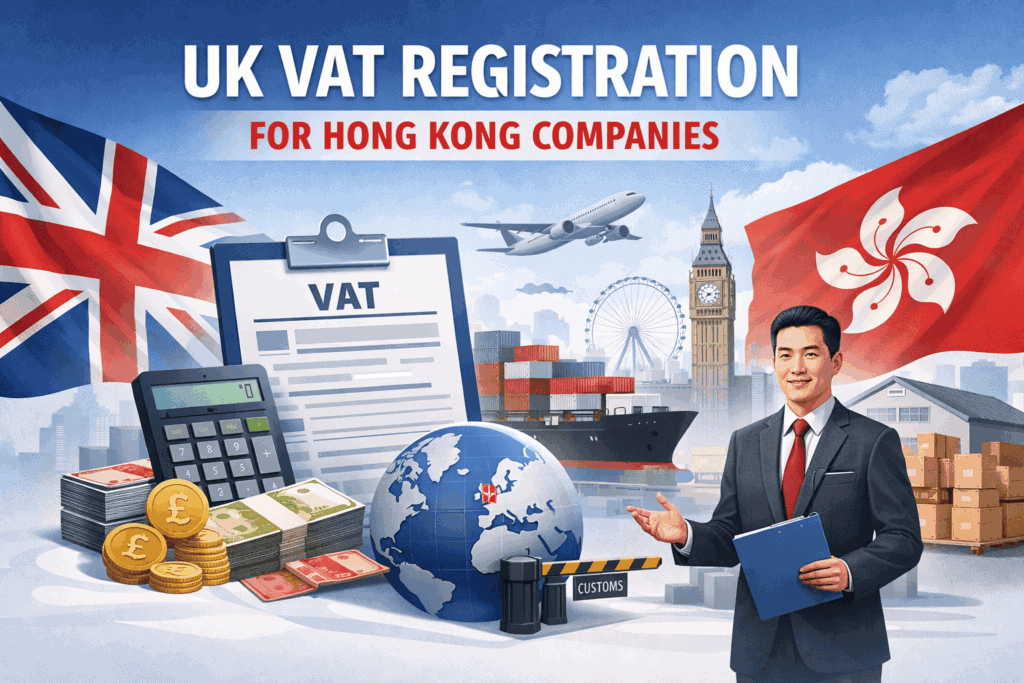
Hong Kong has always played a central role in international trade. Thousands of companies use it as a base for exporting products worldwide — from electronics and consumer goods to fashion, homeware, and technology products. For many of these businesses, the United Kingdom represents a particularly attractive market.
The UK offers a large consumer base, strong purchasing power, well-developed logistics infrastructure, and easy access to global marketplaces such as Amazon. It is therefore common to see Hong Kong brands selling directly to UK customers through e-commerce websites, international distributors, or fulfilment platforms.
However, once a Hong Kong company begins trading in the UK market, tax obligations can arise much earlier than many entrepreneurs expect. One of the most frequent issues international businesses encounter is the requirement to obtain a UK VAT number.
In our experience assisting overseas companies, many business owners only become aware of this requirement after their first shipment arrives in the UK. In other cases, the issue appears when Amazon requests a VAT number before allowing the seller to continue using UK fulfilment centres.
A common misconception is that VAT rules in the UK still operate under the same framework as the European Union. Since Brexit, this is no longer the case. The UK now operates an independent VAT regime, and overseas businesses often need to register for VAT far earlier than they would in the EU.
This guide explains when UK VAT registration for Hong Kong companies becomes necessary, how the process works in practice, and what international businesses should consider before entering the UK market.
What Is UK VAT Registration?
VAT stands for Value Added Tax, a consumption tax applied to most goods and services sold in the United Kingdom. Businesses that are registered for VAT charge this tax on their sales and then report it to HM Revenue & Customs (HMRC).
When a company registers for VAT in the UK, HMRC issues a UK VAT number. This number allows the business to operate properly within the UK tax system and perform several essential functions.
A VAT-registered business can:
- charge VAT on taxable sales made in the UK
- reclaim VAT paid on imports and business expenses
- submit periodic VAT returns to HMRC
- trade legally with UK customers and suppliers
For companies based in the UK, VAT registration generally becomes mandatory once annual taxable turnover exceeds a specific threshold. Many entrepreneurs assume that the same rule applies to international businesses.
In reality, the rules for non-UK companies are very different.
For overseas businesses — including companies registered in Hong Kong — VAT registration can become mandatory before any sales occur if certain activities take place within the United Kingdom.
In practice, this catches many international sellers by surprise. They often assume that VAT registration is only necessary once the business reaches a certain level of sales. Unfortunately, that assumption can lead to compliance problems later.
When Businesses Need UK VAT Registration
For Hong Kong companies, the obligation to register for UK VAT is usually linked to the way goods enter the British market and how they are supplied to customers.
A typical situation arises when a company imports products into the United Kingdom and sells them locally. Once goods become part of the UK supply chain, VAT registration is usually required.
Another important factor is where the goods are stored. If inventory is physically located in the UK — for example in a warehouse or fulfilment centre — the business is considered to be making taxable supplies within the country.
Unlike UK resident businesses, overseas companies often do not benefit from the VAT registration threshold when they import goods or store inventory in the UK.
Many companies only discover this requirement at a late stage. For example:
- a shipment arrives at a UK port and customs requests a VAT number
- an Amazon account is restricted due to missing VAT details
- a logistics provider asks for VAT registration before releasing inventory
These situations can create significant delays in supply chains and marketplace operations. For this reason, it is usually advisable to review VAT obligations before launching UK sales.
Who Typically Needs It
Certain types of Hong Kong businesses frequently require VAT registration when expanding into the UK market.
The most common examples include international e-commerce sellers, Amazon marketplace merchants, importers, and companies distributing goods through UK warehouses.
E-commerce brands
Many Hong Kong brands sell directly to British consumers through their own online stores. Platforms such as Shopify or WooCommerce make it relatively easy to reach UK customers, but the underlying tax obligations still apply.
If the goods are imported into the UK under the company’s name, VAT registration is typically required.
Amazon FBA sellers
Amazon’s fulfilment network is one of the most common reasons Hong Kong companies need a UK VAT number.
When inventory is stored in Amazon UK warehouses through the Fulfilment by Amazon (FBA) programme, the seller is considered to be holding stock within the United Kingdom. At that point, VAT registration becomes mandatory.
Importers and distributors
Some Hong Kong companies operate as international wholesalers, supplying products to UK retailers or distributors.
If the company imports the goods directly into the UK and acts as importer of record, VAT registration is usually required in order to reclaim import VAT and account for sales correctly.
Manufacturers selling directly to UK customers
Manufacturers sometimes bypass distributors and sell directly to British customers or businesses. When the manufacturer controls the logistics chain and imports goods under its own entity, VAT registration is generally necessary.
Technology and SaaS companies
Although less common, some Hong Kong technology businesses supplying digital services to UK customers may also need VAT registration depending on the type of service and the customer base.
Common Situations That Trigger This Requirement
Several practical scenarios regularly trigger VAT registration requirements for overseas companies. These situations arise frequently in international trade and e-commerce.
Understanding them early can prevent complications once the business begins operating in the UK.
Importing goods into the UK
One of the most common triggers occurs when goods are imported into the United Kingdom.
If the Hong Kong company is listed as the importer of record, import VAT becomes payable at the UK border. To reclaim that VAT and account for subsequent sales properly, the business generally needs a UK VAT registration.
Storing inventory in UK warehouses
The moment goods are stored in the UK, the business is considered to be making local supplies.
This situation often arises when companies use:
- Amazon FBA fulfilment centres
- third-party logistics providers (3PL warehouses)
- private UK distribution warehouses
Once inventory is physically located in the country, VAT registration is usually unavoidable.
Selling through Amazon UK
Many international sellers first encounter VAT requirements through Amazon.
Amazon increasingly requires marketplace sellers to provide valid VAT numbers when they store goods in UK fulfilment centres. Without VAT registration, the seller may face restrictions on their account or limitations on inventory storage.
Direct sales to UK consumers
Some Hong Kong businesses ship goods directly to UK consumers from overseas warehouses. Depending on the shipping structure and import arrangements, VAT registration may still be required.
Acting as importer of record
Companies that want full control over their logistics chain often import goods into the UK under their own name. In these cases, VAT registration almost always becomes necessary.
Step-by-Step Process
The VAT registration process for overseas businesses is relatively straightforward, although the details of the application require careful preparation.
Clear documentation and a well-explained business model help HMRC understand how the company operates in the UK market.
Step 1 — Confirm the VAT obligation
The first step is determining whether VAT registration is actually required.
This typically involves reviewing:
- how goods enter the UK
- who acts as importer of record
- whether inventory is stored in UK warehouses
- how products are sold to UK customers
In most cases, an experienced VAT adviser can identify the obligation quickly once the supply chain is explained.
Step 2 — Prepare and submit the VAT application
Once the requirement is confirmed, the VAT registration application is prepared and submitted to HMRC.
The application includes details about the company and its business activities, including:
- company registration information
- director identification documents
- nature of the business activities
- expected UK turnover
- supply chain and logistics arrangements
Providing clear explanations of how the company imports, stores, and sells goods often speeds up the review process.
Step 3 — VAT number issuance and compliance setup
After HMRC reviews the application, a UK VAT number is issued.
From that point onward, the business must operate within the UK VAT system. This includes:
- charging VAT where applicable
- issuing compliant VAT invoices
- submitting VAT returns to HMRC
- maintaining proper VAT accounting records
For many international businesses, ongoing VAT compliance becomes an important part of their UK operations.
Documents Required
When overseas businesses apply for UK VAT registration, HMRC usually requests documentation confirming the company’s identity and trading activities.
Typical documents include:
- Certificate of Incorporation of the Hong Kong company
- Hong Kong Business Registration Certificate
- passport copies of company directors
- proof of business activities
- supplier or marketplace agreements
- logistics or warehouse contracts
- company website or product listings
In certain cases, HMRC may request additional information to understand the supply chain.
For example, Amazon sellers are often asked to provide evidence of their Amazon Seller Central account or documentation confirming that inventory will be stored in UK fulfilment centres.
Common Mistakes Businesses Make
Over the years we have seen several recurring mistakes made by international companies entering the UK market.
Many of these issues arise simply because business owners are unfamiliar with the way VAT rules apply to overseas sellers.
One of the most common misunderstandings is assuming that VAT registration only becomes necessary after reaching a turnover threshold. While this is true for UK companies, overseas businesses importing goods into the UK generally must register immediately.
Another frequent issue is late registration. Some companies only apply for VAT after they have already started selling in the UK. This can lead to retrospective tax obligations.
We also see problems when the logistics structure is set up incorrectly. If goods are imported under the wrong entity or if the importer of record is unclear, reclaiming import VAT can become difficult.
Marketplace compliance is another area where issues arise. Platforms such as Amazon are increasingly strict about VAT compliance, and sellers without valid VAT numbers may find their accounts restricted.
Finally, incomplete applications can slow down the registration process significantly. Missing documents or unclear explanations of the supply chain often lead to additional questions from HMRC.
Risks and Penalties
Operating in the UK without the required VAT registration can create both financial and operational risks.
HMRC has the authority to assess VAT retrospectively if they determine that a business should have registered earlier. In such cases, the company may be required to pay VAT on past sales even if it was never collected from customers.
This can have a significant financial impact, particularly for businesses operating with tight margins.
Additional consequences may include:
- financial penalties
- interest charges on unpaid VAT
- delays in customs clearance
- restrictions on marketplace accounts
- disruption to supply chains
For companies relying heavily on Amazon or other fulfilment providers, VAT compliance is often necessary to keep operations running smoothly.
How Professional VAT Assistance Helps
For companies based outside the UK, navigating VAT requirements can feel unnecessarily complicated. The rules themselves are not particularly complex, but understanding how they apply to international supply chains requires experience.
Professional VAT advisers typically assist with:
- determining whether VAT registration is required
- reviewing the supply chain structure
- preparing and submitting the VAT registration application
- communicating with HMRC if further information is requested
- establishing ongoing VAT compliance procedures
In practice, working with specialists often speeds up the registration process and helps businesses avoid costly mistakes.
For Hong Kong companies entering the UK market for the first time, this support can make expansion far smoother.
FAQ
Do Hong Kong companies need to register for UK VAT?
Yes. If a Hong Kong company imports goods into the UK, stores inventory in UK warehouses, or sells goods locally, VAT registration is usually required.
Is there a VAT threshold for overseas companies?
In many situations there is no threshold. Overseas businesses importing goods or storing inventory in the UK typically need to register for VAT immediately.
How long does UK VAT registration take?
The process normally takes several weeks, although processing times can vary depending on HMRC workload and the complexity of the application.
Can Hong Kong companies reclaim import VAT?
Yes. Once registered for UK VAT, businesses can generally reclaim import VAT paid when goods enter the UK.
Do Amazon sellers need UK VAT registration?
If inventory is stored in Amazon UK fulfilment centres, VAT registration is typically required.
Do Hong Kong SaaS companies need UK VAT registration?
This depends on the nature of the services and the type of customers. Some digital services supplied to UK consumers may require VAT registration.
If your Hong Kong company plans to sell goods or services in the United Kingdom, reviewing VAT obligations early can prevent costly disruptions later.
Many international businesses prefer to work with specialists who regularly assist overseas companies with UK VAT registration and compliance, ensuring the process runs smoothly from the initial application through ongoing VAT reporting.