For businesses headquartered outside the European Union, entering the UK market requires an immediate understanding of UK VAT requirements. International vendors often fail to realise how swiftly these obligations arise — frequently from the very first transaction with a UK customer.
This guide explains when non-EU companies must obtain a UK VAT number, outlines the regulatory framework for international sellers, and details the essential steps required to remain compliant within the UK.
Who Is Considered a Non-EU Company for UK VAT?
According to HM Revenue & Customs (HMRC), a non-EU company is any business established outside both the United Kingdom and the European Union.
This includes organisations based in:
- United States
- Canada
- China
- Hong Kong
- Singapore
- Australia
- UAE
- India
- Other non-EU jurisdictions
From a UK VAT perspective, these businesses are classified as Non-Established Taxable Persons (NETPs).
What Is a NETP?
A Non-Established Taxable Person is a company that does not have a fixed establishment in the UK but makes taxable supplies there.
Why NETP Status Matters
Unlike UK businesses, NETPs do not benefit from a VAT registration threshold. Registration is typically required from the first taxable transaction.
Do Non-EU Companies Need UK VAT Registration?
In most cases — yes, and immediately.
You are required to register if you:
- Store inventory in the UK
- Use UK fulfilment services (Amazon FBA, local warehouses)
- Import goods into the UK
- Sell goods already located in the UK
- Act as importer of record
- Make taxable supplies where the UK is the place of supply
Even a single qualifying transaction may trigger mandatory registration.
Why UK VAT Rules Are Strict for Non-EU Businesses
HMRC applies enhanced scrutiny to overseas applicants due to:
- Jurisdictional enforcement complexity
- Import VAT and customs integration risks
- Increased compliance exposure
- Global logistics verification challenges
As a result, non-EU applications often face:
- Longer review timelines
- Detailed documentation requests
- Increased risk of rejection if information is inconsistent
Common Scenarios Triggering UK VAT for Non-EU Companies
Importing Goods into the UK
If your business clears goods under its own name, VAT registration is required to reclaim import VAT and trade legally.
Holding Stock in UK Warehouses
Even short-term storage creates a taxable presence and immediate registration obligations.
Selling via Online Marketplaces
Platforms like Amazon or eBay may collect VAT on certain transactions, but this does not automatically remove your registration obligation.
Working with UK Logistics Providers
Using third-party fulfilment or 3PL providers frequently creates VAT exposure that overseas sellers overlook.
Selling to the UK Without Holding UK Stock
If goods are dispatched directly from overseas warehouses, VAT treatment depends on:
- Order value
- Import model used
- Importer of record
- Sales channel
Incorrect handling of these variables is a leading cause of VAT non-compliance.
UK VAT Registration Requirements for Non-EU Companies
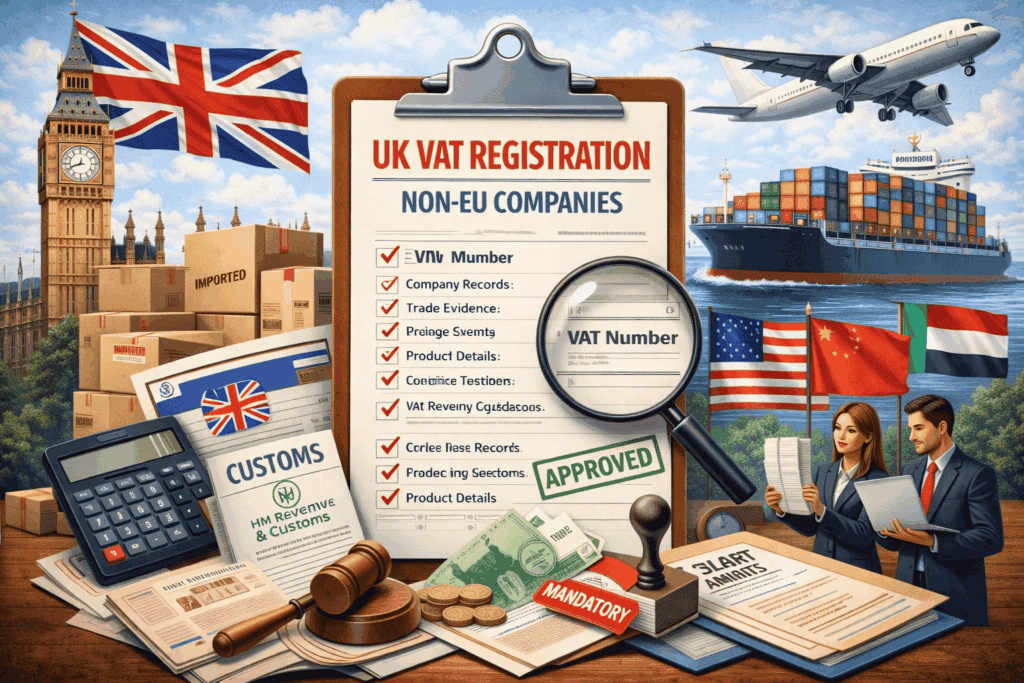
HMRC requires comprehensive documentation, including:
- Certified company incorporation documents
- Proof of active overseas trading
- Detailed product descriptions
- Supply chain explanation
- Projected UK revenue figures
- Verified ID for directors and shareholders
Additional Risk Review
HMRC may evaluate:
- Commercial substance
- Import structure legitimacy
- Risk profile of the applicant
Incomplete applications commonly result in delays.
How Long Does UK VAT Registration Take?
Estimated timelines:
- Standard cases: 4–8 weeks
- Complex logistics: Longer processing
- Incomplete applications: Significant delays
Non-EU applications typically require enhanced compliance checks.
UK VAT Rates Applicable to Non-EU Companies
The UK operates three primary VAT rates:
20% Standard Rate
Applies to most goods and services.
5% Reduced Rate
Energy-saving materials and specific qualifying items.
0% Zero Rate
Food, books, children’s clothing (with defined exceptions).
Incorrect rate application frequently results in backdated liabilities.
VAT Returns and Ongoing Compliance Obligations
Once registered, non-EU companies must comply with Making Tax Digital (MTD) rules.
Ongoing responsibilities include:
- Quarterly VAT submissions
- Accurate VAT collection
- Six-year digital record retention
- Timely electronic payments
Nil Returns
Even with zero sales, VAT returns must be filed. Failure to do so can trigger automatic penalties under the current points-based system.
Common VAT Mistakes Made by Non-EU Companies
- Late registration
- Assuming marketplaces handle all VAT
- Misunderstanding import VAT recovery
- Applying incorrect VAT rates
- Ignoring HMRC correspondence
- Skipping nil returns
These errors frequently lead to assessments, penalties, and interest charges.
Do Non-EU Companies Need a UK VAT Agent?
While not always legally mandatory, appointing a VAT agent is strongly recommended.
A VAT specialist can assist with:
- Correct NETP registration
- Supply chain VAT structuring
- HMRC communication
- MTD-compliant return submissions
- Ongoing compliance monitoring
For international businesses unfamiliar with UK tax rules, professional support significantly reduces risk.
Scaling UK VAT Compliance as Your Business Grows
As UK sales increase, VAT complexity expands.
Growth typically requires:
- More advanced digital record systems
- Stronger compliance controls
- Enhanced audit readiness
- Ongoing VAT optimisation planning
Early compliance integration ensures uninterrupted expansion.
Expanding into the UK as a Non-EU Company
The UK remains a premier market for international enterprises. Strategic VAT planning allows businesses to:
- Enter the market fully compliant
- Avoid historical tax exposure
- Scale with predictable net margins
- Protect logistics channels from disruption
VAT compliance should be treated as a core operational pillar, not an afterthought.
Get Professional Support with UK VAT Registration
Incorrect registration or delayed filing can lead to:
- Financial penalties
- Import delays
- Frozen marketplace accounts
- Reputational risk
Professional VAT services help international businesses:
- Register correctly from the first attempt
- Maintain compliance with 2026 digital filing rules
- Avoid penalties
- Focus on business growth while experts manage tax exposure