Over the past few years, I’ve been working with more and more companies from Pakistan that are selling directly to customers in the United Kingdom. For many Pakistani businesses, the UK is a familiar and accessible market. There is strong demand for Pakistani textiles, clothing, leather goods, sports equipment, and increasingly for online services and software developed by Pakistani IT companies. On top of that, the UK has a large Pakistani community, which often becomes the first customer base for new brands entering the market.
Pakistan’s export economy is heavily built around textiles and garments, which make up a large share of the country’s exports. Cities like Faisalabad are known for bed linen and towels, Sialkot is famous for sports goods and surgical instruments, and Karachi and Lahore are major hubs for clothing manufacturing and ecommerce businesses. Many of these companies used to work only as wholesalers, supplying UK importers. Now the model is changing. More Pakistani businesses are selling directly to UK customers through Amazon, Shopify, and their own websites. When that happens, UK VAT becomes their responsibility, not the UK importer’s.
This is where many businesses get into trouble, not because they want to avoid tax, but because they simply don’t realise that they may need UK VAT registration for Pakistan companies even without a UK office or UK company. UK VAT rules for foreign companies are very specific, especially for ecommerce sellers, Amazon FBA users, and companies importing goods into the UK.
If your business is based in Pakistan and you sell goods or services to the UK, you need to understand when you must register VAT UK from Pakistan, how the process works, and what HMRC expects from you after registration.
Do Companies from Pakistan Need UK VAT Registration?
This is one of the first questions clients ask, and the answer is often yes.
Many Pakistani business owners assume that VAT only applies to UK companies or that they only need to register if their sales exceed the UK VAT threshold. That rule generally applies to UK-established businesses, but it usually does not apply to foreign companies.
If your company is based in Pakistan and you:
- import goods into the UK,
- store goods in the UK,
- sell through Amazon FBA in the UK,
- use a UK fulfilment warehouse,
- or in some cases sell directly to UK consumers,
you may be required to register for UK VAT even if your sales are relatively small.
In many cases, foreign companies must register for VAT before they start selling, because there is no VAT threshold for non-UK established businesses in certain situations.
So when we talk about UK VAT for foreign companies, the key question is not where your company is registered, but where your goods are located and where the import takes place.
Common Scenarios When Businesses from Pakistan Must Register for UK VAT
Let me go through some typical situations I see with Pakistani clients, because this is where VAT registration usually becomes necessary.
Importing Goods from Pakistan into the UK
A very common scenario is a Pakistani manufacturer exporting goods to the UK and selling directly to customers rather than to a UK wholesaler. This is very common in textiles, leather products, and home goods.
For example, a company in Faisalabad producing bed sheets and towels may start selling directly to UK customers through its website. The company ships goods in bulk to the UK and acts as the importer of record. In this case, import VAT is charged at the UK border. Without UK VAT registration, the company cannot reclaim that import VAT, which becomes a real cost. With VAT registration, the import VAT can usually be reclaimed on the VAT return.
This is one of the main reasons exporters decide to apply for a VAT number UK.
Amazon FBA in the UK
This is probably the most common case today.
Many Pakistani businesses, especially from Sialkot and Lahore, sell products like sports equipment, gym accessories, clothing, and small consumer goods through Amazon UK. They send stock from Pakistan directly to Amazon fulfilment centres in the UK.
The moment your goods are stored in a UK Amazon warehouse, UK VAT registration is mandatory. It does not matter that your company is in Pakistan. It does not matter that Amazon collects some VAT. If your stock is physically in the UK, you must be VAT registered and submit VAT returns.
Shopify Stores Shipping to the UK
I also work with a lot of Pakistani clothing brands and home décor companies that use Shopify and sell directly to UK customers. Initially, they ship orders individually from Pakistan to UK customers. Later, when orders increase, they start sending bulk shipments to a UK fulfilment warehouse to reduce delivery time.
At that point, once goods are stored in the UK, VAT registration becomes compulsory.
Using a UK Fulfilment Warehouse
This model is becoming very popular with Pakistani ecommerce brands. Instead of shipping each order from Pakistan, they send pallets or containers to a UK 3PL warehouse, and then orders are delivered locally within the UK.
This is common for:
- Clothing brands
- Modest fashion brands
- Home textiles
- Kitchenware
- Leather bags and accessories
- Handmade gifts and décor
If your goods are sitting in a UK warehouse and you are selling them to UK customers, you need UK VAT registration.
UK VAT Rules for Ecommerce Sellers from Pakistan
When we talk about UK VAT for ecommerce sellers, the platform you use matters, but it does not remove your responsibilities completely.
Amazon UK
Amazon may collect VAT on certain sales, especially for low-value consignments, but if you use Amazon FBA and store goods in the UK, you still need your own UK VAT registration. You must file VAT returns and report your sales, even if Amazon handles part of the VAT collection.
Shopify
Shopify is just a platform. It does not handle VAT for you automatically in most cross-border situations. If you import goods into the UK or store goods in the UK, you must register and charge VAT where applicable.
Many Pakistani Shopify sellers come to me only after they realise they are paying import VAT on every shipment and cannot reclaim it because they are not VAT registered.
eBay and Etsy
These platforms sometimes collect VAT on low-value shipments, but this usually applies when goods are shipped from outside the UK directly to consumers. If you move to a model where goods are stored in the UK, then normal UK VAT rules apply and you must register.
Unique VAT Considerations for Businesses from Pakistan
Pakistan is not just another exporting country. Its export structure and the way businesses expand internationally are quite specific, and this directly affects VAT.
First, textiles are a major part of Pakistan’s exports, and the UK is one of the key markets. Many companies that used to export containers of bed linen, towels, and garments to UK wholesalers are now creating their own brands and selling directly to UK consumers online. The moment they switch from wholesale to direct sales and start importing goods in their own name, they usually need UK VAT registration.
Second, Sialkot has a unique export industry focused on sports goods and surgical instruments. I have worked with several sports equipment manufacturers who used to supply UK brands but now sell directly on Amazon UK under their own brand. This business model almost always requires UK VAT registration because the goods are stored in the UK under Amazon FBA.
Third, Pakistan’s leather industry is significant, especially leather jackets, belts, bags, and gloves. Many small Pakistani brands sell leather products directly to UK customers through Etsy, Shopify, and Amazon. Once they start holding stock in the UK to speed up delivery, VAT registration becomes necessary.
Another trend in Pakistan is the growth of IT services and SaaS companies, particularly in Lahore, کراچی, and Islamabad. Some of these companies sell software subscriptions or digital services to UK customers. In B2B situations, VAT is often handled under the reverse charge, but in B2C situations, UK VAT may apply depending on the structure of the service.
Logistics also plays a role. Many goods from Pakistan arrive in the UK through sea freight routes from Karachi to ports like Felixstowe or Southampton. The company listed as the importer of record is responsible for import VAT. If that is the Pakistani company, then UK VAT registration is usually required so that import VAT can be reclaimed.
So for many Pakistani businesses, VAT registration is triggered not by company size, but by:
- being the importer of goods into the UK,
- storing goods in the UK,
- using Amazon FBA,
- selling directly to UK consumers from UK stock.
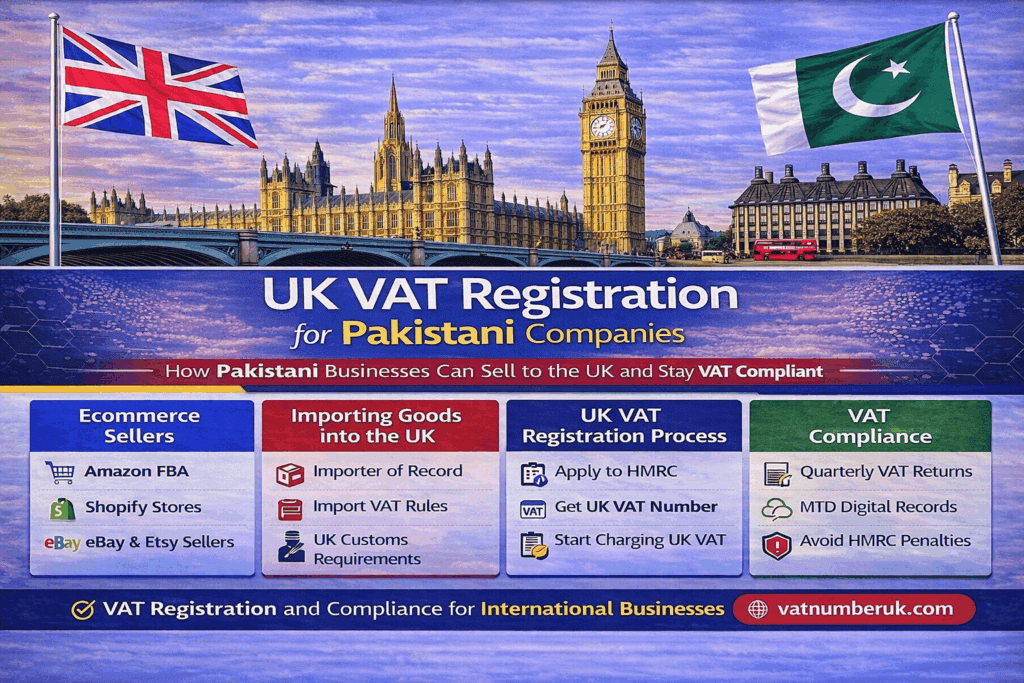
How Businesses from Pakistan Can Register for UK VAT
The process to register VAT UK from Pakistan is not complicated, but it must be done properly and with the correct supporting documents.
In simple terms, the process usually looks like this:
- Review the business model and confirm that VAT registration is required.
- Gather company documents and information about UK activities.
- Complete the VAT registration application for a non-UK established business.
- Submit the application to HMRC.
- HMRC may ask additional questions about your business, suppliers, and customers.
- Once approved, HMRC issues a VAT number UK.
- You then register for Making Tax Digital and start submitting VAT returns.
The key point is that HMRC wants to understand what your company does, how goods enter the UK, where they are stored, and how they are sold.
Documents Required for UK VAT Registration
For UK VAT registration for Pakistan companies, HMRC typically asks for:
- Certificate of incorporation of the Pakistan company
- Company registration documents
- Memorandum and Articles of Association
- Passports of directors
- Proof of business activity (invoices, contracts, Amazon account, website)
- Description of business activities
- Proof of UK warehouse or Amazon FBA storage
- Import and shipping documents
- Authority letter if you use a VAT agent
All documents usually need to be in English or officially translated.
How Long UK VAT Registration Takes
This is a very practical question, because many businesses need their VAT number before they can start selling properly in the UK.
In most cases:
- Simple applications take around 4–6 weeks
- More complex cases take 6–12 weeks
- If HMRC asks many additional questions, it can take longer
This is why I usually advise Pakistani businesses to start the VAT registration process before they send their first large shipment to the UK.
UK VAT Compliance Requirements
Getting a VAT number UK is only the first step. After that, you have ongoing responsibilities.
These include:
- Submitting VAT returns, usually every quarter
- Keeping digital VAT records
- Following Making Tax Digital (MTD) rules
- Using compatible accounting software
- Keeping import VAT documents (such as C79 certificates)
- Recording all UK sales and expenses correctly
HMRC can issue penalties for late registration, late VAT returns, or incorrect VAT reporting, so compliance is very important.
Professional Help with UK VAT Registration
Many Pakistani companies prefer to work with a VAT agent because the rules for UK VAT for foreign companies can be confusing, especially when import VAT, Amazon FBA, and ecommerce platforms are involved.
VATNumberUK helps companies with:
- UK VAT registration for Pakistan companies
- Help to register VAT UK from Pakistan
- Amazon FBA VAT registration
- EORI registration for importing goods
- VAT returns and ongoing compliance
- Making Tax Digital setup and software
- Advice on UK VAT for ecommerce sellers
If your company in Pakistan is planning to sell goods or services in the UK, it is much easier to set up VAT correctly from the beginning rather than fix problems later.
Contact VATNumberUK to apply for your UK VAT registration and get your VAT number UK with professional support.