The United Kingdom remains a vital export market for Polish companies. From e-commerce brands and Amazon merchants to manufacturers and wholesalers, many Polish businesses trade actively with UK customers. Since Brexit, however, the UK has exited the EU VAT framework. Polish firms must now treat the UK as a “third country,” which fundamentally alters all previous VAT obligations.
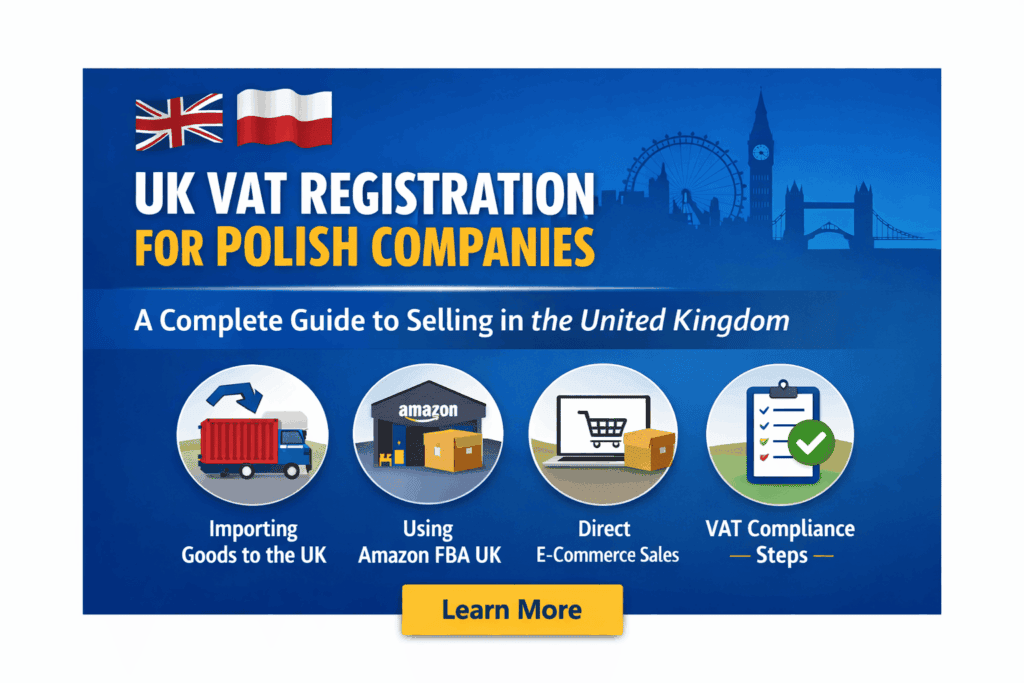
If your Polish company engages in any of the following activities, you may be legally required to register for UK VAT:
• Exporting goods into the UK
• Importing merchandise into Britain
• Using Amazon UK FBA
• Storing stock in UK warehouses
• Acting as importer of record
• Selling directly to UK consumers
If your business engages in these activities, you may be legally obligated to register for UK VAT. This guide explains the mandatory registration requirements for Polish companies, outlines the application process, and provides key strategies to help you avoid common, costly non-compliance mistakes.
Why Polish Companies Frequently Need UK VAT Registration
Poland boasts one of the most dynamic e-commerce sectors in Central Europe, with a high volume of cross-border trade. Many Polish entrepreneurs and established firms now face mandatory UK VAT obligations due to their business models:
• Amazon UK Presence: Utilizing UK fulfilment centres to reach local customers.
• Cross-Border Logistics: Leveraging sophisticated pan-European distribution networks.
• Direct-to-Consumer Shipping: Sending parcels directly from Poland to UK households.
• Manufacturing & Export: Producing goods domestically for sale in the UK market.
Following Brexit, these transactions are no longer classified as intra-EU supplies. Instead, they are formal imports and exports subject to “third country” regulations.
Crucially, a Polish VAT (VAT-UE) registration is insufficient for trading within the UK. In 2026, the two systems are entirely separate. The UK has abolished the previous distance selling thresholds for overseas entities. This means that for the majority of Polish sellers, UK VAT registration is required from the very first sale, regardless of annual turnover.
When Is UK VAT Registration Mandatory?
For Polish enterprises, obtaining a UK VAT number becomes a legal necessity under several specific conditions.
In the absence of a minimum threshold for overseas sellers, registration is often required when:
• Managing UK imports as importer of record
• Storing inventory in UK warehouses
• Making domestic taxable supplies in the UK
• Selling directly to UK consumers
Unlike UK-based firms, Polish companies generally do not benefit from a VAT-free threshold.
Registration is typically mandatory from the moment taxable activity begins.
Scenario 1: Polish Company Acting as Importer of Record
If your Polish business manages exports and is listed as the importer on UK customs declarations, VAT registration is usually unavoidable.
This requirement applies even if:
• Your turnover is relatively low
• You sell exclusively through marketplaces
• Your company has no physical UK presence
Importing goods creates immediate tax liability.
Failure to register can lead to:
• Backdated VAT assessments
• Interest on unpaid VAT
• Late registration penalties from HMRC
Scenario 2: Using Amazon FBA in the UK
Many Polish sellers use logistics models such as:
• Amazon FBA UK
• Multi-country inventory networks
• Independent UK 3PL warehouses
If goods are physically located in the UK, the business is making domestic taxable supplies.
In this situation, UK VAT registration is required before inventory arrives in the warehouse.
Marketplace VAT collection does not necessarily remove this obligation.
Scenario 3: Direct Ecommerce Sales to UK Consumers
Polish companies selling through platforms such as Shopify or WooCommerce must carefully consider several factors:
• Incoterms used for shipping (DDP vs DAP)
• Identification of the importer of record
• VAT collection at checkout
• Compliance with UK customs procedures
Incorrect structuring can create hidden VAT liabilities and border delays.
No UK VAT Threshold for Many Polish Businesses
Domestic UK companies benefit from a VAT threshold.
However, overseas companies often do not.
If a Polish company imports goods into the UK or stores stock locally, registration is generally required from the first taxable transaction.
This “zero threshold” rule is one of the most common sources of confusion for Polish exporters.
The UK VAT Registration Process for Polish Companies
HMRC treats Polish companies as Non-Established Taxable Persons (NETP).
The registration process typically involves several stages.
Step 1: Determine the VAT Liability Date
The Effective Date of Registration (EDR) is critical.
Businesses must determine:
• When the first taxable UK supply occurred
• Whether registration needs to be backdated
• Whether voluntary registration is beneficial
An incorrect date can lead to penalties.
Step 2: Prepare Documentation
HMRC requires documentation proving the legitimacy of your business.
Common documents include:
• KRS extract with English translation
• Articles of Association
• Director passports and proof of address
• Polish VAT-UE certificate
• Shipping and logistics contracts
• Marketplace agreements
• Company bank statements
Complete documentation greatly reduces application delays.
Step 3: Submit the Application
Applications are submitted through the Government Gateway.
Because Polish companies are overseas entities, HMRC may conduct enhanced verification.
Typical processing times in 2026:
• Standard NETP application: 4–8 weeks
• Complex structures: up to 12 weeks
• Additional HMRC queries may extend timelines
Step 4: Receive VAT Number and Begin Compliance
After approval, HMRC issues a VAT registration certificate.
Businesses must then:
• Charge UK VAT on taxable supplies
• Submit quarterly VAT returns
• Maintain digital accounting records
• Comply with Making Tax Digital (MTD)
VAT Returns and Ongoing Compliance
Once registered, Polish companies must maintain ongoing compliance.
This includes:
• Quarterly VAT return submissions
• Digital bookkeeping systems
• MTD compliance
• Record retention requirements
Failure to comply can lead to automated penalties.
Can Polish Companies Reclaim UK Import VAT?
Yes.
If the business is registered for UK VAT, import VAT can generally be reclaimed.
Key mechanisms include:
• VAT recovery as input tax
• Postponed VAT Accounting (PVA)
• Cash flow optimisation
• Avoiding upfront VAT payments at the border
Incorrect registration or importer status can make recovery difficult.
Common Mistakes Polish Companies Make
Assuming EU VAT Covers UK Sales
A Polish VAT-UE number cannot be used for UK domestic VAT obligations.
The systems are separate.
Registering Too Late
Waiting for a turnover threshold often leads to:
• Backdated VAT
• Interest charges
• HMRC penalties
Misunderstanding Incoterms
Using DDP shipping without UK VAT registration can result in customs issues and additional tax liabilities.
Relying Only on Marketplaces
Even if marketplaces collect VAT, storing goods in the UK usually creates a mandatory registration requirement.
Strategic VAT Planning for Polish Exporters
Before entering the UK market, Polish businesses should:
• Analyse their logistics structure
• Determine the importer of record
• Review warehouse arrangements
• Establish the correct VAT liability date
• Register before scaling operations
• Implement MTD-compatible accounting systems
Proper planning significantly reduces compliance risk.
Should a Polish Company Appoint a UK VAT Agent?
Although not always legally required, many Polish companies appoint a UK VAT agent.
An agent can:
• Manage the VAT registration process
• Communicate with HMRC
• Submit VAT returns
• Monitor compliance risks
Professional support often prevents costly mistakes.
How Long Does Registration Take?
Typical timelines:
• Standard applications: 4–8 weeks
• Complex structures: up to 12 weeks
Applications should ideally be submitted three months before launching UK sales.
The Strategic Case for Voluntary VAT Registration
Even before reaching mandatory triggers, some Polish businesses choose voluntary registration.
Benefits may include:
• Reclaiming import VAT
• Improved credibility with UK partners
• Access to advanced Amazon logistics programs
However, voluntary registration also introduces administrative responsibilities.
UK VAT Compliance Checklist for Polish Companies
Before launching UK operations, ensure the following:
• Import structure is clearly defined
• Importer of record is identified
• UK inventory presence is evaluated
• VAT liability date is confirmed
• Documentation is prepared for HMRC
• Accounting software supports MTD reporting
Conclusion
For Polish companies trading with the UK, VAT registration has become an essential legal requirement after Brexit. The UK and EU VAT systems now operate independently, and relying solely on a Polish VAT-UE number is no longer sufficient for UK trade.
Completing proper VAT registration ensures compliance with HMRC regulations, protects your business from penalties, and allows you to reclaim import VAT. For Polish exporters planning to expand into the UK market, early preparation and strategic VAT planning are critical for long-term success.