Over the past few years, I’ve worked with a growing number of businesses from Portugal that are expanding into the UK market. Despite Brexit, the United Kingdom remains one of the most attractive destinations for Portuguese exporters and ecommerce brands. The market is large, consumers are comfortable buying online, and demand for European products remains strong.
Portugal has a well-developed export economy, and several of its industries are particularly active in the British market. For example, the country is one of the world’s leading producers of cork products, responsible for roughly half of global cork production. Portuguese cork is widely used not only for wine stoppers but also for lifestyle products such as handbags, flooring, and eco-friendly accessories that sell well in the UK.
Another important sector is footwear manufacturing. Northern Portugal — particularly regions around Felgueiras, Guimarães, and Braga — produces high-quality shoes that are exported worldwide. Many of these brands now sell directly to UK customers through online stores.
Portugal is also well known for wine exports, including Port, Douro wines, and Vinho Verde, all of which are widely distributed in Britain. On top of that, Portuguese ceramics, textiles, and home décor products have become increasingly popular with UK consumers.
Because of this trade activity, many Portuguese businesses eventually face the same question:
Do we need to register for UK VAT?
In many cases, the answer is yes. UK VAT rules can apply even if the company has no office, employees, or permanent establishment in the United Kingdom. For Portuguese businesses selling goods into the UK — particularly through ecommerce or fulfilment networks — understanding VAT obligations early can prevent serious compliance problems later.
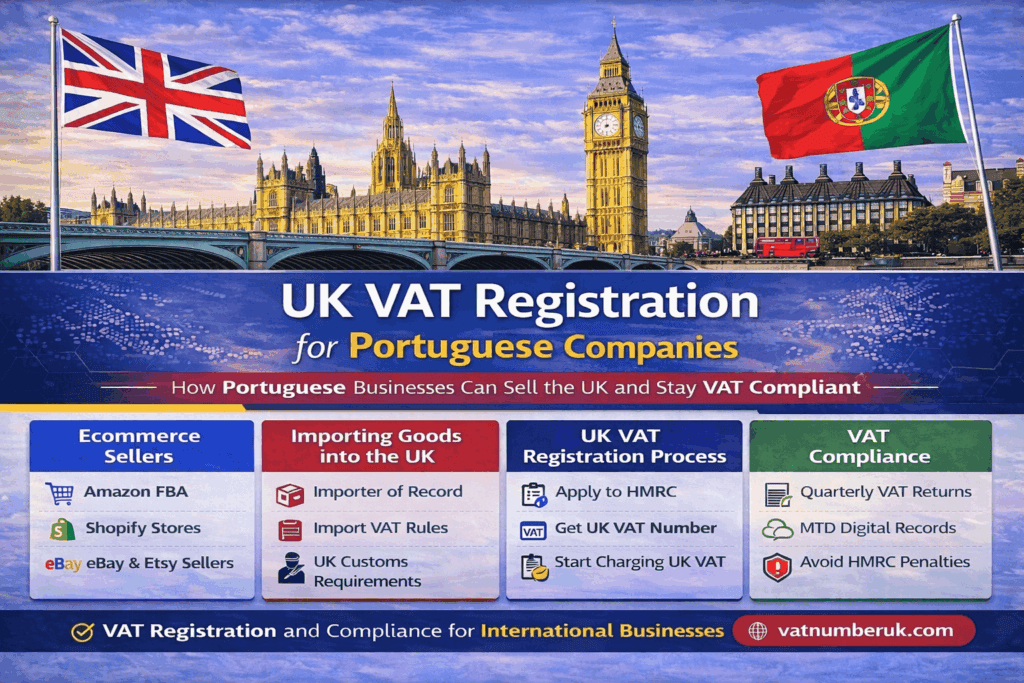
This guide explains when UK VAT registration for Portuguese companies becomes necessary, how the process works, and what businesses should expect once they begin trading in the UK market.
Do Companies from Portugal Need UK VAT Registration?
In practice, many Portuguese companies selling into the UK will eventually need a VAT number UK.
A common assumption is that VAT registration is only required once a company opens a branch or office in Britain. In reality, the rules are quite different for foreign businesses.
Under UK tax law, a company can become liable for VAT simply because of the way it sells or distributes goods in the UK. Physical presence is not required.
Portuguese businesses may need UK VAT registration for Portuguese companies if they:
- import goods into the UK in their own name
- store products inside the United Kingdom
- use Amazon FBA or other fulfilment services located in the UK
- sell goods directly to UK consumers through ecommerce platforms
- appoint a UK fulfilment warehouse
- operate certain digital services supplied to UK customers
One point that often surprises international businesses is that foreign companies usually do not benefit from the UK VAT registration threshold. UK-established businesses can trade up to a certain turnover before registering for VAT, but foreign companies frequently need to register from the first taxable transaction.
Because of this, Portuguese companies entering the UK market should review their supply chain structure early to determine whether VAT registration will be required.
Common Scenarios When Businesses from Portugal Must Register for UK VAT
In day-to-day practice, several situations repeatedly trigger the need to register VAT UK from Portugal. Most of them relate to how goods enter the UK or where they are stored before reaching customers.
Importing Goods into the United Kingdom
Many Portuguese manufacturers export products directly to British customers or distributors.
Typical examples include:
- a ceramics manufacturer from Aveiro supplying UK homeware retailers
- a wine producer from the Douro Valley selling bottles through British distributors
- a Portuguese furniture maker delivering products to interior design studios in London
- a textile company from Braga exporting home décor products to UK ecommerce stores
If the Portuguese company acts as the importer of record, it usually becomes responsible for UK VAT obligations. In these cases, VAT registration in the UK is generally required.
Storing Goods in UK Warehouses
Another common situation involves Portuguese businesses sending stock to warehouses in the UK.
For instance:
- a footwear brand shipping inventory from Porto to a logistics centre in Birmingham
- a cork accessories company storing products in a fulfilment facility near Manchester
- a Portuguese kitchenware brand maintaining stock in a UK third-party warehouse
Once goods are physically stored inside the UK, VAT registration becomes mandatory.
Amazon FBA Fulfilment
Amazon is one of the most popular sales channels for Portuguese exporters. Many Portuguese brands use Amazon FBA (Fulfilment by Amazon) to reach UK consumers quickly.
Under this model, inventory is shipped to Amazon’s UK fulfilment centres. Amazon then handles storage, packing, and delivery to customers.
Because the goods are held inside the UK, sellers must obtain a UK VAT number before selling through Amazon FBA.
Direct Online Sales to UK Customers
Portuguese companies increasingly sell directly to British consumers through their own ecommerce websites.
Examples include:
- fashion brands selling clothing through Shopify stores
- artisan ceramic studios offering handmade tableware through Etsy
- gourmet food producers selling olive oil, sardines, and specialty foods online
Depending on how goods are imported and delivered, UK VAT obligations can arise even when sales are made through a company’s own website.
UK VAT Rules for Ecommerce Sellers from Portugal
Ecommerce has transformed the way Portuguese businesses enter international markets. Instead of relying solely on distributors, many companies now sell directly to UK customers.
Several platforms are particularly popular among Portuguese sellers.
Amazon
Amazon remains the largest ecommerce marketplace used by Portuguese exporters.
Products commonly sold by Portuguese brands on Amazon UK include:
- leather footwear
- cork handbags and accessories
- home décor items
- kitchenware and ceramics
If a Portuguese seller sends inventory to Amazon warehouses located in the UK, UK VAT registration becomes compulsory.
Shopify
Many Portuguese companies operate their own ecommerce stores using Shopify.
This approach is common among:
- sustainable fashion brands
- cork-based lifestyle product companies
- Portuguese home décor manufacturers
These businesses often ship goods directly from Portugal or through UK fulfilment partners. Depending on the supply chain structure, UK VAT rules may apply to these transactions.
Etsy
Portugal has a strong tradition of craftsmanship and handmade products. Many artisans sell their work internationally through Etsy.
Products often exported to the UK include:
- handmade ceramics
- decorative Portuguese tiles (azulejos)
- handcrafted leather goods
- traditional textiles and woven products
Even small artisan businesses should check whether UK VAT registration for Portuguese companies is required based on how goods are delivered and imported.
Unique VAT Considerations for Businesses from Portugal
Portuguese companies tend to enter the UK market in ways that are quite distinctive compared with businesses from other countries. These patterns influence how VAT rules apply.
Portugal’s Major Export Industries
Portugal’s export economy includes several sectors that frequently sell to British buyers.
The footwear industry is a major example. Portuguese shoe manufacturers are known for high quality and craftsmanship. Many brands now sell directly to UK customers through ecommerce channels rather than relying solely on wholesalers.
Another important sector is wine production. Portuguese wines — particularly Port and Douro wines — have a long history in the UK. Today, many wineries are expanding direct-to-consumer sales through online stores and specialty retailers.
Portugal also dominates the global cork industry, producing roughly half of the world’s supply. Cork products have expanded beyond wine stoppers into flooring, insulation, fashion accessories, and eco-friendly consumer goods.
Growth of Sustainable and Natural Products
In recent years, Portuguese companies have become leaders in sustainable manufacturing.
Products such as:
- cork yoga blocks
- eco-friendly cork handbags
- recycled-material footwear
- natural home décor products
have gained popularity among environmentally conscious UK consumers.
To meet demand, some Portuguese brands store inventory inside UK fulfilment centres, which can trigger VAT registration requirements.
Logistics Routes Between Portugal and the UK
Portuguese exporters typically ship goods to the UK using several logistics routes.
Goods may leave through ports such as Lisbon, Leixões, or Setúbal, travelling by sea to British ports. Road transport via Spain and France is also common, particularly for ecommerce shipments.
Many businesses also rely on international courier networks for smaller shipments.
When goods are imported into the UK or stored locally before delivery, HMRC usually requires the foreign company to hold a UK VAT number.
How Businesses from Portugal Can Register for UK VAT
The process to register VAT UK from Portugal is relatively straightforward, although it requires careful preparation.
Step 1 — Confirm VAT Liability
The first step is determining whether the company’s activities create a VAT obligation in the UK.
This depends on factors such as:
- where goods are stored
- who imports the goods into the UK
- whether fulfilment centres are used
- how products are delivered to customers
Step 2 — Prepare the VAT Application
The company then prepares a VAT registration application for HM Revenue & Customs (HMRC).
Foreign businesses typically register as Non-Established Taxable Persons (NETP).
Step 3 — Submit Supporting Documentation
HMRC will review documentation confirming the company’s structure and business activities.
Step 4 — Receive the VAT Number
Once the application is approved, HMRC issues a UK VAT number, allowing the company to charge VAT where required and comply with UK tax rules.
Documents Required for UK VAT Registration
When Portuguese businesses apply for UK VAT registration, HMRC usually asks for a range of supporting documents.
These commonly include:
- Portuguese company registration certificate
- extract from the Portuguese commercial registry
- articles of association
- identification documents for company directors
- proof of trading activity
- contracts with UK fulfilment providers or warehouses
- import documentation
- details of ecommerce platforms or websites
Providing clear and complete documentation helps ensure the application is processed without unnecessary delays.
How Long UK VAT Registration Takes
The time required for UK VAT registration for foreign companies varies depending on the complexity of the business structure.
In most cases, the process takes between four and eight weeks.
However, the timeline may be longer if HMRC requests additional information or clarification regarding the company’s supply chain.
Working with experienced VAT advisors can significantly reduce delays by ensuring the application is prepared correctly from the outset.
UK VAT Compliance Requirements
Obtaining a VAT number UK is only the first step. Once registered, Portuguese companies must meet ongoing VAT compliance obligations.
VAT Returns
VAT-registered businesses must submit regular VAT returns to HMRC, typically on a quarterly basis.
These returns report:
- total sales to UK customers
- VAT collected on those sales
- VAT paid on imports or eligible expenses
Record Keeping
Companies must maintain detailed digital records, including:
- sales invoices
- purchase invoices
- import records
- VAT calculations
These records must be kept in a format compatible with UK tax regulations.
Making Tax Digital
The UK operates a system known as Making Tax Digital (MTD) for VAT.
This requires VAT returns to be submitted through approved digital accounting software rather than manual reporting.
Most businesses use accounting platforms that integrate directly with HMRC’s systems.
Professional Help with UK VAT Registration
Registering for VAT in another country can be complicated, particularly when ecommerce platforms, international logistics, and cross-border imports are involved.
At VATNumberUK, we work with international companies every day to help them obtain their UK VAT number and remain fully compliant with HMRC rules.
We regularly assist Portuguese companies selling products to the UK, including:
- footwear manufacturers
- cork product brands
- wine exporters
- ceramic and home décor producers
- ecommerce sellers using Amazon and Shopify
Our services include:
- UK VAT registration for Portuguese companies
- ongoing VAT compliance and return preparation
- guidance on ecommerce VAT rules
- communication with HMRC on your behalf
- advice on UK import structures and supply chains
If your company plans to register VAT UK from Portugal or expand sales to the British market, professional guidance can help avoid costly mistakes.
Contact VATNumberUK today to obtain your UK VAT number and start selling confidently to customers across the United Kingdom.