Over the last few years, I’ve seen a noticeable increase in the number of businesses from Qatar entering the UK market. In many cases, the UK is attractive not only because of its large consumer base, but also because it’s a relatively straightforward market to enter from a logistics and legal perspective. English language, strong ecommerce infrastructure, and well-developed fulfilment networks make the UK a practical first step for Qatar companies expanding outside the Gulf region.
Qatar’s economy is still dominated by LNG, petrochemicals, and large industrial projects, but that’s only part of the story. Alongside the energy sector, there has been steady growth in luxury consumer products, niche manufacturing, and online businesses. I regularly see Qatar-based companies selling products such as oud perfumes, luxury fragrances, modest fashion, jewellery, specialist construction materials, aluminium products, and increasingly, digital services and SaaS solutions to UK customers.
Many of these businesses start by testing the UK market through ecommerce — often using Shopify, Amazon, or direct shipping from Doha — and then move to holding stock in the UK to improve delivery times. This is usually the point where UK VAT becomes relevant, and unfortunately, it’s also the point where many businesses realise they should have registered earlier.
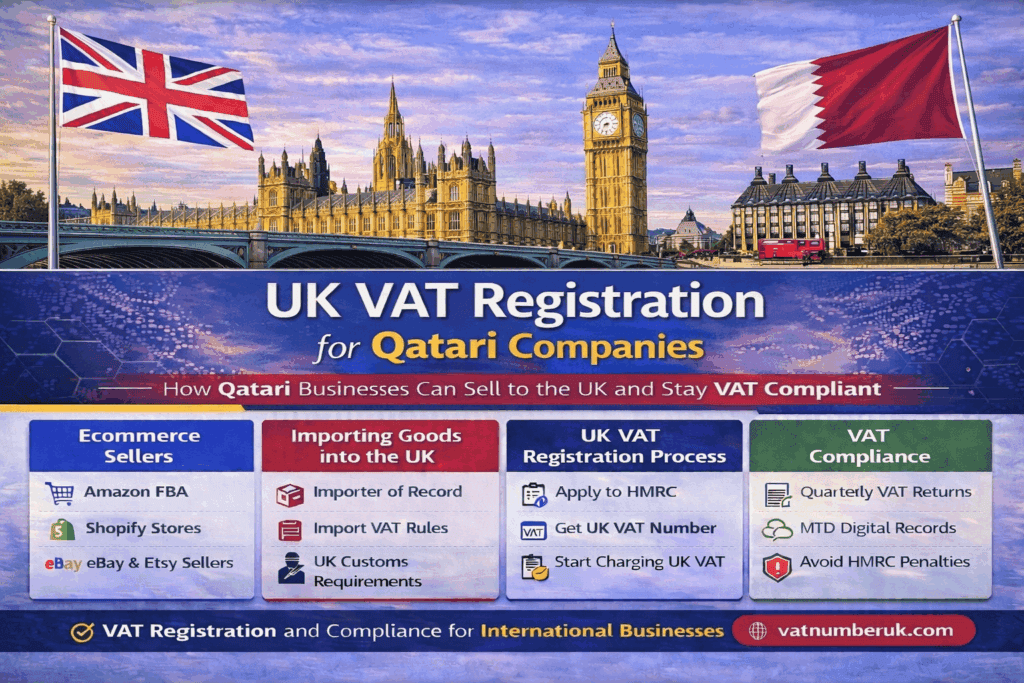
This article explains UK VAT registration for Qatar companies, when registration is required, and how the process works in practice.
Do Companies from Qatar Need UK VAT Registration?
This is one of the first questions I’m usually asked, and the answer depends entirely on how the business is selling into the UK.
A company does not need a UK office, UK staff, or a UK company to be required to register for VAT. The UK VAT system looks primarily at where the goods are located and where the customer is located. So even if your company is fully based in Doha, you may still need a UK VAT number.
In practice, UK VAT for foreign companies becomes mandatory when a Qatar business:
- Stores goods in the UK
- Imports goods into the UK in its own name
- Sells goods from UK stock to UK customers
- Uses Amazon FBA with UK fulfilment
- Supplies certain digital services to UK consumers
One very important point: for non-UK companies, there is usually no VAT threshold. UK companies can wait until they reach the VAT threshold, but non-resident businesses often must register from the first sale if they are making taxable supplies in the UK.
This is why it’s important to look at VAT before you start selling, not after.
Common Scenarios When Businesses from Qatar Must Register for UK VAT
Let’s look at the most common real-life situations where UK VAT registration for Qatar companies becomes necessary.
Storing Goods in a UK Warehouse
A very common structure is that a Qatar company manufactures or sources products locally or from Asia, ships them in bulk to the UK, and then distributes them from a UK fulfilment centre.
Once your goods are physically in the UK and you are selling them to UK customers, you are making UK domestic supplies. At that point, you must register for VAT.
For example, I worked with a Qatar fragrance brand that shipped several pallets of oud perfumes to a fulfilment warehouse near Manchester. They sold through their own website and offered next-day UK delivery. Because the goods were stored and sold in the UK, VAT registration was required before the first sale from UK stock.
Amazon FBA (Fulfilment by Amazon)
Amazon is one of the main entry points into the UK market for Qatar sellers. I see this particularly with:
- Perfumes and fragrances
- Skincare and beauty products
- Modest fashion
- Home décor
- Phone accessories
- Gift items and luxury packaged products
- Specialty foods like dates and sweets
When you use Amazon FBA, your goods are stored in Amazon’s UK warehouses. From a VAT perspective, this means you are storing goods in the UK and selling locally — so VAT registration is required.
In this situation, the Qatar company must:
- Register for UK VAT
- Charge UK VAT on sales
- Submit quarterly VAT returns
- Keep proper digital records under Making Tax Digital
Importing Goods into the UK
Another common situation is where a Qatar company sells goods to UK customers and acts as the importer of record.
This is quite common for industrial suppliers from Qatar — for example companies supplying aluminium components, construction materials, or specialised equipment to UK contractors or engineering firms.
If the Qatar company imports the goods into the UK and pays import VAT, it normally needs a UK VAT number in order to reclaim that import VAT. Without VAT registration, import VAT becomes a real cost.
Ecommerce Sales to UK Customers
Some Qatar businesses initially ship goods directly from Qatar to UK customers on a per-order basis. In those cases, VAT treatment depends on:
- The value of the goods
- Who acts as importer
- Whether the sale is made through an online marketplace
This area can be quite technical, and the VAT treatment is different if you sell through Amazon or eBay compared to selling through your own website. This is why UK VAT for ecommerce sellers needs to be reviewed properly based on the exact business model.
UK VAT Rules for Ecommerce Sellers from Qatar
Most Qatar businesses selling to the UK use one of the following platforms:
- Amazon UK
- Shopify
- eBay
- Etsy (especially for handmade items, perfumes, jewellery, and gift products)
Each platform leads to slightly different VAT consequences.
Amazon
If you store goods in Amazon’s UK warehouses under FBA, VAT registration is required. This is one of the most straightforward cases — if stock is in the UK, you need UK VAT registration.
Shopify
Many Qatar brands prefer Shopify because it allows them to build a premium brand and sell directly to customers. However, if you are shipping orders from UK stock (for example from a 3PL warehouse in the UK), you must register for VAT and charge VAT on UK sales.
eBay and Etsy
These platforms are often used by smaller Qatar businesses selling:
- Handmade items
- Jewellery
- Boutique fashion
- Gift boxes
- Perfumes
- Decorative items
If goods are shipped from within the UK, VAT registration is required. If goods are shipped from Qatar directly to UK consumers, marketplace VAT rules may apply, and the platform may collect VAT on your behalf in some situations.
A lot of Qatar sellers start with direct international shipping and then switch to UK fulfilment once sales increase. That switch usually triggers the VAT registration requirement.
Unique VAT Considerations for Businesses from Qatar
Qatar businesses tend to enter the UK market in slightly different ways compared to European or Asian companies, and this affects VAT.
Luxury Fragrances and Personal Care Products
Qatar has a very strong luxury fragrance market, especially oud-based perfumes and high-end personal care products. These products are popular with niche audiences in the UK and are often sold online through branded websites and Amazon.
In many cases, these businesses begin by shipping orders from Doha, but once volumes grow, they move stock into UK fulfilment centres to offer faster delivery. From a VAT perspective, that move — when stock is first stored in the UK — is the key moment when VAT registration becomes compulsory.
Aluminium, Construction Materials, and Industrial Supply
Qatar is one of the world’s largest producers of aluminium, and I’ve worked with companies exporting aluminium profiles, metal components, and construction-related materials to the UK. These are often sold B2B rather than through ecommerce.
In these cases, the Qatar company often imports goods into the UK and sells to UK construction firms or engineering companies. VAT registration is usually required so that the company can reclaim import VAT and account for VAT correctly on UK sales.
Food Products and Specialty Goods
Another area where I see Qatar companies entering the UK is specialty food — particularly:
- Premium dates
- Arabic sweets
- Chocolate and gift boxes
- Arabic coffee and coffee accessories
- Halal niche food products
These products are often imported in bulk and stored in UK warehouses, then sold through Amazon or specialist food distributors. Again, once goods are stored in the UK, VAT registration is required.
Digital Services and SaaS
Qatar has been investing heavily in technology and digital infrastructure, and some companies now provide software, engineering services, design services, and SaaS platforms to UK clients.
If services are supplied to UK VAT-registered businesses, the reverse charge may apply. If services are supplied to UK consumers, UK VAT may need to be charged. The correct treatment depends on whether the customer is a business or a private consumer.
How Businesses from Qatar Can Register for UK VAT
The UK VAT registration process for Qatar companies is quite structured, but the key is to prepare the application properly so there are no delays.
The usual process looks like this:
- Review the business model and confirm VAT registration requirement
- Register as a non-resident business (Non-Established Taxable Person)
- Prepare and submit the VAT registration application to HMRC
- Provide supporting documents if HMRC asks for more information
- Receive the UK VAT number
- Register for Making Tax Digital and set up VAT software
- Start issuing VAT invoices and submitting VAT returns
It’s important to note that HMRC often asks detailed questions about how overseas businesses operate, especially if the company has no physical presence in the UK.
Documents Required for UK VAT Registration
For UK VAT registration for Qatar companies, HMRC typically asks for:
- Certificate of incorporation
- Articles of association
- Shareholder information
- Director passport copies
- Proof of business activities
- Sales contracts or agreements
- Amazon account or marketplace evidence (if applicable)
- Warehouse or fulfilment agreements
- Expected turnover figures
- Description of supply chain and goods movement
Documents from Qatar sometimes need to be translated into English and provided in a specific format, which is something many businesses don’t expect at the beginning.
How Long UK VAT Registration Takes
In straightforward cases, UK VAT registration usually takes around 4 to 8 weeks.
However, for non-UK companies, HMRC often asks additional questions, so a more realistic timeframe is 6 to 10 weeks, and sometimes longer if the business model is complex or involves imports, Amazon FBA, or multiple sales channels.
This is why I always advise Qatar companies to apply before shipping goods to the UK, not after the goods arrive.
UK VAT Compliance Requirements
Once you receive your VAT number UK, the ongoing compliance is just as important as the registration itself.
VAT Returns
Most businesses submit VAT returns every quarter. The return shows:
- Sales
- Purchases
- Import VAT
- VAT payable or reclaimable
Record Keeping
You must keep proper records, including:
- Sales invoices
- Purchase invoices
- Import documents
- Shipping documents
- Amazon or Shopify reports
- Bank statements related to UK sales
Making Tax Digital (MTD)
All VAT-registered businesses must keep digital records and submit VAT returns through compatible software. Manual submissions are no longer allowed.
Professional Help with UK VAT Registration
Many Qatar businesses prefer to focus on sales and logistics and leave the VAT side to a specialist, which is usually the sensible approach. UK VAT for non-resident companies, especially those using Amazon FBA or importing goods, can become quite technical if not handled properly.
VATNumberUK helps Qatar companies register VAT in the UK, obtain a VAT number UK, and manage ongoing VAT compliance, including:
- UK VAT registration for Qatar companies
- UK VAT for ecommerce sellers
- Import VAT advice
- Amazon FBA VAT support
- VAT returns and compliance
- Communication with HMRC
If your business is based in Qatar and you are planning to sell goods or services to the UK, it’s best to review your VAT position early and register correctly from the start.
Contact VATNumberUK to discuss your situation and get professional help with UK VAT registration for Qatar companies.