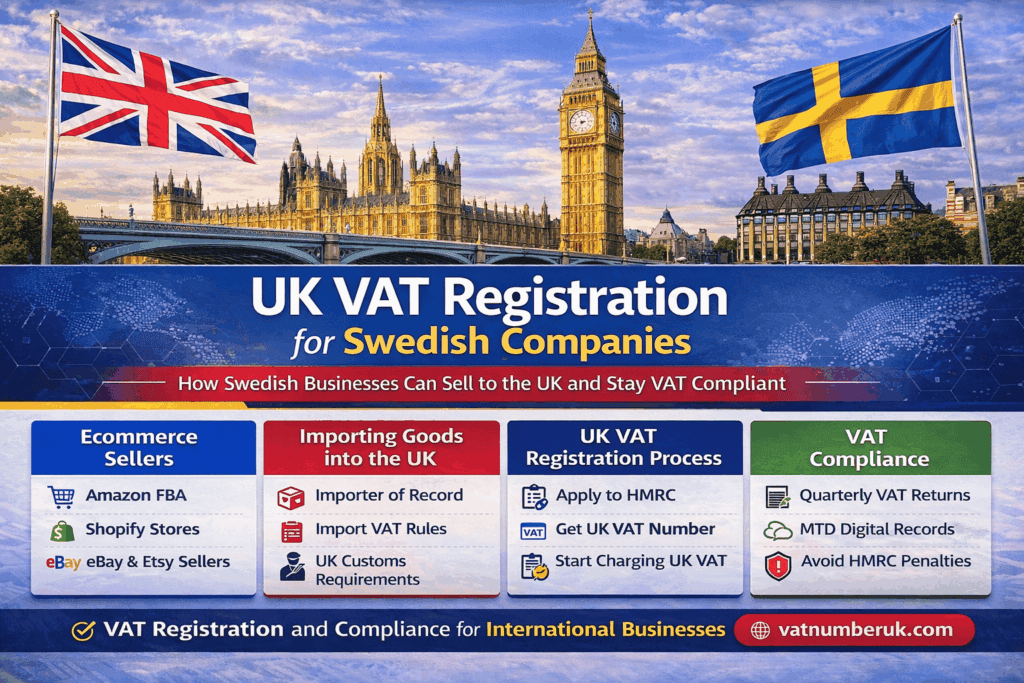
Over the past several years, more and more companies from Sweden have started selling goods and services to customers in the United Kingdom. In many cases this expansion begins online. A Swedish brand launches an ecommerce store, lists products on Amazon, or starts shipping products internationally through a Shopify website.
The UK market is attractive for Swedish exporters. The customer base is large, logistics are well developed, and British consumers are comfortable buying from international brands. Swedish companies selling furniture, design products, fashion, cosmetics, and technology equipment often see strong demand from UK buyers.
However, once a Swedish business begins selling to UK customers, UK VAT rules quickly become relevant. Since the UK left the EU after Brexit, Swedish companies are now treated as non-UK businesses trading with the UK. This has important implications for VAT.
In practice, many Swedish companies discover that they must obtain a UK VAT number sooner than expected, especially if they import goods into the UK or store products in British warehouses.
Understanding when VAT registration is required — and how the process works — helps businesses avoid delays, compliance issues, or unexpected tax exposure.
In this guide, I will explain when Swedish companies must register for UK VAT, how the registration process works, and what ongoing obligations businesses should expect once they receive a VAT number.
Do Companies from Sweden Need UK VAT Registration?
In many situations, yes. Swedish companies selling goods to UK customers may need UK VAT registration for Swedish companies even if the business has no office or physical presence in Britain.
This often surprises business owners. A Swedish company may assume that because it operates from Stockholm or Gothenburg, UK tax rules do not apply. In reality, VAT is determined by where the goods are located and where the customer is based, not only where the company itself is registered.
Since Brexit, Sweden is treated as a non-UK jurisdiction for VAT purposes. That means Swedish businesses are effectively operating as foreign sellers importing goods into the UK market.
As a result, UK VAT registration may become mandatory in several common situations, such as:
- importing goods into the UK
- storing products in UK fulfilment centres
- selling through UK warehouses
- acting as the importer of record
- making taxable sales in the UK market
Unlike domestic UK businesses, foreign companies do not benefit from the normal VAT threshold. If a Swedish company performs certain taxable activities in the UK, VAT registration may be required immediately.
For this reason, businesses planning to register VAT UK from Sweden should review their supply chain and logistics structure before launching UK sales.
Common Scenarios When Businesses from Sweden Must Register for UK VAT
Over the years I have worked with many international ecommerce sellers entering the UK market. Swedish companies often follow similar expansion models, and several scenarios appear repeatedly.
Storing Goods in UK Warehouses
One of the most straightforward situations triggering VAT registration is storing goods inside the UK.
For example, a Swedish ecommerce brand may decide to place inventory in a fulfilment centre located in Manchester or Birmingham. The goal is usually simple: faster delivery times and lower shipping costs for UK customers.
Once goods are physically stored in the UK, the company is effectively making local UK sales from UK inventory. In this case, HMRC normally expects the business to obtain a VAT number UK before those sales begin.
Selling Through Amazon FBA
Another common scenario involves Swedish sellers using Fulfilment by Amazon (FBA).
Many companies list their products on Amazon and ship inventory to Amazon fulfilment centres in the UK. Amazon then handles packing, shipping, and delivery to customers.
From a logistics perspective this works very well. From a VAT perspective, however, it typically means the seller must obtain UK VAT registration.
Because the goods are stored in the UK and sold locally, VAT must normally be charged on those sales. This is one of the most common situations where Swedish ecommerce companies require UK VAT for foreign companies.
Selling Through Ecommerce Platforms
Swedish businesses increasingly sell through large online marketplaces such as:
- Amazon
- eBay
- Shopify
- Etsy
These platforms can simplify international sales, but they do not automatically remove VAT obligations.
In some specific cases — particularly for low-value imports — the marketplace may collect VAT at the point of sale. However, once goods are imported into the UK and sold locally, the responsibility generally returns to the seller.
I regularly see Swedish companies assume that the platform handles all VAT matters. Unfortunately, this misunderstanding can create compliance problems later if the business should have registered earlier.
Importing Goods into the UK
Another situation that often requires VAT registration is when the Swedish company acts as the importer of record.
For instance, a Swedish electronics brand may manufacture products in Asia and ship them directly to the UK. When the shipment arrives, import VAT is charged by UK customs.
If the Swedish company is responsible for the import, it will usually need a UK VAT number to account for that import VAT and report subsequent sales.
This situation is very common for ecommerce brands that source products globally but sell to UK customers.
UK VAT Rules for Ecommerce Sellers from Sweden
Ecommerce has dramatically lowered the barrier to entering foreign markets. Swedish brands can launch UK sales without opening a local office or subsidiary.
However, VAT rules still apply depending on how goods move through the supply chain.
Amazon Sellers
Many Swedish companies selling on Amazon rely on UK fulfilment centres for distribution.
When inventory is stored in Amazon warehouses in the UK, VAT registration is normally required. Once registered, the seller must:
- charge UK VAT on applicable sales
- submit VAT returns
- maintain transaction records
- comply with UK digital reporting requirements
For Amazon sellers, VAT compliance quickly becomes part of the regular business process.
Shopify Stores
Companies operating independent ecommerce websites through Shopify often target UK customers through marketing campaigns or local shipping options.
If goods are shipped directly from Sweden to UK consumers, the VAT treatment depends on how imports are structured.
However, if goods are imported into the UK in bulk and distributed locally, VAT registration will usually be required.
This structure is very common for growing ecommerce brands that want to reduce delivery times and shipping costs.
eBay and Etsy Sellers
Smaller exporters frequently use eBay or Etsy to reach international buyers.
These platforms are popular among Swedish businesses selling handmade products, niche consumer goods, and design items.
Even small sellers should be careful. If goods are imported into the UK or stored locally before sale, UK VAT registration may still be required, regardless of business size.
Unique VAT Considerations for Businesses from Sweden
Sweden has a strong international export profile, and many Swedish companies already have experience selling into global markets before entering the UK.
Several Swedish industries are particularly active in cross-border ecommerce.
Common product categories sold from Sweden to the UK include:
- Scandinavian furniture and interior design products
- sustainable fashion brands
- outdoor and sports equipment
- skincare and wellness products
- consumer technology and smart home devices
Swedish design brands, in particular, have built strong reputations internationally. Many of them start selling to the UK through online channels before establishing a more permanent presence.
A typical situation might involve a Stockholm-based design company launching a Shopify store that targets UK customers. Initially, orders may be shipped directly from Sweden. As demand grows, the company may decide to move inventory into a UK fulfilment warehouse to improve delivery speed.
At that point, UK VAT registration usually becomes necessary.
Another example I frequently see involves Swedish beauty brands selling through Amazon UK. Once inventory is stored in Amazon fulfilment centres, the seller typically needs to obtain a VAT number UK and start submitting VAT returns.
These examples show why UK VAT registration for Swedish companies often becomes relevant earlier than many businesses expect.
How Businesses from Sweden Can Register for UK VAT
From a technical perspective, registering for UK VAT as a foreign company is not overly complicated. The key is ensuring the application is prepared correctly and supported with the appropriate documentation.
The process generally involves several steps.
First, the company must confirm whether VAT registration is required based on its supply chain and sales structure.
Next, a VAT registration application is prepared with details about the business, its activities, and the nature of its sales in the UK.
The application is then submitted to HM Revenue & Customs, which is responsible for administering the UK VAT system.
Once the application is approved, the company receives its VAT number UK and can begin charging VAT on relevant sales.
Finally, the business must implement appropriate accounting procedures to manage VAT reporting.
Documents Required for UK VAT Registration
Foreign companies applying for VAT registration usually need to provide a number of supporting documents.
These commonly include:
- certificate of incorporation
- company registration documents
- passport copies of directors
- proof of business activity
- contracts with logistics providers or ecommerce platforms
- supply chain information explaining how goods enter the UK
In some cases, HM Revenue & Customs may request additional documentation to verify the nature of the business.
Preparing these documents carefully helps prevent delays during the application process.
How Long UK VAT Registration Takes
Processing times for UK VAT registration for foreign companies can vary depending on the complexity of the case.
For most straightforward applications, approval typically takes three to six weeks.
However, if additional information is requested or if the application involves more complex supply chains, the process can take six to ten weeks.
Businesses planning to launch UK ecommerce operations should take these timelines into account when preparing their expansion strategy.
UK VAT Compliance Requirements
Once a Swedish company receives its VAT number UK, the business must comply with ongoing VAT reporting obligations.
The most important requirement is submitting regular VAT returns to HM Revenue & Customs.
Most businesses file VAT returns quarterly. Each return reports:
- total taxable sales
- VAT collected from customers
- VAT paid on purchases
- the amount of VAT payable or reclaimable
The UK also operates the Making Tax Digital (MTD) system. Under this framework, VAT records must be maintained digitally and submitted through compatible software.
VAT payments are usually due one month and seven days after the end of the VAT reporting period.
Maintaining accurate records and meeting reporting deadlines is essential to avoid penalties.
Professional Help with UK VAT Registration
For Swedish companies entering the UK market, VAT rules can sometimes feel unnecessarily complicated. The combination of import procedures, ecommerce platforms, and UK tax compliance often raises questions for business owners.
This is exactly where professional support becomes valuable.
At VATNumberUK, we work with international businesses that need UK VAT registration for Swedish companies and other foreign sellers entering the UK market.
Our team helps with:
- VAT registration for foreign companies
- ecommerce VAT structuring
- Amazon FBA VAT compliance
- VAT return preparation
- communication with HM Revenue & Customs
We regularly assist Swedish ecommerce brands, exporters, and technology companies that need to register VAT UK from Sweden.
If your company plans to start selling goods or services in the UK, obtaining the correct VAT registration from the beginning will save time, reduce risk, and ensure the business operates smoothly.
Contact VATNumberUK today to receive expert guidance on UK VAT registration and compliance for Swedish companies.