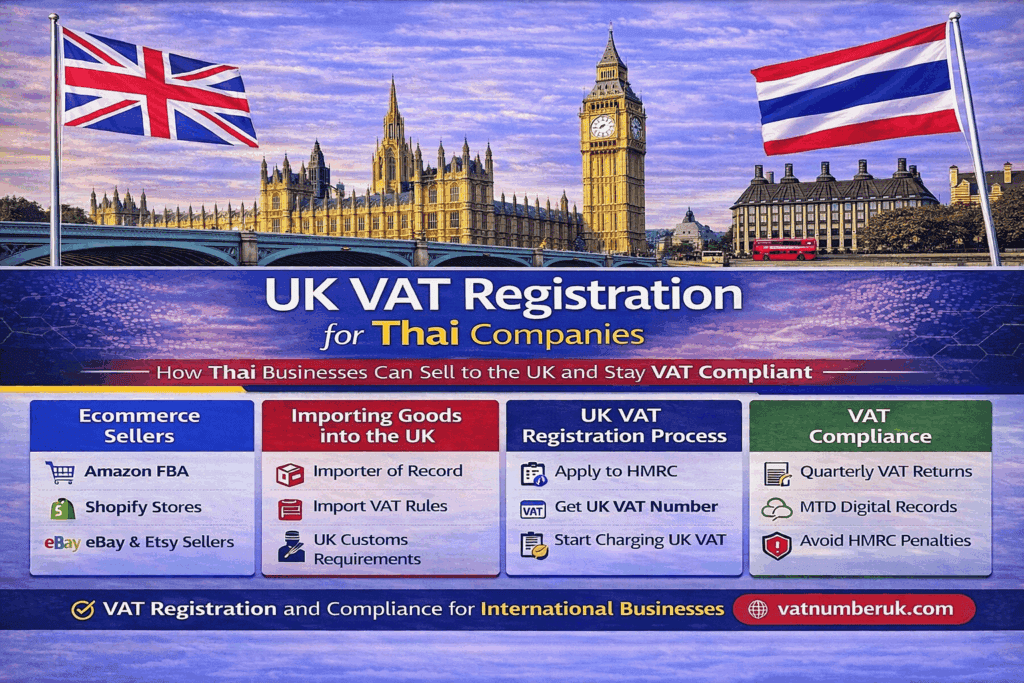
Over the past decade, more companies from Thailand have started selling to customers in the United Kingdom. In many cases, this begins with ecommerce — a Thai business lists products on Amazon UK, opens a Shopify store targeting British customers, or supplies goods to a UK distributor. Very often, the VAT question only appears later, when the business is already making sales and suddenly discovers it may need a UK VAT number.
From my experience working with international clients, Thai businesses entering the UK market usually fall into a few clear categories. There are manufacturers exporting products such as electronics components, automotive parts, textiles, furniture, and processed foods. There are also ecommerce sellers shipping products like beauty products, herbal cosmetics, spa products, kitchenware, home décor, pet products, and fashion accessories. In addition, we increasingly see Thai SaaS companies, digital agencies, and app developers selling services to UK customers.
The UK is an attractive market for Thai companies for several reasons. The UK has a large ecommerce market, strong demand for imported consumer goods, and well-developed fulfilment infrastructure. Many Thai businesses use UK fulfilment centres to store goods locally and deliver quickly to customers. However, once goods enter the UK, VAT rules apply, and this is where many Thai companies make mistakes.
This guide explains when UK VAT registration for Thailand companies is required, how the process works, and what ongoing VAT obligations look like.
Do Companies from Thailand Need UK VAT Registration?
One of the most common misunderstandings is that a company needs a UK office to register for VAT. This is not true. A company based in Thailand can be required to register for UK VAT even if it has no physical presence in the UK.
In simple terms, a Thai company must register for UK VAT if it is making taxable supplies in the UK. For foreign companies, there is usually no VAT threshold, which means registration may be required from the first sale.
Typical situations where UK VAT registration for Thailand companies becomes mandatory include:
- Importing goods into the UK in your company’s name
- Storing goods in a UK warehouse or fulfilment centre
- Selling goods located in the UK to UK customers
- Selling via Amazon FBA in the UK
- Distance selling goods to UK customers through your own website
- Some types of digital services sold directly to UK consumers
If any of these apply, the company will normally need to register VAT UK from Thailand before or soon after starting sales.
Common Scenarios When Businesses from Thailand Must Register for UK VAT
Let’s look at real-world scenarios that I commonly see with Thai businesses.
Scenario 1 — Amazon FBA Seller
A company in Bangkok sells kitchen accessories and small home products. They ship bulk stock from Thailand to an Amazon fulfilment centre in the UK. Amazon stores the goods and delivers them to customers.
Because the goods are stored in the UK and sold to UK customers, the Thai company must register for UK VAT.
Scenario 2 — Importer of Goods into the UK
A Thai manufacturer exports massage equipment and spa products to the UK and imports the goods in its own company name. The company then sells to UK wholesalers.
In this case, the Thai company is the importer and the seller in the UK, so UK VAT registration is required.
Scenario 3 — Shopify Store Shipping from UK Warehouse
A Thai skincare brand uses a UK 3PL fulfilment centre to store products and ships orders to UK customers through its Shopify website.
Because the goods are stored and dispatched in the UK, VAT registration is required.
Scenario 4 — Dropshipping with UK Stock
Some Thai ecommerce sellers work with UK suppliers who store goods in the UK and ship directly to customers. Depending on the structure, the Thai company may still be considered the seller and may need UK VAT registration.
UK VAT Rules for Ecommerce Sellers from Thailand
Many Thai businesses enter the UK market through ecommerce platforms. The most common platforms used by Thai sellers are:
- Amazon UK
- Shopify
- eBay
- Etsy (especially for handmade products, jewellery, craft items, and Thai-designed products)
Each platform has different VAT implications, but the key issue is usually where the goods are located.
If goods are located in the UK at the time of sale, UK VAT applies and the Thai company usually needs a UK VAT number.
For example:
- A Thai seller using Amazon FBA in the UK → VAT registration required
- A Thai seller storing goods in a UK fulfilment centre → VAT registration required
- A Thai seller shipping goods from Thailand directly to UK consumers → VAT may be handled differently depending on consignment value and platform rules
Many Thai sellers start by shipping directly from Thailand, and later move stock into the UK to improve delivery times. This is usually the point where VAT registration becomes necessary.
This is why UK VAT for ecommerce sellers is one of the most common services we provide to Thai companies.
Unique VAT Considerations for Businesses from Thailand
This is where Thailand is quite different from many other countries.
Thailand has a strong export-oriented economy, and several industries regularly sell to the UK market. Some important country-specific facts:
- Thailand is one of the world’s largest exporters of processed food products, including canned tuna, rice products, sauces, and ready meals.
- Thailand is a major exporter of automotive parts and electronics components, many of which are sold to UK distributors and manufacturers.
- Thailand has a globally known beauty and wellness sector, including spa products, herbal cosmetics, essential oils, and massage equipment — many of these products are sold online directly to UK consumers.
Because of this, Thai companies often enter the UK market through specific supply chains:
Typical Supply Chains from Thailand to the UK
Model 1 — Manufacturer → UK Importer → UK Customers
The Thai company sells bulk goods to a UK importer. In this case, the UK company handles VAT.
Model 2 — Thai Company Imports and Sells in UK
The Thai company imports goods into the UK and sells through Amazon or its own website. VAT registration required.
Model 3 — Ecommerce Brand with UK Fulfilment
Common for Thai skincare brands, spa products, supplements, and lifestyle products. Goods stored in UK → VAT required.
Model 4 — Direct-to-Consumer Shipping from Thailand
Common for smaller ecommerce sellers testing the UK market before moving stock into the UK.
From a VAT perspective, the biggest risk area for Thai companies is when they move from Model 4 to Model 3 and do not realise they must register for VAT.
Another important point is product regulation. Many Thai exports to the UK fall into regulated categories such as:
- Cosmetics
- Food products
- Supplements
- Electrical goods
These products often require a UK importer, UK responsible person, or UK compliance registration — and VAT registration is often part of that structure.
How Businesses from Thailand Can Register for UK VAT
The UK VAT registration process for foreign companies is quite structured. The steps are usually as follows:
- Determine if VAT registration is required
- Prepare company documents
- Complete VAT registration application
- Submit application to HMRC
- HMRC reviews the application and may request additional documents
- Receive VAT number
- Set up VAT accounting and reporting
Foreign companies register using the non-established taxable person (NETP) procedure.
It is important to register correctly from the beginning, especially if the Thai company is importing goods into the UK, because the VAT number may be required for customs and Amazon.
Documents Required for UK VAT Registration
Typically, HMRC will request the following documents from Thai companies:
- Certificate of incorporation
- Company registration documents
- List of directors
- Passport copies of directors
- Proof of business activity (website, Amazon store, contracts, invoices)
- Description of business activities
- UK warehouse or fulfilment agreement (if applicable)
- Import/export documentation
- Estimated turnover
All documents must usually be provided in English. Sometimes Thai documents must be translated.
How Long UK VAT Registration Takes
The realistic timeline for UK VAT registration for Thailand companies is usually:
- 4 to 8 weeks in straightforward cases
- 8 to 12 weeks if HMRC requests additional checks
- Longer if the business structure is complex
Many Thai companies should apply before sending goods to the UK, especially if they plan to use Amazon FBA.
UK VAT Compliance Requirements
After receiving a VAT number UK, the company must comply with UK VAT rules.
This includes:
VAT Returns
Usually submitted every quarter. The company reports:
- Sales
- Purchases
- Import VAT
- VAT payable to HMRC
Record Keeping
The company must keep records of:
- Sales invoices
- Purchase invoices
- Import documents
- Shipping documents
Making Tax Digital (MTD)
Most VAT-registered businesses must submit VAT returns using MTD-compatible software such as:
- Xero
- QuickBooks
- FreeAgent
This applies to UK VAT for foreign companies as well.
Professional Help with UK VAT Registration
Many businesses try to register for VAT themselves and run into problems — especially when HMRC asks detailed questions about the supply chain, imports, and UK activities.
VATNumberUK specialises in UK VAT registration for Thailand companies and ongoing VAT compliance. We help Thai businesses:
- Register VAT UK from Thailand
- Set up VAT reporting
- Handle HMRC correspondence
- Ensure compliance with UK VAT rules
- Work with Amazon FBA and UK fulfilment centres
If your company in Thailand is planning to sell goods or services in the UK, it is much better to check the VAT position early and register correctly from the beginning.
Contact VATNumberUK today to discuss your UK VAT registration and get your UK VAT number quickly and correctly.
SEO Summary
Title: Guide for UK VAT Registration for Thai Companies
Keyword: VAT registration for Thai Companies
Meta description: Learn when Thai companies must register for UK VAT, how the process works, and what VAT obligations apply when selling goods or services in the UK.
Rewrite the article to make it sound even more natural and human. Requirements: – increase sentence variation – remove predictable AI phrasing – improve paragraph flow – make the tone sound like an experienced VAT consultant explaining the topic to a business client – keep the SEO structure and headings intact – do not shorten the article – keep all technical details accurate The article should feel like it was written by a real specialist with practical experience helping international businesses with UK VAT.
UK VAT Registration for Thailand Companies
Introduction
Over the last few years, I’ve seen a steady increase in enquiries from companies based in Thailand that are selling to customers in the United Kingdom. In many cases, the business starts small — a few orders through Amazon UK, a Shopify store targeting British customers, or a UK distributor asking to buy products in bulk — and then the question comes up: do we need a UK VAT number?
For Thai companies, the UK is a very attractive market. British consumers are familiar with many Thai products, especially in sectors like food, wellness, homeware, and electronics accessories. Thailand is a major exporter of processed foods, rice products, sauces, canned tuna, and ready meals, many of which are sold through UK wholesalers and ethnic food distributors. At the same time, Thai beauty and spa products — herbal cosmetics, essential oils, massage balms, and skincare — are increasingly sold directly to UK consumers through ecommerce. We also see Thai manufacturers exporting furniture, lighting, automotive parts, and electronics components to UK importers.
What many businesses don’t realise is that once goods enter the UK, VAT becomes part of the picture very quickly. And unlike UK companies, foreign companies often do not get the benefit of a VAT threshold. In many situations, a Thai company must register for UK VAT from the first sale.
This guide explains when UK VAT registration for Thailand companies is required, how the process works, and what ongoing VAT responsibilities look like in practice.
Do Companies from Thailand Need UK VAT Registration?
This is usually the first question business owners ask, and the answer depends on how you sell into the UK.
A common misconception is that you only need UK VAT registration if you open a UK company or office. In reality, a company can be fully based in Thailand and still be required to register for UK VAT.
In simple terms, if your Thai company is making taxable supplies in the UK, you may need to register for VAT in the UK as a non-established taxable person (NETP). For non-UK businesses, there is usually no VAT registration threshold, which means registration may be required from the very first transaction.
Typical situations where a business must register VAT UK from Thailand include:
- Importing goods into the UK in the company’s name
- Storing goods in a UK warehouse or fulfilment centre
- Selling goods that are already located in the UK
- Using Amazon FBA in the UK
- Selling through a Shopify website with goods shipped from within the UK
- Some digital services sold directly to UK consumers
I often speak to Thai companies who assume that VAT only applies once sales reach a certain level. That is true for UK companies, but it is often not true for UK VAT for foreign companies.
Common Scenarios When Businesses from Thailand Must Register for UK VAT
It’s easier to understand VAT registration by looking at real business models. Below are typical scenarios I see with Thai clients.
Amazon FBA Seller from Thailand
A company in Thailand sells kitchen tools, silicone cookware, and small home accessories. They manufacture the products in Thailand and ship bulk stock to an Amazon fulfilment centre in the UK. Amazon stores the goods and delivers them to customers.
Because the goods are stored in the UK and sold to UK customers, the Thai company must register for UK VAT. This applies even if the company has no office, no staff, and no company in the UK.
Thai Skincare Brand Using UK Fulfilment
A Thai skincare brand selling herbal creams, coconut oil products, and spa-related cosmetics decides to improve delivery times by storing goods in a UK fulfilment warehouse and shipping orders from there to UK customers who order through Shopify.
As soon as stock is stored in the UK and sold locally, UK VAT registration is required.
Thai Manufacturer Importing Goods into the UK
A Thai company exporting massage equipment, salon furniture, or LED lighting imports goods into the UK and then sells them to UK distributors or directly to customers.
If the Thai company is the importer of record and the seller in the UK, then the company must register for UK VAT.
Dropshipping with UK-Based Stock
Some Thai ecommerce businesses sell products through eBay or Shopify and work with UK suppliers who hold the stock and ship directly to the customer. Depending on the structure, the Thai business may still be the seller to the final customer, and this can create a UK VAT obligation.
UK VAT Rules for Ecommerce Sellers from Thailand
Ecommerce is one of the main ways Thai businesses enter the UK market. The most common platforms used by Thai sellers are:
- Amazon UK
- Shopify
- eBay
- Etsy (especially for handmade products, jewellery, crafts, and Thai-designed items)
The key VAT question is always the same: Where are the goods located at the time of sale?
If the goods are located in the UK when the sale happens, then UK VAT applies and the Thai company will usually need a VAT number UK.
A typical pattern I see with Thai ecommerce businesses looks like this:
- The business starts by shipping orders directly from Thailand to UK customers.
- Delivery times are long, and returns are difficult.
- The business decides to send bulk stock to a UK fulfilment centre or Amazon FBA.
- Sales increase — but now the company has a UK VAT obligation.
This transition point — moving stock into the UK — is where VAT registration becomes necessary. Many businesses do not realise this until Amazon asks for a VAT number or a UK fulfilment centre requests VAT details.
This is why UK VAT for ecommerce sellers is such an important topic for Thai businesses selling into the UK.
Unique VAT Considerations for Businesses from Thailand
Thailand has a very specific export profile, and this affects how Thai companies typically enter the UK market and when VAT becomes relevant.
Thailand is one of the world’s largest exporters of rice and rice-based products, and many Thai food producers sell to UK importers, wholesalers, and restaurants. Large Thai food brands often sell through UK distributors, but smaller producers are increasingly selling directly to UK consumers through ecommerce websites.
Thailand is also well known for its spa and wellness industry. Products such as herbal compress balls, massage oils, essential oils, natural soaps, and aromatherapy products are commonly exported to the UK and sold online. Many of these products are small, lightweight, and well suited to ecommerce, which is why many Thai wellness brands use Amazon or Shopify to reach UK customers.
Another major sector is furniture and home décor. Thailand exports wooden furniture, rattan furniture, lighting, and decorative home items. These products are often shipped in bulk to the UK and then stored in a UK warehouse before being sold. When the Thai company owns the goods in the UK and sells them locally, UK VAT registration is required.
In terms of logistics, Thai companies typically ship goods to the UK by sea freight to ports such as Felixstowe, Southampton, or London Gateway, and then goods are moved to fulfilment centres. Once goods are imported and stored in the UK, they enter the UK VAT system.
So from a VAT perspective, the key risk areas for Thai businesses are:
- Importing goods into the UK in the company’s name
- Holding stock in UK warehouses
- Selling through Amazon FBA
- Selling directly to UK consumers from UK stock
These situations almost always require UK VAT registration for Thailand companies.
How Businesses from Thailand Can Register for UK VAT
The VAT registration process for a Thai company is quite structured, but it must be done correctly, especially if the company is importing goods into the UK.
The typical process looks like this:
- Review the business model and confirm whether VAT registration is required
- Gather company documents
- Complete the UK VAT registration application for a non-UK company
- Submit the application to HMRC
- HMRC may request additional information about the business and UK activities
- HMRC issues the VAT number
- The company sets up VAT reporting and accounting
It is very important that the VAT registration details match the import structure, Amazon account details, and fulfilment arrangements. If the structure is wrong, it can create problems with customs, Amazon, or VAT reporting later.
Documents Required for UK VAT Registration
HMRC will usually request a number of documents to support a VAT registration application from a Thai company. These typically include:
- Certificate of incorporation of the Thai company
- Company registration documents
- Details of directors and shareholders
- Passport copies of directors
- Description of business activities
- Company website or online store links
- Contracts with UK warehouses or fulfilment centres (if applicable)
- Import documentation and shipping documents
- Expected sales figures in the UK
If documents are in Thai, HMRC may require translations into English.
How Long UK VAT Registration Takes
In most cases, UK VAT registration for Thailand companies takes:
- Around 4–8 weeks in straightforward cases
- Around 8–12 weeks if HMRC asks additional questions
- Sometimes longer if the business model is complex or involves imports, Amazon FBA, or multiple sales channels
I usually advise Thai companies to start the VAT registration process before shipping stock to the UK, not after.
UK VAT Compliance Requirements
Registering for VAT is only the first step. After receiving a VAT number UK, the company must comply with ongoing VAT obligations.
VAT Returns
Most businesses submit VAT returns every quarter. The VAT return shows:
- Sales to UK customers
- Purchases and expenses
- Import VAT
- VAT payable to HMRC
Record Keeping
The company must keep proper records, including:
- Sales invoices
- Purchase invoices
- Import VAT certificates
- Shipping and customs documents
- Warehouse reports
- Amazon or Shopify sales reports
Making Tax Digital (MTD)
VAT returns must usually be submitted through Making Tax Digital (MTD) compatible software such as:
- Xero
- QuickBooks
- FreeAgent
This applies to UK VAT for foreign companies, including companies based in Thailand.
Professional Help with UK VAT Registration
In practice, most Thai companies prefer to work with a VAT specialist, especially if they are importing goods, using Amazon FBA, or storing goods in the UK. HMRC often asks detailed questions about how goods move from Thailand to the UK, who is the importer, where goods are stored, and how sales are made. If the answers are not clear, the registration can be delayed.
VATNumberUK helps with UK VAT registration for Thailand companies, including:
- VAT registration for non-UK companies
- Amazon FBA VAT registration
- Shopify and ecommerce VAT registration
- VAT returns and ongoing compliance
- Communication with HMRC
- Advice on UK import and VAT structure
If your company is planning to sell goods or services in the UK, it is much easier to set up the VAT side correctly from the beginning rather than trying to fix problems later.
If you need help to register VAT UK from Thailand, you can contact VATNumberUK and we will guide you through the process and help you obtain your UK VAT number and stay compliant with UK VAT rules.