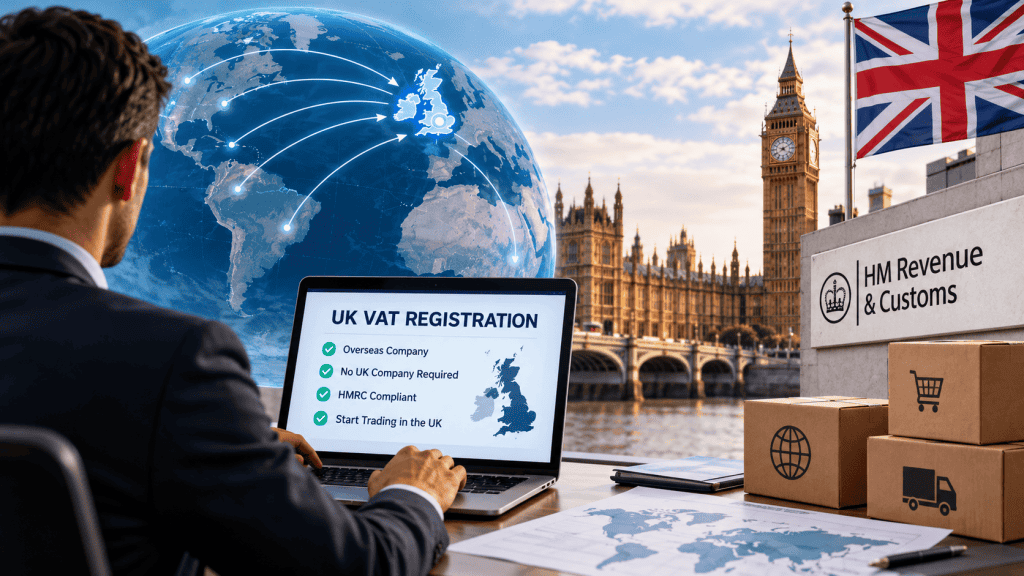
UK VAT Registration Without a UK Company
An overseas company can register for UK VAT without establishing a UK limited company, appointing British directors or opening a physical office in the United Kingdom. HM Revenue & Customs (HMRC) permits foreign businesses to obtain a UK VAT number directly in the name of their existing overseas legal entity. In some circumstances, registration is compulsory even where the company has no employees, premises or management presence in Britain.
For international businesses entering the British market, this distinction has considerable practical value.
A company incorporated in the United States, Germany, China, Singapore, the United Arab Emirates or another jurisdiction can retain its existing corporate structure while meeting its UK VAT obligations. There is no general requirement to establish a British subsidiary simply because the overseas company imports goods, holds stock in the UK or makes taxable supplies to British customers.
However, the ability to register and the obligation to register are two different questions.
A foreign company selling machinery to a British importer may have no requirement to obtain a UK VAT number. Another company selling identical machinery from stock held in a British warehouse may be required to register before its first taxable sale.
The difference is not the nationality of the company, the value of the goods or the location of the customer. It is the legal and commercial structure of the transactions.
The identity of the importer, the location of goods when they are sold, the contractual arrangements and the responsibility for accounting for VAT can all change the result.
These distinctions are particularly important for overseas manufacturers, international wholesalers, Amazon FBA sellers, Shopify businesses and digital service providers.
Incorrect assumptions can lead to retrospective VAT liabilities, difficulties recovering import VAT, registration delays and unexpected compliance costs.
Equally, establishing a UK company unnecessarily can introduce additional corporate administration without providing any meaningful VAT advantage.
The starting point should therefore be the company’s actual trading activities and the relevant HMRC requirements, not an assumption that a British VAT number must belong to a British company.
Can an Overseas Company Register for UK VAT Without a UK Company?
Yes. An overseas company can register directly for UK VAT without incorporating a British company. HMRC registers the existing foreign legal entity, provided it has a qualifying obligation or entitlement to register. A UK office, British director, UK shareholder or locally incorporated subsidiary is not a general requirement for VAT registration.
Consider a company incorporated in Singapore that plans to sell electronic accessories to customers throughout Britain.
The company purchases products from manufacturers in Asia and ships them to a third-party fulfilment centre in Birmingham. Orders are received through its own ecommerce website, and the warehouse dispatches products to British consumers.
All strategic management decisions take place in Singapore. The company has no British employees, shareholders or directors.
Nevertheless, the business makes taxable supplies of goods located in the UK.
It can register directly with HMRC using its existing Singapore legal identity.
Once registered, the company receives a UK VAT number and becomes responsible for the VAT obligations associated with its British trading activities.
It does not become a UK limited company merely because it holds that registration.
Its ownership structure remains unchanged. Its corporate existence continues to be governed by the laws of Singapore.
The UK VAT registration is a separate tax registration.
This is commercially significant because businesses frequently confuse three distinct matters:
- Company incorporation: the legal creation of a company under the corporate laws of a particular jurisdiction.
- VAT registration: registration with HMRC to account for UK Value Added Tax.
- UK business establishment: the existence of an establishment in Britain under the relevant VAT rules.
One does not automatically create the others.
An overseas company can possess a UK VAT number without having a UK business establishment. It can also have commercial activities that create UK tax obligations without incorporating a British subsidiary.
For an international company that only needs to import goods and distribute them in the British market, direct VAT registration may be the appropriate arrangement.
Businesses preparing to enter the UK market can obtain further information through our UK VAT registration service for overseas businesses.
What Is a Non-Established Taxable Person Under HMRC Rules?
A non-established taxable person (NETP) is a business that makes or intends to make taxable supplies in the UK without having a UK establishment for VAT purposes. These businesses are subject to specific registration rules, including the absence of the ordinary domestic VAT registration threshold. Overseas incorporation alone does not determine establishment status.
The expression non-established taxable person is central to understanding how foreign companies register for UK VAT.
HMRC distinguishes between a business that genuinely belongs in the UK and one that operates from overseas but undertakes activities falling within the British VAT system.
The distinction is based on substance rather than appearances.
A company does not necessarily become established in Britain because it:
- Holds a UK VAT number.
- Has British customers.
- Uses a UK warehouse.
- Appoints a British VAT accountant.
- Maintains a virtual office or correspondence address.
- Operates an account with a British online marketplace.
HMRC considers whether the company has an appropriate UK business establishment or fixed establishment.
A business establishment generally relates to the place where essential management decisions are made and central administration is performed.
A fixed establishment requires a sufficiently permanent presence supported by suitable human and technical resources.
This is why the use of a third-party warehouse needs careful analysis.
Suppose a Canadian retailer stores inventory with an independent logistics provider in Manchester.
The warehouse operator receives goods, stores them, packages customer orders and arranges delivery.
However, all sales decisions, commercial contracts and management functions remain with the Canadian company.
The warehouse arrangement does not automatically mean the Canadian company has a fixed establishment in the UK.
The retailer may still be a non-established taxable person despite making taxable supplies from UK inventory.
Conversely, an overseas company operating through a permanent UK team with substantial resources and commercial responsibilities may require a different establishment analysis.
A UK address on a website or invoice does not settle the question.
Neither does the absence of British incorporation.
HMRC is concerned with where the business actually operates, the resources available to it and how its transactions are carried out.
This classification matters because it determines which registration rules apply, how certain supplies are treated and whether the company can rely on thresholds available to UK-established businesses.
Does the £90,000 UK VAT Registration Threshold Apply to Overseas Companies?
The standard £90,000 UK VAT registration threshold generally does not apply to non-established taxable persons. An overseas business without a UK establishment may be required to register from its first taxable UK supply, regardless of turnover. The determining factor is whether the company makes taxable supplies in Britain, not how much revenue it generates.
This is one of the most consequential differences between a UK-established business and an overseas company.
A British company making ordinary taxable supplies may generally remain outside compulsory VAT registration while its taxable turnover is below the applicable threshold.
An overseas company classified as an NETP cannot normally rely on that threshold.
Consider an American business holding £15,000 worth of products in a UK warehouse.
During its first month, the company sells only £2,000 of goods to British consumers.
The directors might assume that VAT registration is unnecessary because annual revenue is far below £90,000.
However, if the company is making taxable domestic UK supplies as a non-established business, the absence of the ordinary threshold means registration may already be compulsory.
The monetary value of the transactions does not determine whether the registration obligation arises.
When does the obligation to register begin?
Under the NETP rules, liability can arise when the overseas business makes its first taxable UK supply or when it has reasonable grounds to expect taxable UK supplies within the following 30 days.
A business that becomes liable must generally notify HMRC within 30 days.
The effective registration date is determined by the relevant statutory rules, not simply by the date HMRC approves the application.
This distinction matters because HMRC may issue a VAT number several weeks after the company’s registration obligation arose.
The business may still need to account for transactions occurring between those dates.
For an overseas seller, the commercial consequences can be substantial.
Suppose an international retailer launches a UK ecommerce operation and begins selling products at a consumer price of £120.
If those products are standard-rated and the £120 represents a VAT-inclusive price, £20 of each sale represents VAT.
The business cannot assume that VAT becomes payable only after HMRC issues its registration certificate.
Where liability arose earlier, the company may need to account for VAT from the effective registration date.
This is why registration planning should take place before taxable trading begins.
When Does an Overseas Company Not Need UK VAT Registration?
An overseas company does not automatically require UK VAT registration simply because it has British customers. Registration may be unnecessary where the relevant supplies take place outside the UK, the British customer accounts for VAT under the reverse charge, or a qualifying online marketplace assumes VAT responsibility. The precise circumstances must be established.
The location of a customer does not, by itself, determine the place of supply.
For businesses selling physical goods, the movement of the products and the contractual arrangements are often decisive.
Consider a German manufacturer selling industrial equipment to a UK engineering company.
The equipment is manufactured in Germany and sold under arrangements whereby the British customer assumes responsibility for importing it into the United Kingdom.
If the relevant supply takes place outside Britain, the German manufacturer may not have made a UK taxable supply.
The British purchaser deals with the import procedures and applicable import VAT.
The overseas supplier does not necessarily need a UK VAT number for that transaction.
Now consider the same manufacturer establishing inventory in a warehouse in Leeds.
The German company retains ownership of the goods while they are stored in Britain and subsequently sells them to domestic customers.
Those sales may constitute taxable UK supplies.
The manufacturer could therefore become liable to register even if its annual UK turnover is very small.
The underlying product has not changed.
The difference lies in where the goods are situated and how the sale takes place.
Services supplied to British businesses
For many business-to-business services, the UK reverse charge mechanism transfers responsibility for accounting for VAT to the British customer.
A consultancy incorporated in Singapore might provide management advice to a VAT-registered UK company.
Where the general B2B place-of-supply rule and reverse charge apply, the Singapore supplier would not normally have to register for UK VAT solely because of those services.
HMRC treats the relevant VAT as being accounted for by the customer.
This can also apply to certain cross-border accounting, legal, consulting, software and professional services.
However, not every service follows the general rule.
Services relating to UK land, admission to certain events, catering and other specifically regulated activities may require a different analysis.
A company should therefore establish the correct VAT treatment of the service rather than assuming every B2B transaction qualifies for reverse charge treatment.
Zero-rated and exempt supplies
Another important distinction concerns businesses making zero-rated or exempt supplies.
Zero-rated supplies are taxable supplies subject to VAT at 0%.
A business making exclusively qualifying zero-rated supplies may be eligible to apply for exemption from registration.
Exempt supplies are different.
A business making only exempt supplies generally cannot register for VAT on the basis of those activities.
The distinction also affects the recovery of VAT on business expenditure.
An overseas company should consider both its registration obligations and the potential financial consequences of operating without a VAT registration.
Avoiding registration is not automatically the most advantageous outcome, particularly where the business incurs significant recoverable import VAT.
Can an Overseas Company Use Amazon FBA Without Establishing a UK Company?
Yes. An overseas company can use Amazon FBA and register directly for UK VAT without incorporating a British subsidiary. However, the presence of inventory in UK fulfilment centres creates important VAT considerations. Amazon may account for VAT on qualifying marketplace sales, while the overseas seller remains responsible for other transactions and import obligations.
Amazon FBA is one of the clearest examples of how an international business can develop substantial UK trading activities without having a British company.
Consider a Chinese manufacturer selling household products through Amazon UK.
The manufacturer imports inventory into Britain and places it in an Amazon fulfilment centre.
Amazon stores the goods, processes orders and arranges delivery to customers.
The Chinese company remains the overseas legal entity carrying on the business.
There is no requirement to establish a UK limited company simply to hold the inventory or obtain VAT registration.
However, the VAT treatment of the resulting sales requires particular attention.
When Amazon accounts for UK VAT
Under the online marketplace rules, where goods are located in the UK at the point of sale and are sold through a qualifying online marketplace by a non-established seller, the marketplace will generally account for VAT on sales to consumers.
For these transactions, the overseas seller is ordinarily treated as making a zero-rated deemed supply to the marketplace.
The marketplace then accounts for VAT on the sale to the consumer.
This does not automatically eliminate every VAT responsibility of the overseas business.
The seller remains responsible for its import arrangements and may have other transactions for which it must account for UK VAT directly.
For example, sales to UK VAT-registered business customers can be treated differently.
The business may also sell products outside Amazon, maintain other sales channels or undertake transactions that do not qualify for marketplace VAT accounting.
Can an Amazon seller avoid VAT registration entirely?
In certain circumstances, an overseas seller making exclusively qualifying zero-rated deemed supplies through a marketplace may apply for exemption from VAT registration.
Whether this is appropriate requires commercial judgement.
Suppose the seller imports £100,000 of standard-rated goods into the UK, with £20,000 of import VAT arising.
If the seller has an appropriate VAT registration and meets the normal recovery conditions, that import VAT may be recoverable.
If the business instead obtains exemption from registration, it will generally lose the ability to recover the import VAT through normal UK VAT returns.
The business may therefore face a significant tax cost even though Amazon accounts for VAT on its customer sales.
The most favourable arrangement cannot be determined simply by asking whether Amazon collects VAT.
The correct analysis must consider import VAT, input tax recovery, marketplace transactions, direct sales and future expansion.
A fuller examination of these issues is available in our article on UK VAT registration for overseas companies using fulfilment centres and 3PL warehouses.
Do Overseas Shopify Sellers Need UK VAT Registration?
An overseas Shopify seller may need UK VAT registration even without a British company. Unlike qualifying online marketplaces, Shopify generally provides ecommerce infrastructure rather than assuming responsibility for VAT on the merchant’s sales. The seller must therefore establish its own VAT obligations based on product location, shipment value and customer status.
For independent ecommerce businesses, fulfilment arrangements are often the determining factor.
A company selling directly to British consumers from overseas may face different rules from a company storing products in Britain before sale.
Goods shipped directly from overseas
Consider an American clothing business shipping individual customer orders from the United States to England.
For qualifying consignments with an intrinsic value of £135 or less, UK VAT is generally charged at the point of sale.
Where the overseas seller makes these direct sales to consumers, it normally becomes responsible for accounting for that VAT.
If it is a non-established taxable person, registration can be required from the first qualifying taxable supply.
The £135 threshold applies to the relevant consignment rather than to each individual product.
For example, two items priced at £80 each and shipped together would normally produce a consignment value of £160.
The business must consider the appropriate treatment of the complete consignment.
For goods exceeding £135, normal import VAT and customs rules generally apply.
The VAT consequences then depend on the import arrangements and the underlying contractual position.
The £135 rules also contain exceptions, including specific treatment of excise goods and certain business-to-business transactions.
Goods stored in a British warehouse
Now suppose the American retailer decides to improve delivery times.
It sends 10,000 garments to a warehouse in Manchester before customers purchase them.
The warehouse subsequently dispatches products to British consumers as orders are received through Shopify.
The goods are situated in the UK when sold.
The American company is therefore making domestic UK supplies and will generally require VAT registration.
The business does not need a British company, but it needs to account correctly for its UK sales.
This creates additional commercial considerations.
Retail prices must reflect the applicable VAT treatment. Import VAT should be addressed before stock arrives. The business must also establish how sales, returns and refunds will be recorded.
A company can operate Shopify successfully without a UK subsidiary, but its accounting systems must reflect the actual VAT obligations.
Combining Shopify and Amazon
A further complication arises when the same overseas company sells through several channels.
Amazon may account for VAT on qualifying marketplace transactions.
Shopify sales may remain the seller’s own taxable supplies.
Wholesale orders to British retailers may have another treatment.
The company’s UK VAT return must reflect those differences.
Treating every transaction as an Amazon marketplace sale would be incorrect.
Likewise, calculating VAT only from Shopify payment settlements may omit relevant transactions or produce inaccurate figures.
For businesses selling through multiple channels, a transaction-by-transaction classification is essential.
Can Foreign Manufacturers and Wholesalers Register Directly for UK VAT?
Foreign manufacturers and wholesalers can register directly for UK VAT without incorporating a British company. Registration is often required where they import goods into the UK and subsequently make taxable domestic supplies. Where goods are sold outside Britain and the UK purchaser imports them, registration may not be necessary for those transactions alone.
For traditional international trade, the critical issues are usually contractual ownership, the movement of goods and the identity of the importer.
Consider a Swiss manufacturer supplying industrial machinery to customers in Britain.
Under one arrangement, the British purchaser buys the machinery in Switzerland and takes responsibility for importing it.
Under another, the Swiss supplier imports the equipment into Britain, retains ownership and sells it after customs clearance.
These arrangements may produce different VAT results.
The relevant Incoterms provide useful information about delivery responsibilities, costs and risks, but they do not independently determine every VAT consequence.
The actual contractual provisions and transactions must be examined.
Why Delivered Duty Paid arrangements require attention
Delivered Duty Paid, commonly referred to as DDP, can create particular complications for overseas suppliers.
Under DDP arrangements, the seller generally assumes extensive responsibilities relating to delivery and importation.
However, the use of DDP terminology does not automatically establish the legal place of supply or resolve the question of who is entitled to recover import VAT.
A proper review should examine the purchase contract, ownership provisions, customs declaration and the arrangements for paying import charges.
Suppose a manufacturer in Turkey supplies machinery to a British customer.
The Turkish company agrees to arrange customs clearance and bear the import charges.
If its contractual arrangements mean that it imports the machinery before making a taxable UK supply, UK VAT registration may be necessary.
Simply describing the transaction as an export from Turkey would not resolve the British VAT position.
Holding stock before customers purchase it
Another common arrangement involves overseas manufacturers placing products in UK warehouses for subsequent distribution.
A foreign supplier might hold spare parts in Britain so that customers can obtain replacements quickly.
Although no British subsidiary exists, the supplier retains ownership of the parts until customers place orders.
The eventual domestic sales can create UK VAT registration obligations.
The same issue can arise with consignment stock, call-off arrangements and inventory held by independent distributors.
The specific contractual terms matter, and special VAT arrangements may apply in some circumstances.
An experienced adviser therefore examines when ownership changes, whether the customer has already purchased the goods and who is legally making the supply.
For manufacturers dealing in high-value products, the consequences of an incorrect classification can be considerably greater than the administrative cost of obtaining a VAT number.
Do Overseas SaaS and Digital Service Providers Need a UK Company for VAT?
Overseas SaaS and digital service providers do not need a UK company to register for VAT. Their obligations depend primarily on the nature of the services and whether customers are businesses or consumers. Electronically supplied services to UK consumers can create a registration requirement, while qualifying B2B services are generally subject to reverse charge treatment.
For service businesses, the challenge is often identifying where a supply takes place.
A company incorporated in Singapore might sell software subscriptions to customers around the world.
Its British customers could include large corporations, small businesses and private individuals.
Those customer categories may produce different VAT obligations.
Business-to-business software services
Suppose the Singapore company supplies cloud-based accounting software to a VAT-registered British business.
Where the relevant B2B place-of-supply rules apply, the UK customer generally accounts for VAT under the reverse charge.
The Singapore provider would not normally need UK VAT registration solely for that transaction.
The same principle can apply to many professional and consulting services supplied to British businesses.
However, the supplier should retain appropriate evidence that its customer is genuinely acting in a business capacity.
A customer’s UK address is not sufficient by itself to establish the correct treatment.
Digital services supplied to consumers
Now consider the same company providing automated software subscriptions directly to British individuals.
Electronically supplied services to UK consumers are generally subject to UK VAT.
A non-established supplier may therefore need to register and account for VAT from its first qualifying taxable supply.
This can arise even where the company has no UK employees, office or servers.
The service may be delivered entirely from infrastructure located overseas.
Nevertheless, the customer’s location can determine the VAT treatment.
The business must also distinguish genuinely automated digital services from services involving substantial human intervention.
An automated software subscription and an individual professional consultation conducted by video call are not necessarily treated identically.
For digital platforms, another issue is whether the platform acts as the supplier for VAT purposes.
Where a qualifying platform accounts for VAT on consumer transactions, the underlying service provider may have a different registration position.
These arrangements should be reviewed using the relevant contractual terms rather than the labels used in marketing materials.
How Can an Overseas Company Apply for UK VAT Registration?
An overseas company can apply directly to HMRC for VAT registration using its existing foreign legal identity. The application must explain the company’s activities, the reason UK VAT registration is required or permitted and the appropriate effective registration date. An authorised VAT agent can manage the procedure on the company’s behalf.
The most effective registration process begins with establishing the VAT position rather than immediately completing the application.
HMRC needs to understand why the overseas company should be registered.
This usually requires identifying the relevant UK taxable supplies and demonstrating how the business operates.
Establish the correct applicant
The registration must identify the legal entity responsible for making the supplies.
For example, where a German GmbH imports and sells products in Britain, the VAT application should generally identify the German company.
It should not be submitted in the personal name of the managing director simply because that person owns the business.
Equally, the overseas company should not register under the details of an unrelated British agent or logistics provider.
The legal entity shown on commercial invoices, company documents and the application should be consistent.
Determine the registration date
The effective date is one of the most important elements of the application.
A company that has not yet begun trading may have a different registration position from a company that has already made taxable UK sales.
Where the business has traded before applying, the potential liability for retrospective registration must be assessed.
Choosing a convenient current date does not eliminate an earlier statutory obligation.
HMRC can examine the actual transaction history and determine that registration should have started earlier.
Explain the UK trading activity
A description such as “international business” or “online trading” does not adequately explain why a foreign company requires UK VAT registration.
A more informative explanation might establish that a Canadian company imports consumer electronics into a fulfilment warehouse in Birmingham and sells those products to British consumers.
This identifies the nature of the products, their physical location and the trading arrangement.
For a SaaS business, HMRC may need to understand the nature of its digital services and whether customers are businesses or consumers.
For a wholesaler, the relevant import and supply arrangements may be particularly important.
The objective is to provide a clear and consistent explanation that can be supported by appropriate evidence.
Submit the application and respond to enquiries
Once the registration information is prepared, the application can be submitted through the appropriate HMRC process.
HMRC may request additional evidence before issuing the registration number.
Processing times vary.
An overseas company should not assume that approval will be immediate or that submitting an application guarantees registration.
Where HMRC requires clarification, accurate and prompt responses can prevent avoidable delays.
Businesses planning significant imports or marketplace launches should take the expected registration process into account when organising their operations.
What Documents Does HMRC Require from an Overseas Company?
HMRC generally requires sufficient information to establish the overseas company’s legal identity and the nature of its UK taxable activities. Supporting evidence may include foreign incorporation documents, director information, commercial contracts, website details, supplier invoices, warehouse agreements and customs records. The precise requirements depend on the business and its registration circumstances.
There is no universal document package suitable for every overseas applicant.
An established manufacturer, a new ecommerce company and a digital service provider will have different types of commercial evidence.
For an incorporated business, the starting point is usually evidence of its legal existence.
This may include a certificate of incorporation or equivalent registration document, together with details of the company’s registered and principal business addresses.
HMRC may also require information about directors, authorised individuals and the company’s ownership or control.
The more complex questions often concern evidence of trading.
Evidence for ecommerce companies
An overseas ecommerce business may be asked to demonstrate how it intends to sell products in Britain.
Relevant evidence could include supplier invoices, website details, marketplace information, product descriptions and fulfilment agreements.
Where products are already stored in the UK, warehouse records and import documents may help establish the underlying transactions.
A company that has not yet commenced trading may need to demonstrate a credible intention to make taxable supplies.
For example, commercial agreements or purchase orders may support an application based on planned UK activities.
HMRC is entitled to distinguish genuine intended business activity from applications submitted without a qualifying VAT registration basis.
Evidence for manufacturers and wholesalers
A foreign manufacturer may need to provide customer contracts, invoices, shipping documents and an explanation of the arrangements for importing goods.
The documents should be consistent about the company responsible for the transaction.
A common difficulty arises where one legal entity appears on the purchase contract, another on the commercial invoice and a third on the customs declaration.
Such inconsistencies do not necessarily prevent registration, but they can make the underlying commercial arrangements difficult to establish.
The correct approach is to explain the relationship between the parties and provide evidence supporting the actual transaction structure.
Evidence for service providers
For services, HMRC may need to understand what the company supplies, where its customers belong and why the supplies fall within the UK VAT system.
A business describing itself as a software company might provide automated subscriptions, bespoke development services or consultancy.
Those services do not necessarily have identical VAT treatments.
Accurate descriptions are therefore more valuable than broad commercial terminology.
For a detailed examination of supporting evidence, see our article on documents needed for UK VAT registration.
Does an Overseas Company Need a UK Address, Bank Account or EORI Number?
A UK business address, British bank account and EORI number are not interchangeable requirements. An overseas company does not generally need a British office or bank account merely to obtain VAT registration. However, a business importing goods may need an appropriate EORI number, while banking arrangements must support its VAT payments and repayments.
These requirements are frequently confused because overseas businesses encounter them at approximately the same stage of entering the UK market.
A freight forwarder may ask for an EORI number.
A marketplace may ask for a VAT number.
A customer may request the company’s business address.
A bank may ask for information about its legal structure.
Each requirement serves a different purpose.
UK business address
An overseas company can normally use its genuine foreign business address when registering for UK VAT.
There is no general requirement to rent a British office simply because the company intends to sell taxable goods in Britain.
Using a virtual UK office does not necessarily establish a genuine UK business presence.
If the company is managed from Hong Kong, its actual principal place of business should not be disguised as a London correspondence address.
HMRC may examine the company’s real operating arrangements when determining its establishment status.
UK bank account
A British bank account is not a universal condition of VAT registration.
An overseas business may nevertheless need suitable arrangements for making VAT payments and receiving repayments.
Before applying, the company should consider how it will settle liabilities in sterling and how repayments will be received.
Banking requirements can vary, and the absence of a conventional British business account does not automatically prevent an overseas company from registering.
However, practical payment and repayment arrangements should not be left unresolved until the first VAT return becomes due.
UK EORI number
An Economic Operators Registration and Identification number, or EORI number, is used for customs identification.
A business importing goods into Great Britain may require a GB EORI number.
A UK VAT number and a GB EORI number perform different functions.
A company may need both when importing goods for subsequent domestic sales.
Northern Ireland can require additional consideration because specific customs and VAT arrangements apply to certain movements involving Northern Ireland and the European Union.
The overseas business should therefore identify its intended supply routes before arranging customs registrations.
Can an Overseas Company Recover UK Import VAT Without a UK Subsidiary?
Yes. An overseas company registered for UK VAT can generally recover qualifying import VAT where it satisfies the normal input tax recovery conditions. A UK subsidiary is not required solely for this purpose. The essential considerations include entitlement to recovery, the ownership and business use of the goods, and appropriate import VAT evidence.
Import VAT recovery is often one of the main commercial reasons for arranging VAT registration correctly.
Consider an American company importing goods with a customs value of £150,000 into Britain.
Assume, for illustration, that the relevant import VAT amounts to £30,000.
If that VAT is recoverable, the company’s final tax cost may be substantially lower than if recovery is unavailable.
However, the company cannot simply reclaim import VAT because it paid an invoice issued by a freight forwarder.
The business must establish its entitlement under the UK VAT rules.
Why identifying the importer matters
Suppose the American company purchases goods in China and ships them to a British warehouse.
A freight forwarder arranges customs clearance.
The company subsequently seeks to reclaim import VAT through its UK VAT return.
If the customs documentation identifies another business as the importer, HMRC may question the American company’s entitlement to the claimed VAT.
The issue is not necessarily resolved by producing evidence that the American company ultimately funded the shipment.
The relevant import records and commercial arrangements must support the recovery position.
Before importing goods, the company should establish who owns the goods at importation, who acts as importer, which EORI number is used and how import VAT will be documented.
Postponed VAT accounting
Postponed VAT accounting can provide substantial cash-flow benefits to eligible VAT-registered importers.
Instead of paying import VAT upfront and subsequently reclaiming it, the importer accounts for the relevant VAT through its VAT return.
Where the company has full input VAT recovery entitlement, the corresponding input tax may generally be reclaimed on the same return.
Suppose an overseas retailer imports stock giving rise to £40,000 of import VAT.
If the appropriate postponed VAT accounting arrangements are used and all £40,000 is recoverable, the company can account for the import VAT and corresponding input tax within the same reporting period.
The arrangement may avoid the need to finance a £40,000 VAT payment while awaiting recovery.
However, postponed VAT accounting is not a VAT exemption.
The relevant VAT must still be reported correctly.
Where input VAT recovery is restricted, the restriction continues to apply.
Non-established importers should also ensure that the necessary customs arrangements, including any required representative arrangements, are properly established.
The commercial benefit depends on the entire import and VAT reporting process operating correctly.
Can an Overseas Company Appoint a UK VAT Agent Instead of Incorporating?
Yes. An overseas company can appoint a UK VAT agent to manage HMRC registration, correspondence, VAT returns and related compliance matters without incorporating a British company. The agent acts on behalf of the foreign business. The overseas legal entity generally remains responsible for its VAT obligations and any tax payable.
For many international businesses, professional representation is more practical than creating a separate corporate structure.
A company established in Canada may need to import goods into Britain and submit quarterly VAT returns.
It may have no intention of employing British personnel or managing operations from the UK.
Its principal requirements may concern VAT registration, customs coordination, reporting and communication with HMRC.
These functions can be managed through an authorised VAT agent.
VAT agent versus VAT representative
The terminology needs to be used carefully.
An ordinary VAT agent is authorised to assist the overseas company with specified HMRC matters.
An agent does not ordinarily become jointly liable for the company’s VAT debts merely because it prepares returns or manages correspondence.
A formally appointed VAT tax representative has a different legal position.
Under the relevant UK rules, a tax representative can become jointly and severally liable for VAT debts of the overseas business.
This is a substantial legal responsibility.
HMRC can require certain non-established taxable persons to appoint a tax representative in appropriate circumstances, subject to the applicable statutory rules and international arrangements.
HMRC may also require security where the relevant conditions are met.
Overseas companies should not assume that appointing a VAT agent and appointing a statutory tax representative are the same thing.
The appropriate arrangement depends on the company’s jurisdiction, commercial activities and HMRC requirements.
VAT Number UK provides UK VAT agent services for overseas businesses, covering registration assistance, VAT administration and ongoing communication with HMRC.
What Are the Compliance Obligations After UK VAT Registration?
An overseas company registered for UK VAT must meet the applicable HMRC reporting and record-keeping requirements. These generally include submitting VAT returns, accounting for taxable sales, maintaining appropriate transaction evidence and complying with Making Tax Digital. The business remains responsible for these obligations even though its management and accounting operations are located abroad.
Obtaining the VAT number is only the beginning of the compliance process.
The company must establish how its UK transactions will be recorded and how the relevant VAT figures will be calculated.
For an international business, the necessary information may originate from several countries and accounting systems.
A company selling through Amazon and Shopify might receive data from marketplace reports, payment processors, customs records, freight agents and warehouse operators.
These sources do not necessarily use the same reporting conventions.
VAT returns
Most UK VAT-registered businesses submit VAT returns quarterly, although other accounting arrangements may apply.
The returns report relevant output VAT, deductible input VAT and other prescribed figures.
For overseas companies, preparation can be complicated by different currencies, import VAT, marketplace deemed supplies, refunds and stock movements.
A recurring error involves using marketplace settlement payments as the company’s sales turnover.
Suppose Amazon reports £50,000 of customer sales but transfers only £39,000 after deducting fees, refunds, advertising charges and other adjustments.
The £39,000 payment does not automatically represent the value of taxable supplies for VAT reporting purposes.
The underlying transactions must be identified and treated according to the applicable rules.
Marketplace sales for which the platform accounts for VAT must also be distinguished from transactions for which the overseas seller is responsible.
A business operating several sales channels should reconcile them separately before preparing its VAT return.
Making Tax Digital
Most VAT-registered businesses, including overseas companies, must comply with Making Tax Digital for VAT unless an exemption applies.
This involves maintaining specified digital records and submitting VAT returns through compatible software.
The fact that an overseas company uses accounting software in its country of incorporation does not automatically establish compliance with UK requirements.
Its systems must be capable of producing accurate UK VAT records and supporting the required digital reporting process.
For ecommerce businesses, the challenge is not merely technical.
The software must correctly distinguish UK taxable sales, zero-rated supplies, overseas transactions, input VAT and relevant marketplace arrangements.
Digital accounting cannot compensate for an incorrect understanding of the underlying tax treatment.
VAT records and HMRC reviews
Businesses must generally retain VAT records for six years, subject to any specific rules requiring a different period.
Relevant evidence may include invoices, import statements, customs declarations, sales records, credit notes and supporting accounting information.
An overseas company must be able to provide records to HMRC where required.
During a compliance review, HMRC may examine whether the company registered at the correct time, applied the appropriate VAT treatment and claimed input VAT correctly.
For businesses with international supply chains, inconsistencies between customs records, marketplace transactions and VAT returns can attract particular attention.
Companies seeking ongoing reporting assistance can review our UK VAT returns service.
What Happens If an Overseas Company Registers for UK VAT Too Late?
An overseas company that fails to register when required may face retrospective VAT liabilities, interest and penalties. HMRC can establish an effective registration date based on when the obligation originally arose. The company may then need to reconstruct historical sales, calculate VAT due and submit outstanding returns.
Late registration is a particularly serious risk for non-established taxable persons because the normal UK VAT threshold generally does not apply.
Consider a foreign ecommerce company that has been selling products from a British warehouse for eighteen months.
Its management believed that UK VAT registration would become compulsory only when turnover reached £90,000.
The company therefore continued trading without registration.
After reviewing the arrangements, it discovers that it should have registered when it began making taxable UK supplies.
The company may need to account for VAT retrospectively.
The commercial impact of historical VAT
Suppose the company made £240,000 of standard-rated sales to consumers at prices that were contractually VAT-inclusive.
At a 20% VAT rate, the VAT element of £240,000 is £40,000.
That £40,000 may represent a substantial historical liability, before considering deductible input VAT and any other relevant adjustments.
The company may not be able to recover the VAT retrospectively from customers.
For consumer sales, the original prices may have been fixed, and customers may have no obligation to make additional payments.
The business must therefore consider the possibility that the VAT liability will reduce its historical profit.
This illustrates why late registration can become a commercial problem rather than merely an administrative issue.
Can historical import VAT be reclaimed?
A retrospective review should not focus exclusively on output VAT.
The overseas company may have incurred qualifying input VAT during the relevant periods.
For example, it may have paid import VAT when bringing goods into Britain.
It may also have incurred VAT on warehousing, professional services or other business expenditure.
The company should establish which amounts are recoverable and whether the appropriate evidence is available.
Input VAT recovery is subject to the normal legal conditions and time limits.
The existence of deductible input VAT can affect the overall historical VAT liability, but it does not remove the requirement to establish the correct registration position.
Penalties and interest
The applicable penalty treatment depends on the relevant circumstances and the period involved.
HMRC may consider whether the company failed to notify its registration liability, whether inaccuracies arose and how the business responded when the problem was identified.
Late payment interest can also arise on overdue tax.
The nature of the failure, the company’s behaviour and any disclosure may influence the outcome.
A company that identifies a historical problem should investigate promptly rather than waiting for HMRC to discover it.
A proper correction should include an accurate registration date, reconstructed transaction records, supporting evidence and the correct treatment of recoverable input VAT.
Further guidance is available in our detailed article on backdated UK VAT registration for overseas companies.
Can HMRC Refuse VAT Registration Because the Company Is Based Overseas?
HMRC can refuse a VAT registration application where the legal requirements are not satisfied or the evidence does not establish a genuine registration basis. However, overseas incorporation and the absence of a British office or director are not, by themselves, reasons to conclude that an otherwise qualifying company cannot register for UK VAT.
A foreign company has no need to create an artificial British business presence simply to support its application.
The more important issue is whether it can demonstrate actual or genuinely intended taxable activity and provide accurate information about its legal structure.
HMRC may raise questions where an application contains incomplete or inconsistent information.
For example, an overseas company may describe itself as an importer but provide no explanation of its planned imports.
A retailer may claim to hold inventory in Britain while being unable to identify the relevant warehouse or commercial arrangements.
A service provider may apply for registration based on transactions that are entirely subject to reverse charge treatment.
These situations require different responses.
In some cases, HMRC simply needs additional evidence.
In others, the business may not actually meet the conditions for registration.
Why registration applications become delayed
One cause of delay is inconsistency between the application and the supporting evidence.
A company may use different trading names across its marketplace accounts, invoices and incorporation records.
Its warehouse agreement may identify another legal entity.
Its stated date of first UK trading may not match the transaction evidence.
These inconsistencies can create legitimate questions.
The solution is to establish the legal and commercial facts, explain any differences and provide coherent supporting documents.
Submitting additional paperwork without addressing the underlying inconsistency may not resolve the issue.
Where HMRC refuses registration, the business should examine the reasons and consider whether further evidence, a corrected application or an appropriate challenge is necessary.
Our article on why HMRC may refuse UK VAT registration examines the practical issues that can arise during the approval process.
Does UK VAT Registration Make an Overseas Company Liable for UK Corporation Tax?
UK VAT registration does not automatically make an overseas company liable for UK Corporation Tax or create a permanent establishment. VAT registration, corporate tax residence and permanent establishment are separate legal concepts. Nevertheless, the company’s actual activities in Britain may independently create direct tax or other legal obligations.
This distinction is particularly important for international businesses evaluating whether they need a British subsidiary.
A company may register for UK VAT because it owns inventory in Britain and sells goods from that inventory.
However, holding a VAT number does not mean the company becomes incorporated in the United Kingdom.
Neither does VAT registration, by itself, establish a permanent establishment for Corporation Tax purposes.
The relevant direct tax position must be analysed separately.
When UK activities may create additional obligations
Suppose an overseas company holds inventory in a third-party warehouse but has no British employees.
Its commercial contracts are negotiated and controlled from its country of incorporation.
Those circumstances may support one conclusion about its UK direct tax position.
Now consider another overseas company employing a permanent team in London with significant contractual authority.
The second company’s activities may require a more detailed analysis of UK permanent establishment rules.
The applicable double taxation agreement, if any, may also affect the outcome.
The existence or absence of VAT registration does not settle these questions.
A company may also have obligations under UK employment, customs or company law independently of its VAT status.
The practical conclusion is that overseas businesses should not confuse a tax registration with the establishment of a separate corporate entity.
A VAT number addresses VAT compliance.
It does not provide a complete determination of the company’s wider UK legal and tax position.
Is Direct VAT Registration Better Than Establishing a UK Limited Company?
Direct UK VAT registration is often appropriate where an overseas company wishes to trade in Britain without creating a separate subsidiary. A UK limited company may be commercially useful for other reasons, but incorporation is not necessary solely to obtain a VAT number. The appropriate structure depends on the business’s wider operational objectives.
For an overseas business entering Britain, establishing a local company may appear to be the obvious solution.
However, additional incorporation does not necessarily solve any VAT issue that cannot be addressed through direct registration.
A foreign company may be able to retain its existing corporate identity and comply fully with HMRC requirements.
The distinction can be summarised as follows.
| Consideration | Overseas company registered directly for VAT | Separate UK limited company |
|---|---|---|
| UK incorporation required | No | Yes |
| Existing foreign legal entity remains the trading company | Yes | Not for transactions undertaken by the subsidiary |
| UK VAT registration possible | Yes | Yes |
| British director required | No | No general nationality requirement |
| Separate Companies House incorporation obligations | Not solely because of VAT registration | Yes |
| UK VAT returns | Where required following registration | Where required following registration |
| Additional corporate entity created | No | Yes |
| Corporation Tax position | Depends on actual activities and applicable rules | Separate UK corporate tax obligations generally arise |
| HMRC compliance responsibilities | Remain with the overseas company | Apply to the UK company for its activities |
For a foreign wholesaler with no British employees, direct registration may provide the necessary VAT compliance without introducing another legal entity.
A company planning to employ substantial UK staff, attract domestic investors or establish extensive local operations may have broader reasons to incorporate.
The important point is that those reasons should be evaluated independently.
A business should not establish a UK subsidiary simply because it has been told that a UK VAT number cannot be issued to a foreign company.
That premise is incorrect.
The more useful question is which structure best supports the company’s commercial plans while satisfying its actual legal and tax obligations.
Frequently Asked Questions About UK VAT Registration Without a UK Company
Overseas companies can often trade in Britain using their existing legal identity, but their VAT obligations depend on the transactions they undertake. The following questions address common uncertainties concerning direct registration, British addresses, import VAT, marketplaces, digital services and the continuing responsibilities of foreign businesses.
Can a US LLC register for UK VAT without forming a UK limited company?
Yes. A US LLC can register directly with HMRC where it has an appropriate UK VAT registration obligation or entitlement.
The registration is made using the relevant legal identity of the American entity.
Its particular legal and tax classification should be reviewed where necessary, but it does not have to incorporate a British limited company solely to obtain UK VAT registration.
Can a Chinese company register for UK VAT without a British director?
Yes. A Chinese company does not need to appoint a British director merely to register for VAT.
The business must establish its registration basis and provide the legal and commercial information required by HMRC.
This commonly arises for companies importing goods into Britain or using UK fulfilment centres.
Can a UAE company obtain a UK VAT number without a UK office?
Yes. A UAE company can register directly for UK VAT if its activities meet the relevant requirements.
The company can generally identify its genuine overseas business address.
Establishing a British office is not a universal condition of VAT registration.
Can an overseas sole trader register for UK VAT?
Yes. UK VAT registration is not restricted to incorporated companies.
An individual operating a genuine business from overseas may qualify or become liable to register under the relevant rules.
The individual’s legal status, trading activities and place of establishment must be considered.
Does an overseas business need to register before making its first UK sale?
Where the business expects to make taxable UK supplies and the non-established taxable person rules apply, registration liability can arise before the first transaction.
The business should therefore assess its obligations in advance.
This is particularly important where goods will be stored in Britain before sale.
Can an overseas company obtain a UK VAT number without making any sales?
Potentially, where the company genuinely intends to make qualifying taxable supplies and satisfies the applicable registration conditions.
However, an overseas business cannot necessarily obtain VAT registration simply because it wants a British tax number for commercial appearances.
HMRC may require evidence supporting the intended activity.
Can an overseas company use its existing EU VAT number in Britain?
No. An EU VAT registration does not replace a required UK VAT registration.
A German company, for example, may need a separate British VAT number when making taxable supplies in the UK.
Different registration rules can apply to transactions involving Northern Ireland and the EU, so the relevant supply arrangements should be reviewed separately.
Does UK VAT registration mean VAT must be charged on every invoice?
No.
A VAT-registered overseas company must determine the correct treatment of each transaction.
Some supplies may be standard-rated, reduced-rated or zero-rated.
Others may be exempt, outside the scope of UK VAT or subject to reverse charge treatment.
A UK VAT number does not make every international transaction subject to 20% British VAT.
Can an overseas company reclaim UK import VAT?
Yes, where the relevant input tax recovery conditions are satisfied.
The company must establish entitlement to recovery and retain appropriate evidence.
Import VAT is not automatically recoverable merely because a foreign company has obtained a UK VAT number.
Does an overseas company need a British bank account to receive a VAT number?
Not generally.
However, it should establish suitable arrangements for payments to HMRC and any VAT repayments.
The practical banking requirements should be considered before the company’s first VAT reporting deadline.
Does Amazon automatically register overseas sellers for UK VAT?
No. Amazon’s marketplace VAT responsibilities do not replace the overseas seller’s obligation to establish whether it must register with HMRC.
The seller must examine its own activities, including imports, marketplace transactions and any sales outside the marketplace.
Can an overseas company cancel its UK VAT registration if it stops selling?
Potentially, yes.
The company must establish whether its liability or entitlement to remain registered has ended.
Remaining UK stock, future transactions, unresolved reporting obligations and historical VAT liabilities should all be considered.
A company that has genuinely ceased relevant taxable activity may need to notify HMRC and cancel its registration.
Further information is available in our article on UK VAT deregistration and cancellation.
When Should an Overseas Company Seek Professional UK VAT Advice?
Professional VAT advice is particularly useful before an overseas business imports goods, establishes UK inventory, launches direct consumer sales or changes its distribution arrangements. These decisions can create registration obligations and affect import VAT recovery. Early analysis helps identify the correct treatment before significant transactions take place.
Many overseas businesses encounter UK VAT difficulties because they treat tax compliance as something to address after commercial operations are established.
A company first negotiates warehouse arrangements.
It then ships stock into Britain.
Sales begin through Amazon or Shopify.
Only afterwards does the business consider whether UK VAT registration was required.
By this stage, customs declarations have been submitted, consumer prices have been fixed and the company may already have accumulated VAT liabilities.
Correcting the historical position can be substantially more difficult than establishing it before trading begins.
A sensible preliminary review should establish the identity of the supplier, the location of goods, the nature of customers, the applicable place-of-supply rules and who is responsible for import VAT.
It should also consider whether the business has an appropriate registration obligation, whether input VAT can be recovered and how future VAT returns will be prepared.
For more complex businesses, the review may need to address different transaction categories separately.
A company may have Amazon marketplace sales, direct Shopify orders, wholesale contracts and cross-border digital services operating simultaneously.
Those activities cannot necessarily be treated as one uniform category for UK VAT purposes.
For businesses already trading, professional assistance can be valuable where registration has been delayed, HMRC requests additional evidence, historical sales have not been reported or import VAT recovery is uncertain.
The objective should be to establish a correct and sustainable tax position rather than merely obtaining a VAT registration certificate.
UK VAT Registration Without a UK Company: Final Considerations
An overseas company can register directly for UK VAT without incorporating a British company, appointing UK-resident directors or maintaining a physical office in Britain. Where the company qualifies or is required to register, HMRC can issue a VAT number to the existing foreign legal entity.
For international businesses, this provides considerable flexibility.
A company can retain its established corporate structure while undertaking commercial activities in the UK and complying with British VAT legislation.
However, direct registration should not be confused with freedom from ongoing obligations.
Foreign companies making taxable UK supplies may need to register from their first relevant transaction, account for VAT, maintain records, submit returns and satisfy HMRC compliance requirements.
The precise treatment depends on how the business operates.
A manufacturer exporting goods to a British importer may have no requirement to register.
An overseas ecommerce company selling goods from UK inventory may have an immediate registration obligation.
A SaaS provider supplying British businesses may rely on reverse charge treatment, while direct electronic supplies to UK consumers can create a different result.
These distinctions demonstrate why the legal identity of the overseas company is only one part of the analysis.
The location of goods, contractual terms, customer status, customs arrangements and nature of supplies are often more important.
For an overseas company entering the British market, the correct approach is to establish the VAT position before trading begins and then implement appropriate registration and reporting arrangements.
VAT Number UK supports overseas companies with UK VAT registration, HMRC correspondence, VAT returns and ongoing compliance. Businesses can retain their existing overseas corporate structure while obtaining professional assistance with the UK VAT obligations arising from their British trading activities.
A separate UK company is not a prerequisite for VAT registration. What matters is identifying the correct legal obligations and ensuring that the business meets them from the appropriate date.