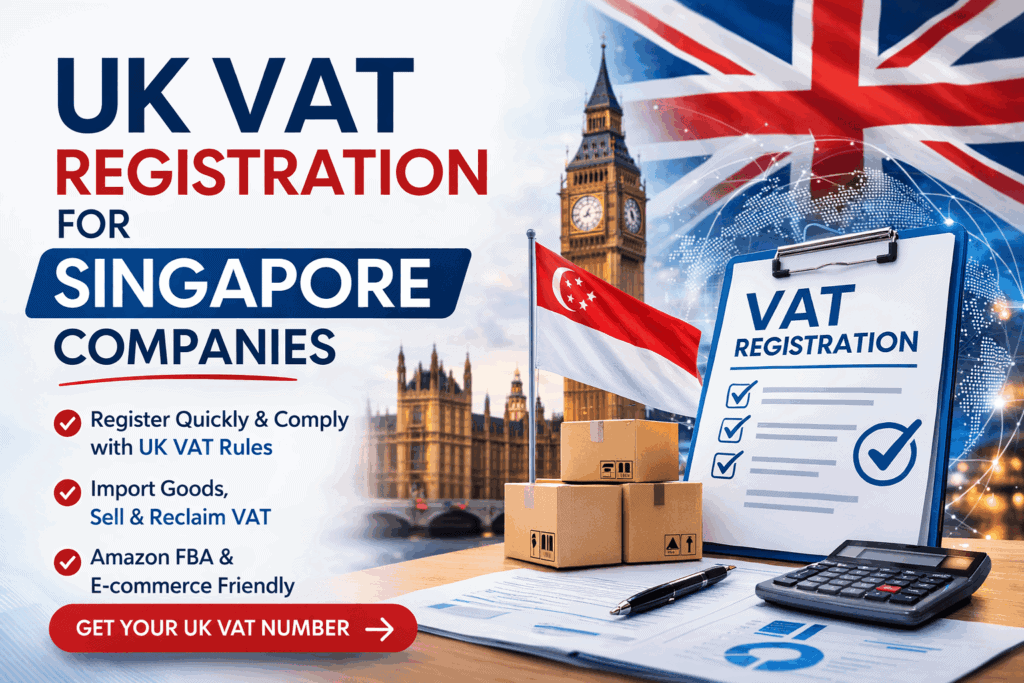
Singapore has developed a reputation as one of the world’s most international business hubs. Companies based there are accustomed to operating across multiple markets, particularly in sectors such as e-commerce, electronics, consumer brands, logistics, and technology.
For many Singapore businesses looking to expand globally, the United Kingdom is a natural next step. The UK offers a large consumer market, a well-developed logistics network, and strong demand for imported products.
We regularly see Singapore companies entering the UK market through several channels:
- selling through Amazon UK or other online marketplaces
- running their own direct-to-consumer e-commerce websites
- supplying products to UK wholesalers or retailers
- importing goods into UK warehouses for local distribution
However, once a business begins trading in the UK, tax obligations arise that are very different from Singapore’s GST system. One of the most common issues international businesses encounter is the requirement to obtain a UK VAT number.
In practice, many Singapore companies only discover this requirement after their first shipment arrives in the UK or when an online marketplace asks for a VAT number before allowing them to continue selling.
Understanding when UK VAT registration becomes necessary — and how the process works — is essential for avoiding costly compliance problems.
This guide explains how VAT registration for Singapore companies works, when it becomes mandatory, and what international businesses should do to stay compliant with UK tax regulations.
What Is UK VAT Registration
VAT, or Value Added Tax, is the main consumption tax in the United Kingdom. It applies to most goods and services supplied within the UK market.
When a business is registered for VAT, it becomes responsible for charging VAT on taxable sales and reporting that tax to HM Revenue & Customs (HMRC).
In practical terms, VAT-registered businesses must:
- add VAT to qualifying sales made in the UK
- issue VAT-compliant invoices
- submit VAT returns to HMRC
- pay the VAT collected from customers to the tax authority
Once registered, the company receives a UK VAT number, which must be included on invoices and is often required by logistics providers, customs agents, and online marketplaces.
For UK-established businesses, VAT registration is typically required once annual turnover exceeds the VAT threshold.
For overseas companies — including those based in Singapore — the rules are different.
In many situations, VAT registration is required from the very first sale or transaction in the UK.
Many international businesses assume they can wait until sales volumes grow before registering. In reality, the obligation often arises much earlier depending on how the goods enter the UK and how they are sold.
When Businesses Need This
Singapore companies are required to register for UK VAT when they carry out taxable activities within the United Kingdom.
Unlike UK-resident businesses, overseas companies usually cannot rely on the UK VAT threshold.
Instead, VAT registration is typically triggered by the nature of the business activity itself.
For example, if a Singapore company imports goods into the UK under its own name, it will generally need a VAT number immediately. The same applies if the business stores inventory in the UK or sells goods that are already located there.
A situation we encounter frequently is when a Singapore company ships its first batch of products to the UK, only to discover that a VAT number is required before the goods can be properly cleared through customs or sold on a marketplace.
Many overseas sellers are surprised to learn that VAT registration can be required even if the business has no physical office, employees, or branch in the United Kingdom.
From HMRC’s perspective, what matters is where the taxable supply takes place — not where the company itself is based.
Who Typically Needs It
In our experience working with international clients, several types of Singapore companies commonly require UK VAT registration.
E-commerce brands
Many Singapore-based consumer brands sell directly to UK customers through their own websites or platforms such as Shopify.
If goods are imported into the UK or stored locally before sale, VAT registration is usually required.
Amazon FBA sellers
This is one of the most common scenarios we see.
Singapore sellers often use Amazon’s UK fulfilment network to store inventory locally. Once goods are held in Amazon warehouses in the UK, the seller is considered to be making taxable supplies within the country.
At that point, a UK VAT number is generally required.
Importers of goods
Singapore trading companies frequently ship products to the UK for distribution.
If the Singapore company acts as the importer of record, it becomes responsible for import VAT and customs declarations. In most cases, this structure requires VAT registration.
Wholesale suppliers
Some Singapore manufacturers or trading companies supply goods to UK distributors or retailers.
If the goods are imported into the UK under the Singapore company’s name before being sold onward, VAT obligations may arise.
Technology and digital businesses
Certain digital services provided to UK consumers may also fall within the UK VAT system depending on how the services are supplied.
Although less common than goods-based trading, SaaS providers and digital platforms should still review their VAT exposure when entering the UK market.
Common Situations That Trigger This Requirement
Several specific trading situations frequently trigger VAT registration obligations for Singapore companies.
Importing goods into the UK
When goods arrive in the UK from Singapore, import VAT is charged at the border.
If the Singapore company is responsible for the import process, it will typically need a VAT number to account for and reclaim this tax through VAT returns.
Storing inventory in the UK
Holding stock inside the UK — whether through a third-party logistics provider or a fulfilment centre — usually creates a VAT obligation.
This is because the business is considered to be supplying goods from within the UK.
Selling through Amazon UK FBA
Many Singapore sellers join Amazon UK and send inventory to Amazon warehouses.
A common misunderstanding is that Amazon handles all VAT obligations. In reality, the responsibility remains with the seller.
Once goods are stored in the UK through FBA, VAT registration is almost always required.
Acting as importer of record
If the Singapore company is listed as the importer on customs documentation, it assumes responsibility for import VAT and compliance.
Without a VAT number, reclaiming import VAT can become difficult or impossible.
Selling goods already located in the UK
If inventory is stored in the UK and sold to UK customers, VAT must usually be charged on those sales.
This situation often occurs with e-commerce sellers using UK warehouses or fulfilment centres.
Step-by-Step Process
Registering a Singapore company for UK VAT is relatively straightforward, but the process requires accurate documentation and clear information about how the business operates.
Mistakes or incomplete information can lead to delays.
Step 1 — Determine VAT obligation
The first step is confirming whether the business activities trigger VAT registration.
This usually involves reviewing:
- how goods enter the UK
- whether inventory is stored locally
- who acts as importer of record
- how sales are made to UK customers
In many cases, professional advisers carry out this analysis before starting the registration process.
Step 2 — Prepare and submit the VAT application
Once it is confirmed that registration is required, the company submits an application to HMRC.
The application includes information about:
- the company structure
- directors and shareholders
- planned business activities in the UK
- logistics arrangements
- expected sales volumes
HMRC reviews overseas applications carefully. They often request additional details about how the company intends to trade in the UK.
Step 3 — Receive the VAT number and begin compliance
After the application is approved, HMRC issues a UK VAT registration number.
From that moment onward, the company must comply with UK VAT rules.
This includes:
- charging VAT on applicable UK sales
- issuing VAT-compliant invoices
- maintaining proper accounting records
- submitting VAT returns to HMRC
Most overseas businesses file VAT returns on a quarterly basis.
Documents Required
When registering for VAT, Singapore companies are typically asked to provide several supporting documents.
These may include:
- Certificate of Incorporation issued in Singapore
- company registration records from ACRA
- identification documents for company directors
- a description of the business activities
- contracts with UK marketplaces or logistics providers
- shipping documentation or supply chain evidence
If goods are already being imported into the UK, HMRC may also request customs documentation.
Providing clear and well-structured documentation helps ensure the application is processed without unnecessary delays.
Common Mistakes Businesses Make
Over the years, several patterns appear when international businesses attempt to manage VAT obligations on their own.
Assuming EU VAT rules still apply
A common mistake we see is assuming that EU VAT rules continue to apply to the UK.
Since Brexit, the UK operates its own VAT regime entirely separate from the European Union.
Registering too late
Some Singapore companies wait until sales increase before applying for VAT registration.
However, certain activities — particularly storing inventory in the UK — require registration from the start.
Incorrect importer arrangements
We occasionally see goods shipped under incorrect importer details.
This can create complications with customs clearance and VAT recovery.
Assuming marketplaces handle tax compliance
Online marketplaces facilitate sales, but they do not remove the seller’s VAT responsibilities.
The legal responsibility for VAT compliance always remains with the business itself.
Risks and Penalties
Ignoring UK VAT obligations can lead to significant problems.
HMRC may impose:
- penalties for late VAT registration
- interest on unpaid VAT liabilities
- tax assessments for historical sales
- compliance investigations
In some situations, online marketplaces may suspend seller accounts if VAT compliance issues arise.
Businesses can also encounter difficulties clearing goods through UK customs if the VAT position is unclear.
Resolving these issues later often becomes far more expensive and time-consuming than registering correctly at the beginning.
How Professional VAT Assistance Helps
For Singapore companies expanding into international markets, the UK tax system can initially feel unfamiliar.
Professional VAT advisers help businesses navigate these requirements efficiently.
Typical support includes:
- determining whether VAT registration is required
- structuring import and supply chains correctly
- preparing and submitting the VAT application
- communicating with HMRC during the process
- managing ongoing VAT returns and compliance
In practice, many international businesses prefer to outsource VAT compliance so they can focus on growing their operations in the UK market rather than dealing with administrative tax obligations.
FAQ
Do Singapore companies need a UK VAT number to sell on Amazon UK?
Often yes. If goods are stored in UK Amazon fulfilment centres or imported into the UK under the seller’s name, VAT registration is usually required.
Is there a VAT threshold for overseas companies?
Generally no. The UK VAT threshold mainly applies to businesses established in the UK. Overseas companies often must register as soon as they begin taxable activities.
How long does UK VAT registration take?
Processing times vary, but it usually takes several weeks for HMRC to review and approve an overseas VAT registration application.
Can a Singapore company reclaim UK import VAT?
Yes. Once VAT registered, businesses can normally reclaim import VAT through their VAT returns provided the goods are used for taxable business activities.
What happens if a company sells in the UK without registering for VAT?
HMRC may require the business to account for VAT on past sales and may also apply penalties and interest.
Do digital services supplied from Singapore fall under UK VAT?
Depending on how the services are supplied and who the customers are, digital services provided to UK consumers may fall within the UK VAT regime.
For Singapore companies expanding into the UK market, understanding VAT obligations early can prevent serious operational disruptions.
If your business plans to import goods, store inventory in UK warehouses, or sell directly to UK customers, reviewing your VAT position at the outset is strongly recommended.
Professional assistance with VAT registration for Singapore companies can help ensure the process runs smoothly and your business remains fully compliant with UK tax regulations.