This is a question I hear all the time from international clients. Usually, the question comes when the goods are already on the way to the UK and suddenly the courier sends a message: “Import VAT must be paid before delivery.” At that moment, the realisation hits — nobody is quite sure who is actually responsible for paying it.
So let’s go through this properly, because this is one of those areas where a small mistake in the setup can cost a lot of money later.
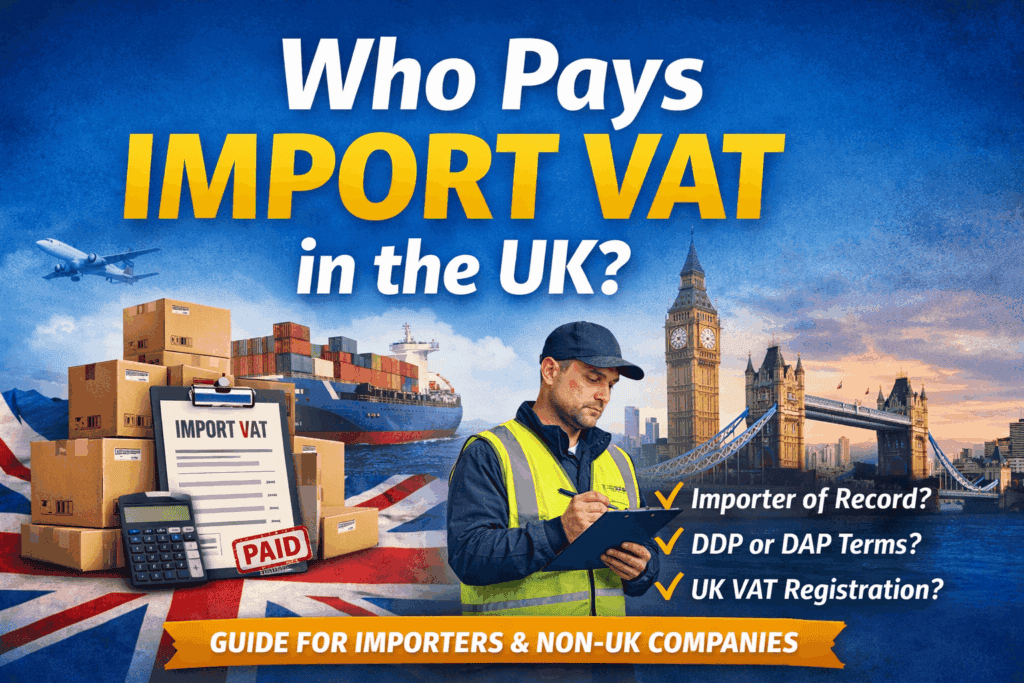
The short answer is simple: the Importer of Record pays Import VAT.
But in real life, it’s not always obvious who that is. It depends on how the shipment is structured, what Incoterms are used, and who is legally acting as the importer.
Once you understand that structure, the whole Import VAT situation becomes much clearer.
What Is Import VAT?
Import VAT is VAT charged when goods enter the UK from abroad. It doesn’t matter whether the goods come from the EU, China, the USA, or anywhere else — if goods enter the UK, Import VAT may apply.
A lot of people mix up Import VAT and customs duty, but they are two different things.
- Customs duty is a tax based on the type of goods and where they were manufactured.
- Import VAT is UK VAT, usually 20%, charged on imported goods.
What many businesses don’t realise at first is that Import VAT is not calculated only on the value of the goods. It is calculated on the total landed cost, which includes:
- Cost of the goods
- Shipping
- Insurance
- Customs duty
So the VAT is calculated on the full cost of getting the goods into the UK.
In practice, this often surprises importers. They expect to pay 20% of the product value, but the VAT bill is higher because shipping and duty are included in the calculation.
The Key Concept: Importer of Record
If you want to understand who pays Import VAT, you need to understand one key term: Importer of Record.
The Importer of Record is the company or person legally responsible for:
- Declaring the goods to UK customs
- Paying customs duty
- Paying Import VAT
- Making sure the goods comply with UK import regulations
So whoever is listed as the Importer of Record is the one responsible for Import VAT.
This can be:
- A UK company
- A non-UK company
- A freight forwarder acting as an agent (but not always as importer)
- In some cases, even the customer
From my experience, this is where most problems start. Many businesses assume the courier or freight company is responsible for Import VAT, but that’s not really how it works. The courier usually pays the VAT to HMRC on your behalf and then invoices you for it, often with an additional handling fee.
So the courier is not the one paying Import VAT — they are just paying it for the Importer of Record and then recovering the money.
Incoterms Decide Who Pays Import VAT
In most international shipments, who pays Import VAT depends on the Incoterms agreed between the seller and the buyer. The two most common Incoterms in UK imports are:
- DDP – Delivered Duty Paid
- DAP – Delivered At Place
These two terms completely change who is responsible for Import VAT, and this is something many businesses misunderstand when they start importing.
Delivered Duty Paid (DDP)
Under DDP, the seller takes full responsibility for the shipment. That includes:
- Shipping
- Customs clearance
- Customs duty
- Import VAT
So under DDP, the seller becomes the Importer of Record, and the seller pays Import VAT.
This is very common for:
- Amazon sellers importing into the UK
- E-commerce businesses shipping to UK customers
- Overseas companies storing goods in UK warehouses
But here is the important part that many non-UK companies don’t realise straight away.
If you are a non-UK company and you ship goods DDP into the UK, you will usually need to register for UK VAT because:
- You are importing goods into the UK
- You are the Importer of Record
- You are selling goods in the UK market
In practice, many international businesses only discover this after their first shipment arrives and the courier asks for a UK VAT number before they can clear the goods through customs.
Delivered At Place (DAP)
Under DAP, the seller delivers the goods to the UK, but the buyer is responsible for:
- Import VAT
- Customs duty
- Customs clearance
So under DAP, the buyer is the Importer of Record, and the buyer pays Import VAT.
This is very common when UK customers order goods from overseas suppliers. The courier contacts the customer before delivery and asks them to pay VAT and duty.
Most people have experienced this at least once — you order something from abroad, and before delivery the courier sends a message saying you need to pay VAT and a clearance fee. That is a DAP shipment.
From a business perspective, DAP can create problems for e-commerce sellers because customers don’t like unexpected charges. Some customers refuse delivery when they see the extra costs. That’s why many online sellers prefer to ship DDP instead.
Import VAT for Non-UK Companies
Let’s look at a very typical structure I see all the time.
A non-UK company manufactures goods in China and ships them to the UK to store in a warehouse — often Amazon FBA or a third-party logistics warehouse.
In this case:
- The non-UK company is the Importer of Record
- The non-UK company pays Import VAT
- The non-UK company must register for UK VAT
- The non-UK company can reclaim Import VAT
This is a very common structure for Amazon sellers and international e-commerce businesses.
The typical process looks like this:
- Goods are manufactured in China.
- Goods are shipped to the UK.
- The non-UK company is listed as the Importer of Record.
- Import VAT is declared when the goods enter the UK.
- Goods are stored in a UK warehouse.
- Goods are sold to UK customers.
- The company submits UK VAT returns and reports sales and VAT.
So in this situation, Import VAT is paid by the overseas company, not by Amazon and not by the customer.
Can Import VAT Be Reclaimed?
Yes, in many cases Import VAT can be reclaimed. But this depends on a few important conditions.
You can normally reclaim Import VAT if:
- You are registered for UK VAT
- You are the Importer of Record
- The goods are used for your business activities
- You have the correct import documentation (for example C79 certificate or PVA statement)
If you are not VAT registered, then Import VAT becomes a real cost because you cannot reclaim it.
This is why VAT registration is so important for businesses importing goods into the UK. Without VAT registration, Import VAT simply becomes an additional cost of importing.
Postponed VAT Accounting (PVA)
Postponed VAT Accounting, usually called PVA, is one of the most useful systems available for UK importers, and surprisingly many businesses still don’t use it.
PVA allows you to account for Import VAT on your VAT return instead of paying it at the border.
So instead of paying Import VAT when the goods arrive and then reclaiming it later, you:
- Declare Import VAT on your VAT return
- Reclaim Import VAT on the same VAT return
In many cases, the cash flow effect is zero.
Let’s say Import VAT on a shipment is £10,000.
Without PVA, you pay £10,000 to the courier or customs and then reclaim it later through your VAT return.
With PVA:
- You declare £10,000 as Import VAT on your VAT return
- You reclaim £10,000 on the same VAT return
So you never physically pay the £10,000 upfront.
For businesses importing regularly, this makes a huge difference to cash flow.
Import VAT and Amazon / E-commerce Sellers
Amazon sellers deal with Import VAT all the time, and this is where I see a lot of mistakes.
If you import goods into the UK and sell on Amazon UK, then usually:
- You are the Importer of Record
- You need UK VAT registration
- You pay Import VAT
- You reclaim Import VAT
- You charge VAT on your sales
- You submit VAT returns to HMRC
One very common mistake is when the freight forwarder lists the wrong company as the Importer of Record.
For example:
- The freight agent lists their own company as importer
- The manufacturer in China is listed as importer
- Amazon is incorrectly listed as importer
If that happens, you may not be able to reclaim Import VAT, because legally you did not import the goods — another company did.
From my experience, this is one of the most expensive mistakes new Amazon sellers make, and it usually only becomes visible when the accountant tries to reclaim Import VAT and HMRC asks for proof that the importer and the VAT number match.
Common Import VAT Mistakes
Over the years, I’ve seen the same problems again and again. The most common ones are:
Wrong Importer of Record
If the wrong company is listed on the import documents, you may not be able to reclaim Import VAT.
No UK VAT registration
Many non-UK companies import goods and only later realise they were required to register for UK VAT.
Not using Postponed VAT Accounting
This creates unnecessary cash flow pressure because Import VAT has to be paid upfront.
Using DAP for e-commerce sales
Customers receive unexpected VAT bills and sometimes refuse to accept the delivery.
Freight agent listed as Importer of Record
In this case, legally the freight agent imported the goods, not you.
Import VAT paid but no C79 certificate
Without the C79 certificate or PVA statement, Import VAT cannot be reclaimed.
These are all real situations that happen regularly, especially with new importers.
Final Practical Example
Let’s look at a simple example with numbers.
A US company imports goods into the UK and sells them online.
- Goods value: £20,000
- Shipping: £2,000
- Customs duty: 4% = £800
- VAT rate: 20%
Import VAT is calculated on:
£20,000 + £2,000 + £800 = £22,800
Import VAT = £4,560
Now the key question: who pays the £4,560?
The answer depends on who is the Importer of Record.
Scenario 1 — US Company Is the Importer of Record
- The US company pays £4,560
- The US company registers for UK VAT
- The US company reclaims £4,560 on the VAT return
- If using PVA, the VAT is not paid upfront
Scenario 2 — UK Customer Is the Importer of Record
- The UK customer pays £4,560
- The overseas seller does not deal with Import VAT
- This usually happens under DAP shipping
Scenario 3 — Freight Agent Is the Importer of Record
- The freight agent legally imported the goods
- The US company may not be able to reclaim Import VAT
- This creates a serious VAT problem
The Simple Rule to Remember
If you remember only one rule, remember this:
The Importer of Record is the one who pays Import VAT.
Not the courier.
Not Amazon.
Not the warehouse.
Not automatically the customer.
The Importer of Record.
In many cases, especially for Amazon sellers and e-commerce businesses, the overseas seller is the Importer of Record, which is why UK VAT registration is often required.
From my experience, Import VAT itself is usually not the real problem. The real problems appear when the structure is set up incorrectly from the beginning — wrong Incoterms, wrong importer, no VAT registration, or incorrect paperwork.
When everything is structured correctly, Import VAT becomes a routine part of importing and can usually be reclaimed or accounted for through Postponed VAT Accounting.
But when the structure is wrong, businesses suddenly find themselves paying VAT they cannot reclaim, and that’s when Import VAT becomes a real cost instead of just a tax that passes through the VAT return.
And almost every time, when we investigate the situation, the issue comes back to the same question: who was listed as the Importer of Record when the goods entered the UK?